CSR Jobs Portal

For those of you who didnt know, in 2001 I set up a corporate responsibility jobs site. Last year we revamped it to become the world’s most comprehensive source of CSR jobs info. It uses fancy open source technology to amalgamate jobs info from around the world, and send it out to users on the basis of their expressed preferences. There are over a 1000 opportunities on the site at any one time. A copy of the bulletin going out today follows below, so u can see the way it looks (although without the links). The portal is at http://www.lifeworth.com so check there if you want to follow up on one of the job opportunities!

——– Original Message ——–
Subject: Lifeworth Monthly Bulletin
Date: Thu, 13 May 2010 12:27:31 +0100
From: connect@lifeworth.com
To: jem

Welcome to the Lifeworth Monthly Bulletin of jobs and events in responsible enterprise. It includes an editorial from Lifeworth, featured events, top jobs, other events, the top topics on our site, and this month’s expert insights. Your user name is jem. For information on how to retrieve your password or unsubscribe, see the bottom of the email.

FROM LIFEWORTH: TOO BUSY TO KEEP UP WITH THE CSR JOB SCENE?

We should never be too busy to look at the horizon. But many of us are so busy with the here and now of our jobs. Therefore we don’t have time to see what opportunities are out there for us to make a greater impact in the world. But now there is a solution….

Read more from Lifeworth’s Jem Bendell

THIS MONTH’S FEATURED EVENT

Don’t Miss Deadline for Jobs at the Principles for Responsible Investment (UNPRI)

The Principles for Responsible Investment is an investor initiative in partnership with UNEP Finance Initiative and the UN Global Compact.
28 May 2010
more…

THIS MONTH’S TOP JOBS

Knowledge Manager, Edelman, USA
Director of Implementation Support, UNPRI, United Kingdom
Director of Communications and Marketing, UNPRI, United Kingdom
Clearinghouse Manager, Social Issues, UNPRI, United Kingdom
Community & Corporate Social Responsibility Manager, Nestle, United Kingdom
Consultant, WWF-UK, United Kingdom
Supply Chain Manager, BCI, China
Associate – Budget & Financial Analyst, Room to Read, USA
Director of Value Chain Social Responsibility, Cisco, USA
CSR/Labor Rights Program Associate , Verité, USA
Contract ESG Research Analyst, RiskMetrics Group, USA
Communications Specialist, Shakti Foundation, India
Corporate Social Responsibility ( CSR ) Specialist, Al-Majal For Environmental & Technical Services, Oman

THIS MONTH’S TOP EVENTS

Don’t Miss Deadline for Jobs at the Principles for Responsible Investment (UNPRI), UNPRI
Ouverture Inscriptions DAS Management durable, HAUTE ECOLE DE GESTION GENEVE & UNIVERSITE DE GENEVE, Switzerland
International EFMD – FDC Conference “Strategic Movements in Business Education”, FDC, Brazil
Launch of the 2010 Corporate Responsibility Salary Survey Results, Acre Resources
Local money design webinar series 2, Value for People, Germany
2nd International Worldly Leadership Summit ‘Leading with Responsibility and Conviction’, United Kingdom
1st International Conference in Responsible Leadership in Africa., South Africa
BASELondon 2010, Siemens, United Kingdom
ERSCP-EMSU 2010 Conference, Netherlands
2010 Asian Business & Management Conference, Japan
Asia Pacific Academy for Business In Society (APABIS) Annual Conference, Japan
CSR and International Development Executive Summer Course – Switzerland – July 4-11, 2010., University Geneva & MHC International Ltd, Switzerland

THIS MONTH’S EXPERT INSIGHTS

Innovative Financing for Global Networks Steve Waddell begin_of_the_skype_highlighting     end_of_the_skype_highlighting on Networks
Marketing and Military Metaphors Ryan Jones
Video Blog: Steve Puckett on CSR in Singapore and the Energy Sector Wayne Visser
CSRI News Digest (Week 1, May 2010) Wayne Visser
McDonald’s Announces “Global Best Practices” in Sustainability Supply and Green Initiatives Wayne Visser
Sustainable Packaging Delivers Lighter Weight, Higher Recycled Material Content Wayne Visser
Cow Manure Project to Produce 38,000 mWh of Power Annually Wayne Visser
EPA Helps States, Utilities Reap Greater Energy Savings Wayne Visser
Canadian Lawmakers Pass Climate Change Act Wayne Visser
Chemical Supply Chain Embraces Wal-Mart’s Sustainability Goals Wayne Visser
Spain’s Leading PLC’s Take Close Look at Suppliers’ CSR Credentials Wayne Visser
Does Type of Ownership Matter for CSR? Wayne Visser
Slides: CSR 2.0: The Future of Corporate Social Responsibility Wayne Visser
Course: Introduction to CR (London, 13 Jul 2010) Wayne Visser
Course: Measuring Socio-Political Risk (Calgary & Edmonton, 14 & 17 May 2010) Wayne Visser
Online course: Sustainability Reporting (21 Jun-1 Aug 2010) Wayne Visser
CSR 2.0: From the Age of Greed to the Age of Responsibility Wayne Visser
BP: morally confused? Adrian Henriques
A New Approach to Network Leadership Steve Waddell on Networks
Oil spills and externalities Crane and Matten

THIS MONTH’S TOP TOPICS

1. General Environment (446)
2. Education or Culture (266)
3. Consumer Affairs (157)
4. Capacity Building (125)
5. Social Development (116)
6. Social Enterprise (107)
7. Human Rights and Security (98)
8. Diversity and Non-Discrimination (98)
9. Sustainable Resource Use (88)
10. Community and Philanthropy (77)
11. Climate Change (76)
12. Public Health (74)
13. Clean Technology (45)
14. Governance and Risk (28)
15. Pollution Prevention (27)
16. Health or Safety at Work (19)
17. Intellectual Property and Tech Transfer (16)
18. Responsible Investment (11)
19. Sustainability Reporting (9)
20. Personal Development (8)
21. Stakeholder Dialogue (8)
22. Anti-Corruption (8)
23. Employee Ethics (4)
24. Labour Practices (4)
25. Fair Marketing (3)
26. Fair Competition (3)
27. Fair Supplier Relations (3)
28. Fair Taxation (3)
29. Social Dialogue (3)
30. Employment Creation (3)
31. Political Involvement (1)

Recruiting

To include a job or event on our website and in this bulletin, visit http://www.lifeworth.com. A listing is free, with an optional charge to promote it to the top of our database, on our homepage and have it included in the monthly bulletin.

If you are seeking talent, then you can become an Employer member and access the extended profiles of our subscribers, including their CVs and contact information. If you are an expert in responsible enterprise and finance, you can become an Expert member, and share your insights with our subscribers, through our website and monthly newsletter.

Are you expert?

If you are an expert in responsible enterprise, you can upgrade to Expert member, and share your insights with our subscribers, through our website and monthly bulletin. Log in as jem to your account page now!

Your account

If you do not already receive a WEEKLY email with a comprehensive listing of all jobs and events related to your regional, sectoral and professional interests, then log in to http://www.lifeworth.com and update your profile. This is also where you can add or change an email or add your CV

This email is sent to you as you subscribed to Lifeworth’s jobs information service at some point since 2001. To unsubscribe, log in and then DELETE your account. Your username is jem. If you have forgotten your password, then obtain a new one by following the instructions at: http://www.lifeworth.com/user/password

The Final Annual Review from Lifeworth – challenging Capitalism!

For the past 9 years I have written an annual review of the corporate responsibility field. In each review I have focused on what I thought were key trends, and sought to promote heartfelt and progressive engagement in this field. 2010 is the final year of my writing quarterly reviews in the leading Journal of Corporate Citizenship. Next year, therefore, I will produce a new edited book, with co-author Ian Doyle, that analyses the last 5 years. Then, Ill focus less on written commentary and more on implementing the ideas and insights from the past decade.  So, as this is the final annual review, I thought it important to encourage us all to use this time of post-crisis reflection to go deeper, and see how our work might relate to the kind of economic transformations we need for a fair and sustainable world. Hence, when I saw how many people are now debating fundamental elements of “capitalism” I thought it important to bring this to the fore. Because, as the World Economic Forum draws to a close in Davos, the real debate about the future of our economic systems is only getting started… in the real world of people’s communities and businesses. The press release for the new review follows below.

Post-crisis, Capitalism now a focus for CSR, says Lifeworth Review

Press Release from Lifeworth. February 1st 2009.

Capitalism is up for debate, and that’s a good thing, according to a new review from a management consultancy. “The dual financial and climate crises are leading people in all walks of life to question the kind of economy that makes sense for their businesses, communities and families,” explains lead author of the review, Associate Professor Jem Bendell. “As well as some anger at bankers, the financial crisis has led many to ask deeper questions about finance in general and, therefore, about capitalism. From bars to seminars, bookshops to board meetings, capitalism is being discussed – openly and critically,” he claims.

Entitled “Capitalism in Question”, the annual review describes how politicians and even business leaders are calling for more critical assessment of what kind of economic system we need for a fair and sustainable future. The review from Lifeworth Consulting summarises over a dozen books that have been published in the last weeks that debate the relative merits of capitalism and what form of economic governance is needed post-crisis, and in a new era of economic power. “The majority of these new books seek to do something that previously seemed neither necessary or interesting − to defend capitalism,” says John Stuart of Greenleaf Publishing, which supports the review.

Bendell explains that defensiveness wont help. Referring to the “Restoring Trust” report overseen by Allianz, Barclays Capital, Blackstone, and Carlyle Group, among others, he said “seeking to defend one’s immediate interests, as the banks writing the recent World Economic Forum report clearly did, is not how we are going to discover together the next step in our economic evolution. Fearful people in incumbent institutions may waste our time with diversionary drivel, but real exploration of the core issues is unavoidable. The question now is who should participate and how.”

Co-author of the review, Lifeworth Consulting’s Ian Doyle, explained that “much of the corporate social responsibility, or CSR agenda, has been predicated on a belief that government is constrained by global finance and can, or should, only intervene in markets to a limited extent. The giving of huge amounts of money to private banks may suggest that global finance is still dominant, but it also shows that sometimes when called on to act, most governments will intervene in markets in dramatic ways. So it’s not unreasonable for people to look to their governments to now shape responsible business practice more than before. And that is what we are seeing.”

The review is a call for people to become more involved in exploring how to evolve economic systems to promote fair and sustainable societies, says Bendell. “We are calling for this kind of engagement because after doing nine years of quarterly responsible business trends analysis for the Journal of Corporate Citizenship, we have concluded that there is a nascent social movement for the transformation of business and finance. Behind the jargon of corporate social responsibility, corporate accountability, environmental management, social enterprise, and responsible finance, are people like you and me who want to change the way business does business and the way money makes money. As such we need to think through what we are aiming for, longer term, and how we can work in concert. We all need to look up from our projects and shape the unfolding programme of economic transformation.”

To contribute to the debate, Lifeworth offers a framework for democratising capitalism. As Bendell, who is also Lifeworth’s director explains, “It’s simply that we need more governance of capital by people who are directly affected by its ownership and control. From that one concept flow many implications for tax, currencies, stocks, and all social and environmental regulations. This democratisation of capitalism could be the ultimate goal of the corporate responsibility movement, and the seeds of this approach are already to be found in the ideas and practices of many people working on corporate responsibility today.”

A discussion of economic systems can seem distant from the day-to-day preoccupations of most executives and the academics who seek to educate them, but as Bendell suggests, “making such connections will be important if the corporate responsibility movement is to have a substantial and lasting effect on commerce and society.” In ‘Capitalism in Question’ some initial guidance is given for how business leaders and educators can play a socially progressive role at this time. Specific multi-stakeholder initiatives are recommended.

The review of trends in corporate responsibility during 2009 includes analysis of government stimulus packages, responsible tax management, responsible mining, responsible cosmetics and beauty businesses, as well as particular trends in Asian and Francophone countries. It also explores the potential of ‘design thinking’ for sustainable business innovation, and provides in-depth analysis of the implications of the Copenhagen climate summit.

“Deep changes will be required in economic governance if we are to achieve a sustainable society… Capitalism will change, there is no doubt, and it must change so that it delivers both private wealth and public good” explains Professor Malcolm McIntosh of the Asia Pacific Centre for Sustainable Enterprise. “As we enter a period of potential reconfiguration of economic governance, leaders of organisations will need to better understand the issues, actors and dynamics to be successful. Part of Griffith Business School in Australia, Professor McIntosh’s centre supported the free release of this review to promote creative thinking at a time of critical global challenges and because “the lead author Jem Bendell, is an important commentator on the world stage.”

Dr Bendell says there are important implications for management education. “In Griffith’s new “Graduate Certificate for Sustainable Enterprise” we help our students to navigate increasingly complex social and political contexts so they can find ways to prosper by being part of the solution.”

‘Capitalism in Question: The Lifeworth Annual Review of 2009’ is available in pdf for free download at http://www.lifeworth.com/consult/2010/02/annualreview/

Lifeworth’s responsible enterprise trends analysis during 2010 can be obtained by subscribing to the ‘Journal of Corporate Citizenship’. New subscribers to the journal before March 31st 2010 receive all 2009 copies for free. Visit http://www.greenleaf-publishing.com

Information on Griffith’s research centre and graduate certificate is available at http://www.asiapacificsustainableenterprise.com/

For media enquiries about ‘Capitalism in Question’ contact Jem Bendell via connect [at] lifeworth.com or +44(0)2071936102

What will success look like for the CSR Movement?

In recent months Ive been talking more widely about the existence of a new social movement of people who are making business and finance contribute to a world that is sustainable and fair. Im talking more with social entrepreneurs and social activists, and I find many people who have a sense of urgency and leadership are surprised at my view, as they regard mainstream CR or CSR as an effort to maintain the corporate status quo, not fundamentally transform it. In response I agree that much CSR is lacking, but I point to those initiatives, projects and people within the corporate world who are working of more systemic transformations of markets – whether through influencing standards, regulations, mindsets or financing systems. Yet, in these conversations, I realise that we dont have a clear set of successes to point to – so many of the examples are about the incredible efforts that people are making, rather than the results being achieved. Any movement needs to know what success looks like. So, it was interesting last month to hear a CR leader, Simon Zadek, ask a class of students to reflect on what they considered real CSR successes to date. I encourage you to reflect on these questions.

What is the most successful multistakeholder initiative and why?
What is the most important piece of CSR legislation, from a CSR perspective?
Think of three CSR CEOs who you believe have demonstrated CSR success, and what have they been successful at?
Think of a civil society leader who has promoted CSR really effectively?
What is it that you still dont know about CSR, and is critical to you future work?

Perhaps you could forward this email to your colleagues in your team, so you can discuss your responses together. I also invite you to post your responses on my blog, at https://jembendell.wordpress.com/

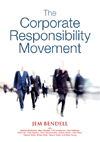
If you are interested in what it could mean for your own work to be part of a CSR movement,  I encourage you to get my book on the topic for your organisation’s library. “The Corporate Responsibility Movement”, available from.  http://www.greenleaf-publishing.com/productdetail.kmod?productid=2767

This message was included in the Lifeworth CSR jobs Bulletin for July.  To sign up for that bulletin, issued about once a month, visit http://lifeworth.com/main/sign-up/

Asian CSR set to reshape the global business environment, according to Lifeworth review.

Press release, 25th May 00.01 GMT, Lifeworth, Manila.

Asia is becoming a leading region for corporate social responsibility (CSR), as its businesses gain international influence, according to some leading CSR academics and practitioners, writing in the eighth global review from a CSR consulting firm. “Diverse Asian approaches to responsible enterprise will increasingly affect business practices around the globe. Not only can this trend be welcomed, it is essential to achieve a fair and sustainable world,” argues lead author of the review, Dr Jem Bendell.

The Eastern Turn In Responsible Enterprise describes the rise of Asian business and finance that was hastened by events during 2008. It argues that although expanding economic power generates difficult social and environmental challenges, the world needs Asian business and society to help innovate the technologies, processes and concepts that will help us meet the critical challenges of our time, such as climate change and poverty eradication. It explores some initial implications of this global shift, and some characteristics of Asian forms of corporate social responsibility (CSR). “In order for executives to respond to the global challenges of our time, we must recognise and learn from sustainable innovations that are occurring everywhere, including across Asia, not just in one region,” concludes Dr Bendell, director of Lifeworth.

The review begins by chronicling the economic rise of Asia. The region has become home to the majority of the world’s middle classes. Asia now trades amongst itself more than with the rest of the world and it holds the vast majority of the world’s savings. Asian businesses continue to acquire famous brands from the West. “The current crisis has sharply accentuated the Eastern Turn in the world order,” notes the Pro-Vice Chancellor of Griffith University, Professor Michael Powell, in a foreword. The shift in global power is one of a number of implications of the economic crisis for responsible enterprise and finance that the review explores in detail.

The review shows how this rise in economic power is being followed by a rise in activity on the social and environmental performance of business. It describes how domestic factors within Asian societies are driving CSR, such as growing environmental awareness. Director of ethical reputation analysts Covalence, Antoine Mach explains that “coverage of CSR issues in Asia by the press and non-governmental organisations continues to grow year on year.” This domestic pressure marks a development from recent years where Western interests have been key in encouraging the adoption of CSR codes by Asian business.

Commenting on the review, Stephen Hine of the responsible investment analysts EIRIS, explains that “whilst CSR has traditionally been seen as something primarily undertaken by Western companies there is increasing evidence of it being seen as important by Asian companies.” The review provides data on the growth of CSR-related activities, such as the level of reports, institutes, and certifications on social and environmental performance. For instance Asia has become the top region for IS014001 environmental management certifications and reports issued in compliance with the Global Reporting Initiative (GRI) guidelines. It also highlights some environmental innovations from Asian businesses, such as BYD Auto in China, which is rapidly establishing itself as a leading electric car maker, and BetterPlace.com from Israel, which is a developing integrated electric car recharging systems with auto makers. “It is increasingly clear that many people in Asia see the need for a focus on responsible enterprise and will increasingly lead the way in responsible business development,” notes Professor Powell.

Rising academic interest in CSR within Asia is also chronicled. The review is published to coincide with the launch of the Asia-Pacific Centre for Sustainable Enterprise at Griffith Business School in Australia. Professor Powell sees the potential for business schools to help address the changing global business environment. “No fewer than 30 business schools in the “East” have signed on to the UN Principles of Responsible Management Education and that number is growing all the time.” he writes in a foreword.

“The Eastern Turn in responsible enterprise is not an option,” explains Professor Jeremy Moon of the International Centre for Corporate Social Responsibility (ICCSR), at the University of Nottingham, a leader in internationalising research on CSR. “It brings new normative, conceptual and operational challenges,” he explains in the review. The Eastern Turn in Responsible Enterprise postulates on some common characteristics of Asian CSR in comparison to the West, highlighting implications for policy, practice, and research.

Also author of the new book The Corporate Responsibility Movement, which describes the emergence of a social movement of business people transforming corporations, Dr Bendell concludes that people working on CSR could benefit from more cross-cultural dialogue on globally responsible enterprise and finance. The review even suggests that insight into new forms of business and finance after the crisis could come from such a dialogue, pointing in particular to the Gandhian concept of the trusteeship of assets.

Further Information:

The review can be viewed for free via http://www.lifeworth.com where a fully referenced electronic or hardcopy can also be purchased.

The review is published by Lifeworth Consulting, a boutique professional services firm specialising in responsible enterprise strategy, evaluation and education. It includes the quarterly reviews from the Journal of Corporate Citizenship (http://www.greenleaf-publishing.com). It is written by Jem Bendell, Niaz Alam, Sandy Lin, Chew Ng, Lala Rimando, Claire Veuthey, and Barbara Wettstein.

The ideas in the review will be discussed at a conference organised by the Asia Pacific Academy of Business in Society (APABIS), in November 2009 (http://www.apabis.org). A special issue of the the journal Business Strategy and the Environment will also explore these issues in connection with inter-organisational collaboration, edited by the lead author of the review (https://jembendell.wordpress.com/2009/05/22/asia-pacific-csr-partnerships/).

The review is made possible with the support of the International Centre for Corporate Social Responsibility (ICCSR) at Nottingham Business School (http://www.nottingham.ac.uk/business/ICCSR), Griffith Business School (http://www.griffith.edu.au/gbs), EIRIS (http://www.eiris.org), Covalence (http://www.covalence.ch) and Greenleaf Publishing  (http://www.greenleaf-publishing.com).

“The Corporate Responsibility Movement” is published by Greenleaf, March 2009, and is available at: http://www.greenleaf-publishing.com/productdetail.kmod?productid=2767

To contact the authors of this review email enquiries at lifeworth.com.

Applying ‘Movement Thinking’ to your work

The scale of the challenges we face today, from climate change to economic instability, remind us that it is no longer smart, if ever, to plan our own work without attention to how we influence social change more generally on the issues that are of personal and strategic importance to us.

Based on some of the analysis in my new book, I have developed a simple process to applying ‘Movement Thinking’ to your responsible enterprise efforts.

APPLYING ‘MOVEMENT THINKING’

Social movements theories point to four categories of factors that shape the generation and development of social movements. Reflecting on how we relate to these factors can help us to understand our contribution to, or benefit from, a social movement. Work through the following questions to aid you in applying ‘movement thinking’ to your responsible enterprise efforts. Make notes on a piece of paper, and discuss them with a friend or colleague.

To understand more about these factors in movement generation, refer to pages 16-20 and 24-29 of The Corporate Responsibility Movement.

Assessing general movement participation

Ask yourself the following questions, in relation to your work on aspects of responsible business and finance.

1) How have I contributed to identification and pursuit of common interests of a particular group of people (like me)? Have I benefited from others doing this? What more could I do, or be done?

2) How have I contributed to the development of shared identities and social ties? Have I benefited from others doing this? What more could I do, or be done?

3) How have I contributed to mobilising resources for a particular group? Have I benefited from others doing this? What more could I do, or be done?

4) How have I contributed to the shaping or identification of significant political and societal opportunities for further action? Have I benefited from others doing this? What more could I do, or be done?

Applying a ‘movement approach’ to strategic responses to organisational challenges

Choose a particular organisational challenge you are working on that you recognise has public-interest dimensions. Ask yourself:

5) To what extent are my motivations for addressing this challenge instrumental (benefiting myself and employer), relational (benefiting my social relations at work and private life) and/or moral (relating to my values)? If relational or moral motives rank highly, go to question 7. If not, then go to question 6.

6) In some cases even instrumental reasons require collective changes in society in order to be successful at the organisational and personal level. To transform society in ways that help resolve a challenge you face, you may benefit from understanding how to interact positively with social movements. Therefore, if relational or moral reasons rated fairly low in the previous question, ask yourself what the limits of individual action might be on the challenge you have identified. – if you see the need to participate in social change for instrumental reasons, go to question 7.

7) With the specific organisational challenge in mind, work again through questions 1 to 4. i.e. append “related to the specific challenge I am working on now” to the end of each question.

Sharing

Share the results of your thought processes with professional confidants. Focus on the question “What more could I do, or be done”?

Share the results to the question “What more could I do, or be done?” here at https://jembendell.wordpress.com/by using the comments option below.

Example

Excerpt from page 28 of The Corporate Responsibility Movement

“As I [Jem Bendell] see myself as a participant in the corporate responsibility movement, I decided to test the theory on myself. I challenged myself to identify at least one thing that has emerged in me and one thing that has emerged from me for the corporate responsibility movement over the past 13 years, that relate to the four aspects of movement generation described above. In terms of common interest, I have learned that my interest is not related to a specific profession, such as consulting or academia, but with people who believe in being entrepreneurial in any sector in order to make economic activity contribute to a better world. For others in the movement, my consulting and training has sought to connect people to that sense of their own interest. In terms of common identity and ties, I have now developed camaraderie with people in a variety of sectors who are pioneering ways of making significant changes in business practice, and benefit from extensive networks of professional colleagues, many of whom I consider friends. For others in the movement, I have helped facilitate connections through online networks and newsletters, and promoted awareness of a potential common identity through my writings. In terms of resource mobilisation, I have benefited from people in the movement commissioning me to work with them on projects, and I have created more resources for such work by helping to conceive new non-profit organisations working on corporate responsibility that now have incomes of over a million dollars. In terms of opportunity structures, I have now benefited from the efforts of others to help shift the mainstream corporate responsibility agenda onto a more transformative one, and, for others in the movement, I have helped shape discursive opportunities through successfully challenging some mainstream interpretations of concepts through my writings.”

The book

The Corporate Responsibility Movement: Five Years of Global Corporate Responsibility Analysis from Lifeworth, 2001-2005

Jem Bendell et al. March 2009 387+viii pp 234 x 156 mm paperback ISBN 978-1-906093-18-1 £72.00 http://www.greenleaf-publishing.com/productdetail.kmod?productid=2767

The advisors

This exercise was prepared by Dr Jem Bendell, Lifeworth Consulting, a responsible enterprise strategy advisory, evaluation, education, inspiration and liaison service. http://www.lifeworth.com

Globalising Trusteeship

Jem At Jallian Wala Bagh in April 2009
Jem Bendell visiting Jallian Wala Bagh in April 2009

On April 13th, ninety years ago, a British General ordered the firing on people peacefully protesting the repression of India. Mohandas K Gandhi was so moved by the massacre in Amritsar that he called for a special week to be observed every year – a Satyagraha Week. “Satya” means truth, “Graha” means both ‘involved in’ and ‘global’. Gandhi used satyagraha to describe a non-violent way of life, that does not participate in oppression wherever it occurs, and challenges it in non-violent ways. It became synonymous with India’s liberation movement.

Due to the work of Varsha Das and her colleagues at the Gandhi National Museum I was reminded of Gandhi’s teachings, and began re-reading what he said and did about life, politics and economics. As you probably are yourself, I was familiar with his famous phrases including that “we must be the change we want to see in the world’. But as I read on, I realised his views are very relevant to the current global economic crisis and the work I do on sustainable enterprise and finance.

The recent G20 failed to launch a deep reconsideration of the global economy, and some of its precepts, such as current concepts of property and a consumption-led economy. I suppose the pressures on the leaders for more-of-the-same were immense. But it has become clear that is up to us to begin a broader dialogue. Gandhi called for the Satyagraha Week to be one of fearless yet convivial dialogue about the truth of society and to redouble our efforts to live by that truth. Reading that affirmed some of the work I did this past year, with the Global Finance Initiative. After consultations with finance professionals and stakeholders in dozens of countries we concluded with a recommendation that dialogues on changes in financial systems are required that are:

  • Foundational, addressing profound questions about the purpose of the financial system and the principles that direct its actions;
  • Comprehensive, encompassing the connections between accounting systems, currencies, regulatory systems, economic structures and all parts of the financial system;
  • Inclusive, with processes reaching beyond traditional insiders, to engage responsible investors, multi-stakeholder groups working on finance issues, asset owners, labor, NGOs and critical academics, and be truly global;
  • Systemic, connecting financial stability to the real economy, social equity, and environmental sustainability.

This dialogue could be part of a global truth-seeking — a ‘Global Satyagraha’. Beyond his views on dialogue and truth-seeking, MK Gandhi’s views are relevant to the future of the global economy and our work on responsible enterprise and finance in at least four ways: economic equality, appropriate technology, self-reliance, and trusteeship.

Challenging both the caste system and negativity between religions, he promoted the equality of all peoples, which meant non discrimination in employment and economic affairs. He also believed that technology could be good if did needed work, but bad if it put people out of work. This philosophy led him to spend many hours working on the spinning wheel, a technology that was appropriate to the economic level of villagers across India at the time. Another important aspect of the spinning wheel was how it generated self-reliance. Gandhi spoke of ‘swadeshi’ or economic self-sufficiency, as the only way that India would achieve self-determination. He called on his country-people not to pay into the system of empire by buying foreign clothes. In our current context the implication here is not simply that we produce for ourselves, but that we seek to become independent of systems of exploitation for our own livelihoods and lifestyles.

Jem Bendell at site of MK Gandhi assasination, March 2009

These aspects of Gandhian economics are well documented and discussed. Like many business folk the world-over, many Indian executives do not see the relevance of these approaches to modern business, viewing them as anachronistic. Yet, in a resource-constrained and climate-threatened world, where hyper-inequality fuels violence, the need for principles and practices of equality, appropriateness and self-reliance to pervade business is clear.

What stunned me was the resonance of his views on ‘trusteeship’ with the latest thinking within the corporate responsibility movement. More of us have come to understand that we need to redesign the systems of corporate governance and finance in order to create more sustainable and responsible economies, and that business executives can and should engage in public policy debates to promote that redesign. In my latest book, I develop the concept of “capital democracy” to describe an economic system that responds to this understanding. I write:

Corporate Responsibility Movement, Bendell et al, March 2009

“In a democratic society, property rights should only exist because people collectively decide to uphold them; they are not inalienable but are upheld by society as a matter of choice. Therefore, if society confers us the right of property, then we have obligations to that society. Today property rights have become so divorced from this democratic control that they are undermining other human rights. A reawakening to a basic principle is required: there can be no property right without property duties, or obligations. From such a principle, it should not be left up to the powerful to decide if they are responsible or not, or if they are carrying out their obligations or not. Instead, the focus shifts to the governance of capital by those who are affected by it” (Bendell, et al, 2009, Pg 33 to 34).

The Mahatma’s view of trusteeship is the same, but elegant in its simplicity. It arises from an understanding that everything is owned by everyone, and wealth is owned by those who generate it. Thus the one who controls an asset is not an owner but a trustee, being given control of that asset by society. Gandhi wrote “I am inviting those people who consider themselves as owners today to act as trustees, i.e., owners, not in their own right, but owners in the right of those whom they have exploited.” In the Harijan paper his views on trusteeship of property were later documented to clarify “It does not recognize any right of private ownership of property except so far as it may be permitted by society for its own welfare” and “under State-regulated trusteeship, an individual will not be free to hold or use his wealth for selfish satisfaction or in disregard of the interests of society.” He also wrote that “for the present owners of wealth… they will be allowed to retain the stewardship of their possessions and to use their talent, to increase the wealth, not for their own sakes, but for the sake of the nation and, therefore, without exploitation.” All those years ago the Mahatma was proposing an economic system that many people are only beginning to conceive of today. If you have my book, I apologise for my prior ignorance of Gandhi’s trusteeship concept. If you don’t have it under your trusteeship yet, hey, it’s still worth reading!

Sangeeta Das of the Gandhi Smriti Museum revealed to me how some Indian industrialists supported many of Gandhi’s ideas and applied some to their own business. Upon reading the views of some current Indian business leaders I see the concepts of equality and trusteeship have informed their voluntary corporate responsibility efforts. However, I am left with a sense that the concept of trusteeship has much untapped potential as an economic system, codified into public policy and regulation. The current crisis demonstrates the need to globalise trusteeship, or capital democracy, as an approach that can be debated and interpreted into new principles and policies for economics, finance and enterprise. In addition it is clear that concepts of appropriate technology and self-reliance have much more to offer both to corporate strategy and public policy than currently the case. I wonder whether Indian business leaders could play a role in bringing this insight to the world.

The life of Gandhi is important not only for his views on economic systems but also on how to bring them into being. In my book I argue that the global challenges we face mean those of us who work to make business better must start thinking and planning like a movement. “The corporate responsibility movement is a loosely organised but sustained effort by individuals both inside and outside the private sector, who seek to use or change specific corporate practices, whole corporations, or entire systems of corporate activity, in accordance with their personal commitment to public goals and the expectations of wider society.” (Bendell, et al 2009, pg 24). As a movement leader, we could learn from Gandhi’s mastery of symbolic communication combined with personal authenticity, his embrace of both dialogue and direct action, his respect for people no matter the differences, and his demonstration that we must ourselves disengage with systems that uphold a lie. More of us can mobilise our networks and knowledge for transformative ends. And if it means changing our lives to be less economically dependent on the status quo, then that’s what we must do.

The recent violence from authorities against protesters and bystanders (and the truth) at the G20 is yet another reminder of the need to learn how to engage in a transformative non-violent movement that provides people diverse ways to participate while sucking energy out of violent systems. On the 90th anniversary of the hundreds who died in Jallianwala Bagh, we can remember how their memory inspired millions in the pursuit of truth and freedom.

I will be discussing some of these ideas in a webinar, online, and seminar in Geneva, called: “The Corporate Responsibility Movement: Where are we going and why?” Seminar: Thursday May 14, from 12.30 to 14.00 Swiss time, Uni Mail, 40 bd du Pont d’Arve, Geneva, room MR 150 (ground floor, opposite the cafeteria). Register: csr@unige.ch.  Webinar: Tuesday May 19, from 16:30 to 18:00 UK time, organised by CSR International. Venue is “online”. Register: clemence@csrinternational.org http://www.csrinternational.org/?p=273

The Corporate Responsibility Movement, Jem Bendell et al. March 2009 ISBN 978-1-906093-18-1
http://www.greenleaf-publishing.com/productdetail.kmod?productid=2767

Thx to Suzy, Satjiv, Inderpreet, Nandita, Varsha and Sangeeta for unwittingly guiding my serendipitous journey in India.

Deepening Luxury in Delhi

Im just about to leave India after an amazing month. The International Herald Tribune conference last week was inspiring, and for me very affirming. Feedback from Christian Blanckaert, Laurent Claquin, Suzy Menkes and Anna Zegna, among others, about the impact of the report Deeper Luxury on their own work was wonderful to hear. Theyre all doing what they can to promote sustainable luxury. The transcript of my presentation follows. I was taking a bit of a risk, a Britisher going to India and leading an audience in a group reflection/meditation, but the reaction was positive (or those with a negative reaction were too polite to tell me!).

To follow up I wrote a piece in the local business paper, and an article in NYT and IHT mentions the talk.

Deeper Luxury, Presentation by Jem Bendell at the International Herald Tribune conference on Sustainable Luxury, Imperial Hotel, Delhi, India, March 26th 2009.

“Despite the difficulties, the choice of India and of sustainable luxury as the conference theme now has a feeling of serendipity about it, doesn’t it?

Since the IHT made their bold choice, we have seen dramatic events, both here and abroad. What does an economic collapse and a terrorist attack have to do with sustainable luxury? If sustainability is about how we live our lives and what we work for, then they are very relevant, because we must employ our best talents to make our world a better place, whatever our line of work.

India is probably the richest country in the world, in the truest sense of the word rich. Yet it is one beset by massive social and environmental challenges. Coming here to collectively imagine what luxury and sustainability might offer each other, is as important now as it ever was. So thank you IHT for organising what could be a watershed in the luxury industry, and perhaps, if we make it so, an important moment in the sustainability movement.

I’m here because of a report I produced in 2007 for the environmental group WWF. In Deeper Luxury, we mapped out the sustainability challenge and the reasons why luxury brands could do a lot more, ranked companies and provided some examples and tips, as well as a charter for responsible brand endorsement by celebrities. The report took off around the world. I even ended up in Tatler; a dubious indicator of success for an environmentalist. But today I wont go into the report. Instead I’ll say some things about the heart and the head of sustainable luxury management in light of rapid changes. I hope to allay any lingering doubts you may have about sustainability being the future of luxury, rather than just a passing fad.

At its most basic sustainability is about people being in harmony with nature, eachother and ourselves. As our societies have developed, our work and ways of living have had both a positive and negative impact on that harmony. You have likely heard that before. But right now I’d like us to take a moment to sense what restoring that harmony could feel like. You may find it helpful if you close your eyes for the next few moments.

So, now with you eyes shut, try to recall a moment when you think you won an argument, or clinched a deal, or got promoted. Think of how it felt.

Next, try to recall a moment when you were in nature, perhaps looking at a sunset, or where you completely lost yourself in the moment of something you enjoy doing. Try to taste that feeling.

Now contrast it with the first – the feeling generated within you when you won out on something.

Consider whether that first feeling is one of self-promotion – a worldly feeling, while the second feeling comes from your soul.

This is a reflection recommended to us by Anthony De Mello, a Jesuit priest who hailed from Mumbai, and integrated Eastern and Western philosophies.

He says the worldly feelings are not really natural. I quote “they were invented by your society and your culture to make you productive and to make you controllable. These feelings do not produce the nourishment and happiness that is produced when one contemplates nature or enjoys the company of one’s friends or one’s work. They were meant to provide thrills, excitement – and emptiness.”

He suggests we are weighed down by these worldly motivations for approval, popularity, and power. He is suggesting that, actually, less can be more, and “I” can become “we”. That is also a sustainability message. Because sustainability is not so much a challenge out there, but in here. It comes down to how conscious we are in our work. A sustainable luxury industry will flow from a sustainable luxury profession of people inspired by creating things and experiences that generate well-being for everyone involved, and restoring the biological diversity and balance of our planet.

Fear often holds us back from living and working in full consciousness. In our work on corporate responsibility in the luxury sector, there is a nagging fear that there is something fundamentally contradictory between luxury and sustainability. Some fear that we cant do that much, particularly given the current economic situation and the limited awareness of consumers in key growth markets.

One way to calm that fear, is to realise how greater social and environmental responsibility can often be a cost saver and a driver of innovation. That is what we sought to do in the WWF report. This morning I want to go further, and address four conundrums facing the industry that can hold us back from engaging fully, soulfully, in sustainability. So far I’ve only heard them expressed in quiet conversation by people who are aware of the challenge but not sure of how this sector can really deliver.

In hearing reassurances about the financial sustainability of brands and luxury groups we have been reminded of the strength of the Asian market. Their economies are still growing, middle classes expanding, and fashion consciousness rising. The difficulty I’ve been told about by some executives is that such consumers are not aware of social and environmental aspects of brands and don’t really care. In the past year, new market research points to a wave of environmental awareness sweeping through Asia.

Research done by some WPP agencies, found that Chinese consumers now see the environment as a higher priority than do their US and UK counterparts. 69 percent of the Chinese respondents said that they expected to spend more on environmentally friendly products in the coming year.

The graph on the screen is from the French agency IFOP, showing levels of concern assessed in June last year. It also shows emerging market consumers concerns are higher in Brazil, China and India. More unpacking and interrogating of the nature of this concern is required to gauge its relevance for corporate strategy, but it shows the awareness is now there.

Consumer awareness takes time to translate into consumer behaviour, because we cant chose what doesn’t exist, or behave differently when we are unclear about our options. As the connections are made between what we buy and the environment we live in, the commercial implications are huge. So it is time to empower the consumer with the right information and better choices. So the first conundrum is not so real.

At a global level some analysts say the world has lost almost half its wealth since September. The crisis is real and scary. As someone running a small consultancy, we have lost one major client already. My company also works on sustainable finance, and worked on a project which consulted with finance professionals in over dozen countries. The insight from this is that the current crisis is not something that will be “got through” before a return to “normal”. Instead, it marks a major shift in global power. At root it is a Western financial crisis. The impacts will not only be financial, but also cultural, impacting on the status of the West, and on consumer culture. The implications for luxury are therefore deeper than our immediate concerns about profit and loss.

Many of us here work in enterprises that are the very best at what we do, whether that’s watch making, boat building, resort management, and so on. The crafts themselves may be excellent, and the sincerity and quality discussed yesterday morning very real. But what groups us together in this room as “luxury” is not so much that excellence, but consumer perceptions of what “luxury” means and our need to understand how to continue to appeal to the consumer of “luxury” as much as the consumer of our particular product or service. If there ever was such a thing as a luxury industry, then it is now endangered, because of the economic situation. More people are thinking twice about any discretionary spending. They are questioning the true value of what they buy, and how it appears to others at a time of increasing hardship. The ability and motivation to buy what is, to some, unnecessarily expensive, will therefore decline. In such a context, luxury must become something meaningful and lasting, providing the most enduring products and experiences to consumers.

Therefore the economic crisis is ushering in a fundamental change in world power and consumer values that moves social and environmental excellence from an option to a category-defining dimension of luxury brands.

The social legitimacy of luxury becomes more challenging in situations of extreme inequality and absolute poverty. Within sustainability there is a principle of fairness and social equity. Some people consider that luxury involves excess, so it could never be moral while there is poverty. That’s quite a conundrum.

If you visit the Taj Mahal this weekend you will not be that far from the border with Madhya Pradesh. If you travel on, UNICEF says that in some villages 6 out of every 10 children you will see are malnourished, like these children, pictured a few months ago.

It’s natural to block out this other reality as we enjoy our own privilege. Because many of us dont know what to do about it.

The two world’s collided last week when the two Slumdog child actors from Mumbai’s slums fronted a fashion show. The success and subject matter of the Slumdog film has raised debates about poverty and child protection, and the role and responsibility of the creative industries, like film. One response to this situation is charity. Designers Ashima and Leena announced last week that a new Jai Ho Foundation will support children like Rubina and Azahruddin.

If done well, charity can help. But it rarely addresses root causes. In my 10 years as a consultant to the UN on development issues I have been constantly reminded of one thing. People with low incomes do not want our charity, but their dignity and opportunity – which basically means good education, a safe environment and decent work. Just like ourselves, no one appreciates pity. But solidarity and support is always welcome.

The economy of Madyha Pradesh has been booming but it doesnt trickle down well unless you have responsible businesses buying from responsible businesses. Therefore the best way to reduce inequality and poverty is for the products and services we make to provide decent work throughout the value chain.

To illustrate I’ll mention one breakthrough British luxury brand. For several years jeweller and anthropologist Pippa Small has been designing jewellery made by fair trade groups. Her range for Nicole Fahri’s store in New Bond Street is produced by a group of slum-dwellers in Nairobi using discarded brass and recycled glass. The product line is helping ensure the workers’ children go to school, has funded a crèche, is teaching them computing skills, and shows them how to run a business. Pippa believes the reason the Farhi range sells so well is, I quote, “because people feel good wearing jewellery that is doing some good, as opposed to exploiting people”. But she also notes that, I quote again, “buyers in big stores often don’t get it. They think that jewellery made in slums equals something horrible and dirty, rather than seeing that giving people skills offers them an opportunity to get out of there.”

I was pleased to find out last night that there are some similar innovations occuring in the high end fashion sector here in India. The brand Bombay Electric are working with WomenWeave, to source materials from women working in villages, so that high end fashion can promote social development.

So we need not ignore. We need not feel guilty. Neither actually helps. Instead, the conundrum can be resolved if luxury comes to embody a fullness of our ability to live in solidarity with everyone we influence. Its ambitious. But are luxury brands not always ambitious?

The last conundrum I’ll explore here is sustainable consumption. Luxury brands are promoting consumerism in countries at a time when we need to reduce consumption in order to avert a climate catastrophe.

We only have one planet don’t we. Yet some aspire to live as if we have 5. If everyone lived like Americans we would need 5 planets of biological resources to support us. But it’s not simply a Western binge. Estimates put Malaysia at 4 planet lifestyles, Dubai at 10. Some research suggests the Indian middle classes now have a carbon footprint higher than the average Briton. The impacts are profound. For thousands of years the river Ganges has been revered. The Himalayan glacier that feeds it is shrinking by 40 meters a year, meaning it could disappear altogether in 20 years, and with it the Ganges in the dry season. Water is precious, to some it can be sacred. The shirts on our backs each took a few thousand litres of water to create. If we cherished them more, we would use less water. As well as less energy and other resources. To cut carbon emissions we have to reduce our consumption of resources. We only have about 10 years to transform our development so we don’t tip the world into catastrophic climate change. If you don’t believe it, you’ve been living in a bubble, and need to read your Herald Tribune.

Some of us are here to work out how better to sell Western brands into this highly complex market. Key to that is promoting a consumer fashion culture in a country where style traditions are centuries old and slow to change. Yet we know our world can’t cope with another billion embracing unbridled consumerism and a throwaway society. It would be an epic tragedy for some of our brightest minds to work on that, at a time when we need their talent to create a sustainable future.

What’s the answer? Become the best. Offer the best environmental option. Luxury brands have the margin and mandate to create the most environmentally friendly products and services. Yesterday Anna Zegna gave you some real examples, as will Stella in a moment. The great thing about luxury brands is that the way consumers relate to them actually prefigures the way we need consumers to relate to all their products. To look after them, to repair them, to see them as becoming vintage not garbage.

So let’s not be pale green, seeking to reduce our environmental impact a little to protect our reputation. That would be understandable, but it wouldn’t be real luxury. Instead, lets seek to create products and services that are actually environmentally restorative. So that by buying them people help the environment. One example is the UN’s Biotrade initiative, which is working with brands to develop skins and other products that create new revenues to pay for the conservation of species and their ecosystems.

Once we have created environmentally restorative products and services, then lets integrate that into the marketing and advertising of them in new markets, to help guide that wave of environmental awareness into more beneficial environmental behaviours. We have the power to shape aspirations and can use it wisely.

My intention in addressing these issues has been to release possible blockages to you being in flow in your your work and life. Because sustainability must start with us.

I am here because I believe that luxury can lead, not lag, in the transition to a fair and sustainable world. Its designers, entrepreneurs and executives can become part of what I term in my new book, The Corporate Responsibility Movement – A movement that is pursuing a transition to a fair and sustainable economy through new approaches to enterprise.

Together with the luxury brands Timothy Han and EcoBoudoir, as well as the UN Biotrade initiative, and luxury marketing expert Marco Bevolo, we are creating an association to support this transition. The Authentic Luxury Association gives you the opportunity to become an expert in the strategic importance of social and environmental excellence, as well as its operational implications. Already over 200 luxury professionals have joined our online network, which you can find at authenticluxury.net

We need not be confounded by this time of global stress, but work towards a new form of luxury that embodies what is personally, socially and environmentally the best of human creativity. The reflection from the late Anthony de Mello helps us see that at this time of strife, our world needs from us simply what we need for ourselves: o be authentic, soulful and purposeful. So thank you, for being, simply, you.”

IF YOU WOULD LIKE TO DISCUSS THE IDEAS HERE, OR ENGAGE, PLEASE VISIT WWW.AUTHENTICLUXURY.NET

Links to the video of the talk will be posted there.

Loose Change We Can Believe In? Why Salary Caps Won’t Do

Barack Obama has made international news announcing a salary cap for the heads of companies that are being bailed out by government. Other governments are expected to follow suit. Billions have been lost, and trillions pumped in to keep these companies afloat. Compared to that, these salary caps are loose change, not the ‘change we can believe in’ people hoped for.

That bankers are being bailed out, while home owners struggle, and people are laid off, is galling to many. Robert Borosage, president of the Institute for America’s Future, has said that “many homeowners were misled by predatory lenders to taking mortgages that they didn’t understand and couldn’t afford. It would be simply obscene to help the predators and not those that they preyed on.” Some also question the revolving door between bankers and regulators, and whether people like former Treasury Secretary Hank Paulson, who became super-rich from working in one of the firms whose practices had helped create the crisis, should have been deciding how to hand out billions to the same sector. News that the bankruptcy courts released $2.5bn to secure Lehman Brothers bonus payments at a time when savers were losing out, is just one example of a situation that seems to many like a systemic abuse of power by a professional elite of regulators, judiciary and bankers. Then Merryll Lynch giving out more millions to its staff as the crisis really crunched is not just obsence, as time may tell, it is likely criminal.

The bail-outs are defended by the fact that a financial institution is “too big” or “too interconnected” to fail and that its failure would cause a systemic risk. If governments and regulators have let financial institutions become so big that they cannot be allowed to collapse, shouldn’t they be encouraging more competition and more diversity? This is at least the view of trade unions. UNI Finance, the global trade union for finance workers, has repeatedly called for a diverse finance market that includes not only private banks and insurance companies but also public banks, savings banks and insurances, co-operative banks, mutual insurance companies and foundations. However, this does not seem to be the view of governments and regulators who are pushing failing institutions into the arms of healthier ones (e.g. acquisition of Merrill Lynch by of Bank of America in the United States or the takeover of HBOS by Lloyd’s TBS in the United Kingdom). As Lina Saigol, a Financial Times columnist, has argued, this “new generation of gargantuan institutions [will have] the power to dictate the next financial boom and bust.” With the new injection of funds from governments, many banks have since turned their attention to attempts at buying each other out, and thus compounding the problems associated with market domination by too few players, rather than quickly getting back to the business of lending money to people in the business of making things for others.

In many cases the bailouts have became part nationalisations of the banks involved. This gives governments some additional influence over their practices, yet most politicians are currently cautious about what influence they exert, and act on issues like future executive pay, as the new announcement from the US illustrates. The irony of increasing government ownership of the banks, is that the tax payer may face a double whammy of their own. Not only have they bought up bad debts, but they have bought into potentially massive legal liabilities. In a comment in The Guardian, Nick Leeson, the trader who brought down Barings Bank in 1995, said: “For my role in the collapse of Barings I was pursued around the world, and ended up being sentenced to six and half years in a Singaporean jail. Who is going to go after the reckless individuals responsible for the financial catastrophe? Apparently no one”. However, there appears to be growing pressure to hold companies as well as individuals responsible for the global financial crisis. Regulators have announced the broadening of the investigations into the collapse of the subprime mortgage market to include Fannie Mae, Freddie Mac, Lehman Brothers and AIG. In addition, many observers expect a sharp rise in shareholder lawsuits against investment banks and other financial institutions following the millions of dollars of losses they made by gambling money in asset-backed securities and the like. Law suits are emerging from Hong Kong to Paris to Rekjavik.

These actions slam the legal door after the capital horse has bolted. Rather than punishing the individuals who profited from using other people’s money to buy derivatives they did not fully understand, but knew could turn a profit in time for their next bonus, this legal action will cost the companies’ new owners, including the tax payer. First the bankers, then the lawyers, will have bled the collective purse. The sick irony of this is that many ex-bankers are getting in on the game: they are helping fund the lawyers to pursue claims against financial institutions for those who have lost their money. In doing so they aim to make a nice commission. They screwed the public purse once, and now will do it again, through taking a slice of payments paid out by their old employers. As this situation becomes visible to the general public, calls for the people who made millions from speculating with their money to replenish their depleted pension funds may grow. There could be investigation into whether there was abuse of fiduciary duty by those who received large bonuses through creating, investing, rating or trading in mortgage backed securities or credit-default swaps since the deregulation of those markets in 1999. Given the mobility of capital, such processes would require international cooperation, to freeze assets of those being investigated. If this happened, it would remind us of Interface CEO Ray Anderson, who said that people like him would in future be regarded as criminals for doing things that at the time they considered normal business. Letting bankers live as millionaires, some as billionaires, from creating a crisis that has emptied the pensions funds and now the coffers of government, would sadly stand as a testament to systemic injustices of contemporary societies. However, it is unlikely that governments will want to see such a wave of litigation. As such there may be growing calls for some form of ‘financial truth and reconciliation’ commission, to explore how this crisis developed, where fault lies, and how to repatriate some savings.

Those calls will grow louder in the coming months, with major activist mobilisations planned to call for financial justice before the G20 meeting in London. Obama was expecting a hero’s welcome at his first big meet up in London. But saving a few million in salaries in return for the trillions thrown at the financial sector, while millions of people lose their jobs? Salary caps aren’t the loose Change We Can Believe in. He will have to do more. Far more. As will the rest of the G20. They can start by endorsing a more legitimate and inclusive process to develop principles and rules for a new financial order, and coordinating a process to repatriate some funds from the pockets of the irresponsible bankers, some of whom now seek to even profit from the coming litigation.

– More analysis of the future of the financial system will appear in the next Lifeworth.com Annual Review of Responsible Enterprise, released at the end of the month.

– For a discussion of the corporate responsibility movement’s contribution to the future of capitalism see my new book http://www.greenleaf-publishing.com/productdetail.kmod?productid=2767

Naked in Davos

Davos kicks off again this week, with its head Klaus Schwab saying he wants to help shape the new rules for global finance, with the World Economic Forum (WEF) playing a similar role to the Bretton Woods meetings at the end of World War II. Given that his organisation praised and promoted the very actors whose greed and pride combined to ruin so many people’s lives, some might ask “does he have no shame?” Before the Forum can play a useful role in convening dialogue to generate any useful insights into what we need to do internationally in face of the crisis, its management could benefit from some ancient truths about how we understand our world.

“We see things as we are, not as they are” it says in The Talmud. If I am someone who wants to benefit from society’s resources and respect, and therefore associate with the people, organisations and ideas ‘in power’, how will I see “things”? Will I see them in a way that accepts, even praises, the status quo, and scoff at ideas which seem to challenge power? Most likely.

Since the beginning of recorded history there have always been people willing to sell their intellectual prowess to those in power. “The exceptions seem so rare that they are talked about for centuries afterwards. The most famous being Socrates. More typical are those who come up with reasons that the status quo is the appropriate organization of society and that those in power are the perfect persons to be running things” explains Robert Feinmann.(1) Until the 18th Century religious leaders played a key role in providing justifications for power, such as the “divine right of kings”. Their influence waned with the Age of Enlightenment and modern science. “What is needed is a “scientific” rationale for the organization of society” says Feinmann. “This role has now been taken over by economists. Using statistics and mathematical theories they have been able to produce whatever justification was desired by those employing them. Proof of their intellectual dishonesty is easily found. For every economist who can “prove” the effectiveness of, say, trickle down economics there is another who can demonstrate that such policies are a complete failure,” he notes.

In the field of academia called “business studies” this approach is often taken to the extreme, as an academic’s concept finds its validity in being adopted by a famous CEO. As a result business academics have often been seen as the intellectual rentboys of corporate elites. The alternative should not be a retreat to the libraries, but to be clear about the type of business and business person a business school seeks to inform. For the difference between a management guru and a management geek is not only the style of communication and the reach of their ideas, but also how they see a wider context and serve a higher purpose.

Organisers of the World Economic Forum like to think it is the leading intellectual forum on the world of business. It is the leading forum in terms of size and power, but intellectually? As the financial system has unraveled, their minor mea culpas mixed with “told you so” (due to passing mentions of house price bubbles in their reports) have been particularly revealing. In interviews with Bloomberg, leading staff at the WEF said “chief executive officers who gathered in Davos, Switzerland, over the last five years didn’t listen to warnings from their peers. Davos organizers also say they failed to play tough with the financial-industry bosses, opting to accept their funding and let them turn Davos into a rave-up for Wall Street excesses.” (2). Leaders of the Forum have been putting their failure down to excess, rather than principle. “We let it get out of control, and attention was taken away from the speed and complexity of how the world’s challenges built up,” said Schwab. If not so much money had been taken from Wall Street speakers at Davos, would the WEF really have been much smarter? Hardly. The lesson for us must be that an institution that pays its bills by convening the world’s largest companies to entertain them at high-powered meetings will be beset by systemic sycophancy.

Some Forum staff complained that delegates did not seriously listen to helpful sessions on emerging bubbles. But what do they expect when you are in the Alps and Angelina Jolie might be at the bar? The hubris of some involved in the Forum is that they are an emerging power in global governance as significant as the UN. Yet, despite any good intentions, would it not be a fascist planet if the world’s largest corporations would be able to set the agenda for policies across the world?

A Davos delegate for seven years warned finance bosses “about global risk and the abusive nature of their actions, but they had no incentive to change.” The World Bank Director of Governance and Anti-Corruption, Daniel Kaufmann continued “why should they have listened to us? I see it with my 10- year-old daughter, who scolds me because I don’t put the garbage in the correct bin. Let’s not delude ourselves. It’s impossible to teach old dogs and investment bankers new tricks unless you change the incentive structure.” (2)

This story implies that if one is truly committed to improving the state of the world then one must reach out beyond the old dogs and fat cats. More than that you must seek to be accountable to others. Perhaps if the WEF had listened to the protesters outside the luxury hotels, rather than only their handpicked NGO leaders, might they have developed a better sense of the state of the world? Mamy WEF staff mistakenly thought such protests were about specific social and environmental concerns, which they could then effectively incorporate into the agenda with some new initiatives. A bit of glam philanthropy to warm hearts in the Alps. Other staff realised that the criticisms were of an economic kind, particularly as the counter World Social Forum developed. However, their disagreement is not merely on economic theories of how to encourage social development, but on the legitimacy of WEF delegates to decide for others.

The ambitions of this year’s Forum suggests that message has not sunk in. To seek to shape the future of global finance, and thus the global economy, and hence the lives of all peoples on Earth,  in their current elitist and unaccountable form, will cause concern from across civil society. The World Economic Forum might soon find that not only were they some of the highest praisers of the Emperor’s new clothes: they were those clothes. If the Forum wishes to become more than an insubstantial adornment to power, and play a positive role in the future of the world, the organisers  must recognise the role of power and pride in shaping what we are able to truly “know” and embrace greater accountability and diversity. Otherwise, if the delegates remain intellectually naked in Davos, our world may catch their cold.

If interested in NGO accountability, check out my UN report on the topic at:

Click to access NGO_Accountability.pdf

If interested in a concept for a new form of democratic capitalism, check out my new book at:
http://www.greenleaf-publishing.com/productdetail.kmod?productid=2767

Refs
(1) http://robertdfeinman.com/society/whores.html
(2) Copetas. A. Craig, `Out of Control’ CEOs Spurned Davos Warnings on Risk, Oct. 24, Bloomberg.

Issues Arising for Corporate Responsibility due to International Developments

Stepping back from the day to day, we should at times ask what is happening in the world of corporate responsibility and corporate sustainability, as a field of interest, and to the voluntary pursuit of responsible or sustainable behaviour by business people? To answer that we can try to consider what is happening in the worlds of business and society more broadly.

In 2008 we are experiencing the same megatrends that have made this area of interest more important in the last 15 years: continuing challenges with our environment, increasing inequalities, persistent poverty and injustices, and a continuing situation where economic globalisation has given some corporations more power in relation to governments and communities, but where people also have new opportunities to connect and to pursue business for social purposes. But this year three developments are becoming clearer that are particularly interesting for how the field of corporate responsibility (CR) may develop:

  • The Financial Crisis
  • The “Rise of the Rest”
  • Rising environmental awareness across the South

Implications of the financial crisis

The stock market is crashing around the world, exchange rates are volatile, and credit is expensive or unavailable, there is recession in the West, and a slowing rate growth in the rest of the world. Therefore people are beginning to ask the following questions:

  • Is CSR recession proof? Meaning: is the voluntary pursuit of responsible business going to suffer when budgets are squeezed. Is CSR a choice? Articles in blogs and magazines are asking about that.
  • Has most responsible business activity been irrelevant, beside the point, not focused on the basic issues of governance and economic systems? This was asked in 2001 after Enron collapse, and is being asked again, this time also in terms of the work on socially responsible finance and investment.
  • Will people demand deep reform of the financial system, and therefore perhaps the wider economic system? The questions about executive pay are now mainstream. Litigation is beginning. People are becoming aware of the licence to print money that is given to banks and thus their shareholders and employees that is enshrined in a monetary system based on the issuing of debt by private banks.
  • Will values change? As people question the unrestrained pursuit of financial self interest, and as people fall on hard times, will people think again about themselves and their neighbours?
  • Will neoliberal ideology around deregulation and market approaches be fractured and new ideas emerge about managing capitalism and if so how will voluntary corporate responsibility efforts relate to that?

Implications of the “Rise of the Rest”

The current financial crisis is hitting the whole world, but it originates in the late industrial countries we call “the West” and is having a greater impact on both their financial systems and real economies, while also undermining the basis of the West’s levels of power and consumption in recent decades – cheap credit. Many nations in the Middle East and Asia have huge reserves and are now investing this through Sovereign Wealth Funds. The fundamentals of many Asian economies remain strong. The growing role of non-Western companies around the world, in influencing the lives of workers, communities and their environments, is shaping the future landscape of corporate responsibility challenges and initiatives. Therefore some people are beginning to ask the following questions, albeit not the mainstream CSR practitioners, most of whom are yet to awaken to the implications of these shifts:

  • Will non-Western companies experience the same pressures for adopting voluntary corporate responsibility as Western companies have in recent years?
  • Will investors and consumers in non-Western countries become aware of what is done throughout the value chains of the products and services they benefit from, will they care, and will they be able to express that in behavioural change?
  • Will managers in non-Western companies see it more as government’s role to manage social and environmental issues, not a part of their own work as globally responsible business leaders?
  • Will voluntary corporate responsibility continue to be seen as a Western import by many non Western business leaders, and thus seen as doing whats required by Western consumers rather than emerging from your own community’s values? If so, what might happen if the West becomes less important to their businesses?
  • Will the Sovereign Wealth Funds compound problems with disengaged bottom-line focused share ownership, rather than active responsible investment, due to political pressure not to engage with the management of the companies they invest in?
  • Will new initiatives emerge from the rest of the world that are persuing values through the private sector in ways that might affect the lives of workers and communities in the West and how will the West react to that, especially if the values are culturally specific?
  • Will the rhetorical power of universal principles relating to human rights and dignity that are enshrined in conventions of the United Nations become less authorative if that organisation is increasingly challenged as an anachronism of the World War II settlement? How might moral power on the global scene evolve?
  • As Western philanthropy wanes, due to the stock market crash, and Eastern and Southern philanthropy grows, what are the implications for civil society organisations, everywhere, and at the international level? In turn, what are the implications for the way civil society shapes the field of corporate responsibility? Will different agendas begin to be favoured over others by the new philanthropy? How could the new philanthropists of Asia be encouraged to learn from the history of efforts at social change and play a useful social purpose, internationally?

Rising environmental awareness in Asia and ‘South’

Many people working on corporate responsibility have assumed that the drivers for voluntary responsible business are higher in the UK and Northern Europe than Southern or Eastern Europe, and higher than in North America, and in turn higher than in the rest of the world. This is largely put down to the levels of consumers and investor awareness, free media, and sizeable middle classes with disposable incomes, and thus with a level of discretion in their consumption and employment, as well as a reasonable level of philanthropy to support a civil society. People in the West and in the rest of the world have often articulated aspects of that view, to say that contemporary voluntary responsibility is a Western originated phenomenon. This seemed intuitive, but the evidence to back up this view was not systematically gathered. In 2008 some market research agencies, including WPP and IFOP did global studies on environmental awareness and consumer behaviour, and found that levels of concern about the environment are actually higher in parts of Asia, particularly in China, than in parts of Europe or in the USA. They also found higher levels of concern about the environment in Asia, when purchasing products. This is a major finding, and raises a number of questions, which are not being asked yet because not many people know about this data and are operating on the basis of a false assumption of a lack of interest in environmental issues:

  • Is evidence of green consumer awareness across Asia and the South the product of poor research, rather than a real situation?
  • If it is real, is this a new phenomenon and why is it happening?
  • If it is real, does it stem from similar values to environmental consumer concern in the West, or from something else?
  • Is this a widespread phenomenon and an early sign of a turning away from the major commercialisation of cultures in Asia and the rest of the world in the past decades?
  • Could the pace of eco-modernisation in Asia be faster than in the West due to the stronger role of government in society?
  • Are companies ready to provide the necessary environmentally preferable alternatives to help this awareness become behavioural change?
  • Will the institutions to watch out for and punish greenwash be put in place fast enough to enable this new awareness to lead to effective behavioural change, rather than mistaken understandings and eventual disenchantment due to corporate greenwash?
  • Could this wave of awareness lead to a wave of eco-innovation in Asia that could help solve some of the worlds resource and energy challenges, and how could that be supported?

In 2008 I have spent many months in Asia, meeting with people in the marketing and financial sectors, as well as the broader corporate responsibility arena, and the budding philanthropy sector, to develop some insights into these underlying trends that I believe will shape the future of business in society.

Some of the questions relating to the financial crisis I discuss in my new book “The Corporate Responsibility Movement” and in the forthcoming issue 31 of the Journal of Corporate Citizenship. In The Lifeworth Annual Review of 2008, to be published in late January, we will discuss all of these issues in further detail. In advance of that I’d welcome any thoughts on these issues…

I’m also looking forward to discussing these issues at the first Global Social Innovation Forum in Singapore in November. If you are interested in going, request an invite by mentioning my name to Erin Frey <erinfrey@socialinnovationpark.org>