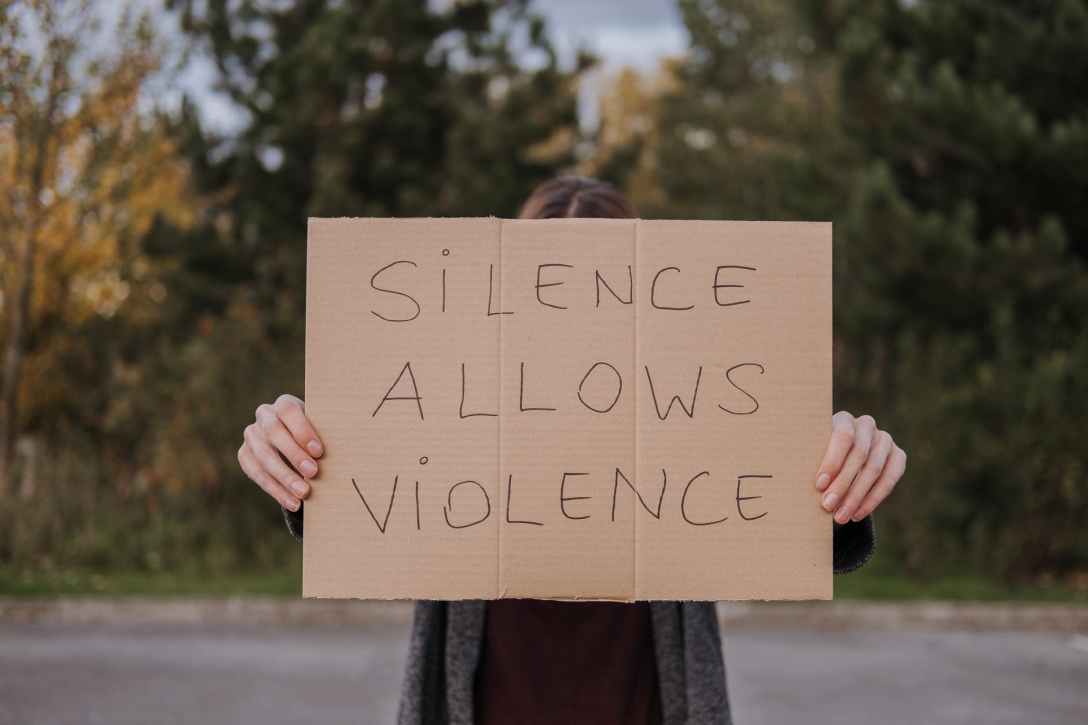
As non-violence is non-negotiable we must have tough conversations

The commitment to nonviolence in climate activism and deep adaptation is a central principle and we must criticise anyone who suggests otherwise. The risks of tolerating any deviation from this principle are too great & therefore we have no choice but to risk painful reactions, even from colleagues, when confronting it.

Trying to reduce harm and the antecedents of harm during societal disruption and collapse is not going to be pretty. I launched the Deep Adaptation Forum (DAF) as a safe space for people to help each other process difficult emotions and work out what next in life to reduce harm, save more of the natural world and seek meaning and joy in the process. It has been wonderful to see the voluntary commitment from people around the world to grow the activities. I left the daily operations in September 2020 and on February 8th this year I tendered my resignation from DAF’s non-executive board, called the Holding Group. That is the final step of me stepping away, in line with my knowledge of the research that shows we humans are susceptible to the counterproductive self-infantilising process of arguing about ‘leader’ character and views rather than taking responsibility ourselves. I am delighted that two experienced women from the Global South have agreed to be nominated in my place and look forward to seeing them communicating about Deep Adaptation.

Continue reading “As non-violence is non-negotiable we must have tough conversations”

Discuss #DeepAdaptation with experts in 2021

My Deep Adaptation Q&As are back for 2021. In these discussions, a guest shares their own perspective on what matters to them as we consider, or respond to, societal disruption and collapse.  The Deep Adaptation framework is for dialogue, without one right way of responding to our environmental predicament, or one source of knowledge on that. Therefore, I host these Q&As to broaden the discussion – and discussants – on the matter of societal disruption. All previous Q&As are available, with guests including Vanessa Andreotti, Skeena Rathor, Joanna Macy and Charles Eisenstein.

Continue reading “Discuss #DeepAdaptation with experts in 2021”

COVID and Climate Change – why XR must visit the WHO

New research confirms the role of climate change in making diseases like COVID-19, which come from wildlife, more likely, by direct and indirect effects, working in concert with other environmental damage.

Yep, shocking.

I use the words “more likely” and “like” in that sentence, reflecting scientific method and norm for communicating conclusions. In hypercomplex systems where isolating individual variables and establishing specific connections between events is difficult, that should not limit our ability to draw conclusions about probabilities, especially when they have massive implications for life on Earth.

Continue reading “COVID and Climate Change – why XR must visit the WHO”

Taking Climate Adaptation to Heart – talks by Jem Bendell

If you are currently trying to make better sense of societal disruptions and your future in a climate-disturbed world, then I believe ‘Deep Adaptation’ to be of use to you. It is the ethos and framework for a movement of people who consider the collapse of industrial consumer societies to be either probable, inevitable or already unfolding. We are seeking to reduce harm, save more of the natural world, and learn in the process. We tend to be agnostic about what might occur after any societal collapse.

This post in my blog links to a selection of introductory videos.

Continue reading “Taking Climate Adaptation to Heart – talks by Jem Bendell”

Still being academic – writings on management, environment and Deep Adaptation in 2020 by Prof Jem Bendell

In 2020 I co-authored some academic resources on management, environment and ‘deep adaptation’. Here is a quick summary and links, in case you are interested in these topics to a degree where you read or listen to academic outputs on them.

In an academic journal article, with Dr Katie Willocks of Lancaster University and Prof Richard Little, of Impact International, we explored ways of supporting learning within hospitals. In particular, we showed how the ideology of top-down managerialism can militate against a recognition of the motivation of staff in the caring professions, and side-line support for them to be better able to solve workplace disagreements as a means of professional learning. It’s basic common sense to seek to help not hinder nurses and doctors, but the dark forces of bureaucracy and commercialisation are so widespread in late modernity that it can be useful to challenge them empirically, as we have done in this paper.

Willocks, Katie, Bendell, J. and Little, R. (2020) Professional Learning from Disturbances in Healthcare: Managerialism and Compassion. International Journal of Management, Knowledge and Learning, 9 (1). Download here.

Continue reading “Still being academic – writings on management, environment and Deep Adaptation in 2020 by Prof Jem Bendell”

Beyond Climate War: Writings on Deep Adaptation to societal collapse

Updating this post in 2024, it is nearly 8 years since I first delivered a keynote lecture on the need to discuss what if it is too late to avert catastrophic damage to our societies from the direct and indirect impacts of climate and ecological damage. In that talk, I asked whether we don’t talk about it because of our fears. Because we can fear we will descend into despair and inaction. Or we might fear we will be attacked by our peers and dismissed by our friends. I suggested we needed to overcome such concerns, to explore what an anticipation of societal collapse might mean for our personal, professional and political lives. I offered a framework of questions to begin that conversation and called it Deep Adaptation. By taking time off from my job as a University Professor, I studied the climate science more closely in 2017 and 2018, and reached my personal conclusion that societal collapse in most countries in my lifetime is now inevitable. That meant I could not keep working on sustainable development and corporate sustainability any longer and released a paper in 2018 called Deep Adaptation. That was part of my process of moving on and transforming, not knowing what would come next.

The paper went viral and fuelled a new wave of activism, with Extinction Rebellion, and a new global network of people freely supporting each other, called the Deep Adaptation. Increasing numbers of people have been hearing about this paper, analysis, framework and community from its critics. My friends tell me that this negative reaction indicates that it has become a movement that matters. On the one hand, it is disappointing that people are hearing constant misinformation about what we are doing and why, and the implications for climate activism and policy. On the other hand, perhaps criticism of collapse anticipation is the safest way for some members of the general public to first hear about this possibility, as only those who are emotionally ready will explore further.

In 2023, I released a book, Breaking Together, which provided a lot more depth on the processes of societal collapse, and offered my ideas on how to respond to it. I recommend you read or listen to that, but if you want to locate commentary on specific issues related to DA, then the links to some of my blogs since 2018, below, may be of use.

Continue reading “Beyond Climate War: Writings on Deep Adaptation to societal collapse”

Let us hail over 500 scientists and scholars for their courage on societal disruption and collapse

Like many people who pay attention to trends in the world, I want all leaders to change everything immediately to give humanity a better chance of reducing the harm that’s unfolding due to the climate and ecological crisis. Like many people with that aim, I also recognise that young people are going to live in a future that will be far more harsh and difficult than it has been for people like me.

Rather than argue for more measurement, more reform, more technology, more hope and heroes, I think a more useful focus in solidarity with young people is to work for more action on adapting to the current and future disruptions. That includes having really difficult conversations about the situation and the options we are faced with (and learning how to have those discussions generatively, as we explored in a new paper).

Continue reading “Let us hail over 500 scientists and scholars for their courage on societal disruption and collapse”

If guys with guns are talking about collapse, why can’t we?

Thanks to Hollywood, we have all seen stories of near apocalyptic futures, where people descend into violence and depravity. We have also seen sensationalist, even racist, TV news reporting on looting after natural disasters. It seems the mass media is not always a good channel for hearing about the solidarity and cooperation that emerges between so many of us in times of crisis. It takes authors like Rutger Bregman to remind us of the better sides of human nature. Or Rebecca Solnit to show how human solidarity has always been a powerful resource during crises. Unfortunately, such views don’t get as much airtime when it comes to discussing the possibility for societal disruption and collapse.

Continue reading “If guys with guns are talking about collapse, why can’t we?”

Leading in a time of dying – notes for talk at ILA 2020

Below are are notes I prepared for a talk at the International Leadership Association 2020 conference on ‘Leading at the Edge’ (9th November 2020).

Also on the panel was Miguel Alejandro Naranjo Gonzalez of the United Nations Framework Convention on Climate Change (UNFCCC). He responded to my presentation in a very open and constructive way, demonstrating how we should be exploring things together without prejudice:

“Both focusing on the mitigation side, reduction of emissions… and the work… on Deep Adaptation are complementary. We will definitely need to face impacts of climate change… All over the world people are already suffering because of the impacts of climate change and this… is only going to become… more difficult. So, the approach that Jem [Bendell] presented on helping individuals deal with the difficult situations they are going to be living is definitely very important. It is of course beyond the level that we usually deal with in the climate change secretariat… The Deep Adaptation is deeply personal… so speaking from a personal point of view, I completely agree and appreciate that kind of work.”

Here are the notes for my presentation:

Deep Adaptation is an agenda, framework, and community, for people who anticipate societal collapse in their lifetimes, and want to stay engaged and useful rather than returning to avoidance. It came about after a paper I wrote on Deep Adaptation (DA) in July 2018 went viral and has been downloaded now over a million times. Launched in April 2019, the Deep Adaptation Forum (DAF) now involves a small team of staff engaging over 100 volunteers from around the world, who are supporting interaction, for free, of over 15,000 participants. Many initiatives are underway, created by the volunteers, to help people process emotions and find new ways of living kindly, creatively, wisely, and accountably, in this time of increasing turbulence.

Continue reading “Leading in a time of dying – notes for talk at ILA 2020”

When the Methane News Stinks – let’s not forget to Breathe then Act

There has been a news report from climate scientists working in the Arctic right now, about their observation of the release of methane gas from frozen deposits on the sea floor. That is a process which, if confirmed as true, is likely to continue and worsen, and lead to rapid heating of the atmosphere at rates not seen since pre-historic mass extinction events. Which, if confirmed as true, means the collapse of societies will occur sooner and harsher than I, and many others, have anticipated. It would also mean we might be struggling to survive as a species in the decades ahead.

Truly, this is a harrowing situation and piece of news. If true, it means we could reconsider everything in our lives, like some people do when they receive a terminal diagnosis. If not necessarily true, or not necessarily as bad as some scientists conclude, it nevertheless means we can consider what if it is true, a bit like when people are awaiting results from a scan or biopsy.

Continue reading “When the Methane News Stinks – let’s not forget to Breathe then Act”