Let’s meet in 2024?

Although I resigned my academic position to increasingly focus on local resilience efforts in the country I have now emigrated to, Indonesia, during 2024 I will continue to share thoughts on collapse risk, readiness and response. I will do that in four ways – essay writing, podcast interviews, public lectures, and short courses. As long as world systems hold together until March 2025, and I stay fit and well (!!), then I will be speaking and teaching in Australia, Belgium, Hungary, Mexico, Switzerland, Germany, UK and the USA. In Belgium in March, I will be joined by Satish Kumar and Pablo Servigne. In April in Budapest I will be celebrating 5 years of the Deep Adaptation movement in the country with the largest national group.

My keynote talk Mexico in October will mark the launch of the Spanish language version of Breaking Together. Then I will head to Oakland (California) that month to teach. In November I will present at some international NGOs and the United Nations, in Geneva, which will also include the launch the French version of the book, before I head to Berlin to present there. I will conclude my book tour in Brazil in early 2025, to launch the Portuguese translation of the book.

Aside from events in those locations, I will teach an online course “Leading Through Collapse” twice a year, scheduled to be suitable for any time zone. Any income from these activities already has a destination… the regenerative farming school I’m co-developing here in Bali.

Subscribe / Support / Study / Essays / Covid

Read more: Let’s meet in 2024?

My aim with these events around the world is to support people who are bringing collapse-awareness to their professions and public, in different regions and languages. This is the first international tour I am doing for 7 years, and I don’t intend to do another for many years, if ever. Therefore, I don’t feel guilty about the flying involved, as, like me, I still encourage people to fly less and fly effectively i.e. we should think about what we are trying to accomplish. Of course, that is how we can reflect on why we do anything that has an impact on the environment. Having a better reason to travel than the largest polluter in the world, which is the US military (not including proxy wars), probably isn’t a high enough bar to set for ourselves, although puts things in perspective 😉

If you would like to receive information on my events or courses in one of the countries I just mentioned, then please sign up to the relevant notification list below.

Jem in Brussels, Geneva, Berlin, and Budapest, 2024

Jem in Mexico, October 2024

Jem in California, October 2024

Donate to keep Jem writing / Read his book Breaking Together / Read Jem’s key ideas on collapse / Subscribe to this blog / Study with Jem / Browse his latest posts / Read the Scholars’ Warning / Visit the Deep Adaptation Forum / Receive Jem’s Biannual Bulletin / Receive the Deep Adaptation Review / Watch some of Jem’s talks / Find Emotional Support / Jem’s actual views on Covid

Be my twitter?

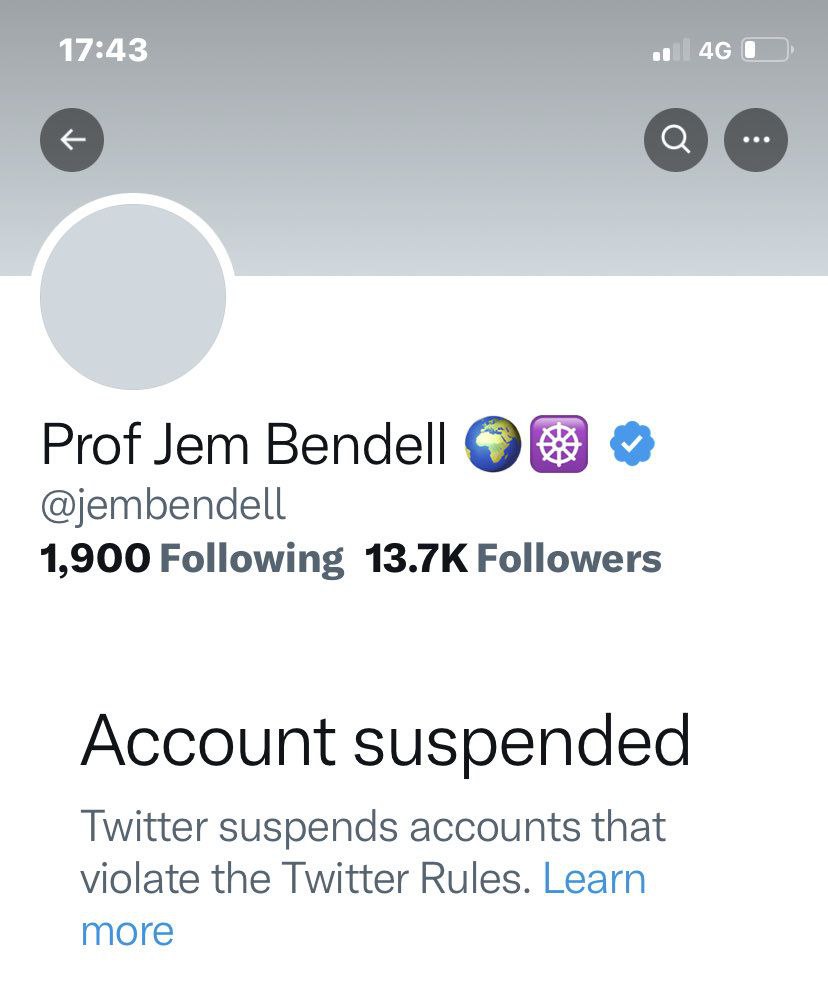
As I have been suspended from Twitter, I’d like to ask your help so that a Q&A on my book can be heard about. I was heartened that over 80 people joined me to discuss “Breaking Together: a freedom-loving response to collapse.” The event was hosted by Katie Carr of the Deep Adaptation Forum. The video follows below.

Why have I been booted from Twitter? Short answer: dunno. I received no warnings and no explanations. The text on my account says “After careful review, we determined your account broke the Twitter Rules.” Although I can be radical and forthright, at times responding to what I consider unfair criticism, I aim to be civil. Without further information, I’m curious as to the reason. Possibilities include some censorship code from old Twitter being triggered by a recent uptick in attention to my account. Or perhaps new Twitter doesn’t like my views on the unfortunate limits of renewables and electrification to transition humanity to sustainability. Another possibility is that the account was hacked in a sophisticated way so Twitter suspended it. I have submitted an appeal.

Subscribe / Support / Study / Essays

Continue reading “Be my twitter?”

Climate truth is a challenge to power – even that of senior experts

After another week of frightening temperature anomalies around the world, I gave a talk to supporters of the MEER project, which is trialling various means of locally-led climate adaptation that involve reflecting the sun’s rays. The video and transcript follow below. References for all the factual statements made in my presentation can be found within Chapters 1 and 5 of Breaking Together, which is available in all formats and regions, including a free epub download. Free audios of those chapters are also available. In the talk I am critical of mainstream climatology, as well as BigTech censorship of science-based analyses of the climate crisis that lie outside their preferred view of a manageable problem with technological solutions. From the talk:

“The so-called ‘fact checking’ group ‘Climate Feedback’ didn’t even consider two top climatologists worthy of a reply when they complained to them about helping Facebook to shadow ban an article that concluded we are inevitably heading for over 2 degrees global warming that will likely set off feedback loops. My understanding is that Professor Will Steffen died without even the courtesy of a reply from Climate Feedback. Dr Wolfgang Knorr still awaits one. So, we need to reclaim environmentalism from elites and officers of the establishment. We must stop pretending we are on the same side and instead build alternatives from below.”

Continue reading “Climate truth is a challenge to power – even that of senior experts”

Taking Climate Adaptation to Heart – talks by Jem Bendell

If you are currently trying to make better sense of societal disruptions and your future in a climate-disturbed world, then I believe ‘Deep Adaptation’ to be of use to you. It is the ethos and framework for a movement of people who consider the collapse of industrial consumer societies to be either probable, inevitable or already unfolding. We are seeking to reduce harm, save more of the natural world, and learn in the process. We tend to be agnostic about what might occur after any societal collapse.

This post in my blog links to a selection of introductory videos.

Continue reading “Taking Climate Adaptation to Heart – talks by Jem Bendell”

ScientistsWarning.tv presents Jem Bendell in Bristol

This is the first recorded lecture on Deep Adaptation, to 300 people in Bristol, UK. It uses a more informal format than a University lecture, inviting the audience to explore forms of action additional to cutting and drawing down carbon from the atmosphere – actions associated with personal and collective preparedness for coming disruption.

The lecture was accompanied by Toni Spencer, a facilitator who works on Deep Adaptation and Transition. She led the audience in a reflective process to explore feelings and ideas emerging. She also offered some poems and reflections during the process.

Members of the Climate Psychology Alliance spoke from the floor, explaining their new initiative to provide therapeutic support to people working on or affected by this agenda.

The event was organized by the local Constituency Labour Party and Momentum group, but made open to anyone with any political interest or none. To engage on this topic see http://www.deepadaptation.info

We thank Emilio Mula for filming and editing and Seeding Our Future for support to make it possible.

Prof Bendell will speak at several more public events in 2019.

Prof Bendell previously appeared on Scientists Warning TV in this collage.

Deep Adaptation Retreat

EXPLORING LIFE AFTER SUSTAINABILITY, 8th-15th June 2018

The emerging realisation that climate change is becoming a destructive tragedy, not just an urgent challenge, is bringing a sense of profound disorientation for many people.  How are we to feel?  What are we to do? What might become the purpose of our lives and work if we consider disruptive climate change as now inevitable?

alĂŠxandros 0
A view from the retreat

You are warmly invited to join us for a week of dialogue and reflection, with the aim of gaining a clearer sense of how meaning can re-emerge in full acceptance of the climate tragedy. We will explore dimensions of an emerging “deep adaptation” agenda, drawing on the lived experiences and various stories of each participant, and a range of wisdom traditions.

This retreat is for you if you:

  • work on sustainability in some form and are questioning your motivation and future,
  • want to explore implications of climate disruption in depth with supportive peers,
  • sense that a week in community and nature could support your transition.

The disorientation felt due to an awareness of our climate tragedy can lead to withdrawal and loneliness. Therefore, our intention for this retreat is to bring fellow travellers together to develop a new sense of purpose and community. Within a safely held and gently facilitated space, we hope to enable and discover insight on finding meaning, priorities and joy amidst tragedy. We anticipate you might feel inspired and supported to host future gatherings of peers on the deep adaptation agenda.

The retreat is hosted within an intentional community which lives lightly and beautifully on the verdant green and blue shores of the Aegean. The food is mostly locally sourced, all homecooked and vegetarian. A stunningly wild beach is a 20-minute walk away, while old villages are nearby through forests.

alexandros 2
The coastline near the retreat is the Mediterranean at its best

You are invited to bring a reading, practice or insight to share that is helping you to explore meaning after sustainability. You will be given pre-reading from the www.Dark-Mountain.net collection within your ‘preparation pack’ for the retreat. Its founder Dougald Hine will lead one session by video link.

The retreat centre Alexandros, part of the Kalikalos community, is less than 2 hours from the Greek city of Volos. The nearest village with a bus stop is Ag Ioannis. Buses to Volos leave from Athens and Thessaloniki, where flights arrive. Flights are also available into Volos with seasonal airlines like Small Planet and Thomas Cook. More information here. Prices and booking here.

SCHEDULE

Friday, the 1st day, is our arrival with check-in, registration and the welcome meal in the evening. Dialogue and reflection will begin after dinner with an opening circle. The 2nd day includes a welcome circle with our hosts, the volunteers of Kalikalos. From the 3rd day onward our rhythm will flow as follows:

  • 8:00am – 9:00am Breakfast
  • 9:00am – 9:15am Opening Circle
  • 9:15am – 10:15am Opening talk (30 mins) and discussion.
  • 10:15am – 11:00am Two or more participants share a resource (text, art, other) with discussion.
  • 11:00am – 11:30am Drinks break
  • 11:30am –  12:30pm Group Activity (typically in pairs, threes or fours)
  • 12:30pm – 1:00pm Closing Circle
  • 1:30pm Lunch
  • 2:30pm – 6:00pm Free time for reflection (beach, forest, villages).
  • 6:30pm Karma Yoga (supporting the community)
  • 8:00pm Dinner
  • 9:15pm – 10:30pm Optional evening activities (some activities such as Ecstatic Dance are organised at nearby centres).

On one of the days the morning session will involve a walk. The flow of the daily sessions above is indicative; actual activities will be woven organically from the programme above in response to the emergent needs and wishes of the group.

Prices: include the workshops plus full accommodation with 3 daily vegetarian meals (except for one evening out in a Taverna). One week in a tent € 470, triple room € 520, twin room € 620, single room € 770. All rooms are en suite with views and/or balcony.

Registration opens from November 2017. For more information, please contact me, Jem Bendell: drjbendell @ gmail dot com

alexandros 1

BIOGRAPHY OF YOUR HOST

Jem Bendell began offering transformational professional development courses after 20 years pursuing a variety of methods for social change. From anti-globalisation activism and sustainability consulting in the late 1990s, via senior management in large environmental organisations and research roles with the United Nations, to grassroots economics and social venture capital today. One theme throughout has been sense-making and communication, with Professor Bendell responsible for over 100 publications and a range of Masters courses worldwide. In the past few years Jem has focused his research, advice and teaching on sustainable leadership and communication, working with senior officials in business, politics and civil society. His approach to teaching is participative, experiential and focused on the whole person. A graduate of the University of Cambridge, Jem is the founder of the Institute for Leadership and Sustainability (IFLAS).

In 2014, Jem began to sense he had been emotionally dependent since the age of 16 on a story of meaning, focus and self-worth through helping society transform in the face of climate change. This insight came from taking to heart the latest climate science and no longer resisting doubt, grief and despair. In 2016 he gave a speech to climate scientists that outlined a “deep adaptation” agenda to the climate tragedy.

j-wn2CSbMMczqXXYTG5TFemn3De1qB1wC1UgJVIKg34,5WewfNosQC6fP5dUNe-oD1hg7Icy5uBVH1QSITeVogE

Engaging the Climate Tragedy

When discussing the sorry state of efforts to address climate change with professionals working on this topic, across sectors, I often hear a reluctance to question whether it is too late to avert catastrophic climate change, or what such a view might mean for the focus of our work. Various objections to this view are raised and prevent open discussion or an evolution of work. Therefore, I decided to deliver a speech at a leading climate business and finance event in Australia, at Griffith University, to seek feedback on my argument that we must now shift focus.

In my keynote, Nov 29th, I’m outlining the following:

  1. There has been some progress on environmental issues in past decades, from reducing pollution, to habitat preservation, to waste management.
  2. Much valiant effort has been made to reduce carbon emissions over the last twenty years.
  3. There have been many steps forward on climate and carbon management, from awareness, to policies, to innovations.
  4. Larger and quicker steps must be taken and can be now that there is COP21 and major Chinese engagement on the issue.
  5. To support the maintenance and scaling of these efforts is essential.
  6. Small steps have been taken on adaptation to climate changes, such as flood defences and planning laws.
  7. Yet these steps on climate mitigation and adaptation are like walking up a landslide. If the landslide had not already begun, then quicker and bigger steps would get us to the top of where we want to be. But the latest climate data, emissions data and data on the spread of carbon-intensive lifestyles tell us that the landslide has already begun.

That the ground is already moving beneath our feet is summarised thus:

  1. The politically permissible scientific consensus is that we need to stay beneath 2 degrees warming of global ambient temperatures to avoid dangerous and uncontrollable levels of climate change, with impacts such as mass starvation, disease, flooding, storm destruction, migration and war
  2. If the world does not keep further anthropogenic emissions below a total of 1,300 billion tonnes of carbon, we won’t keep average temperatures below that 2 degrees warming.
  3. If we are not already on the path to dramatic reductions we will not keep within this limit.
  4. We are not on such a path, with emissions still at around 40 million tonnes of CO2 a year and the decoupling of growth from emissions minimal.
  5. The uncertainties on the edge of scientific consensus do not suggest a respite, with some increased carbon sequestration through increased vegetation not as significant as the methane emissions not factored into most models, and where Arctic warming is already progressing beyond even the most extreme predictions.
  6. Therefore, we are set for disruptive and uncontrollable levels of climate change, bringing starvation, destruction, migration, disease and war.
  7. The implication is that we need to expand our climate work into a deep adaptation agenda, including resilience, relinquishment and restoration while learning why this tragedy is occurring.

I will explain more about that deep adaptation agenda in a moment. I realise that at this point the reader, or listener, might feeling a bit affronted, disturbed, or saddened. In the past few years, many people have said to me that “it can’t be too late to stop climate change, because if it was, how would we find the energy to keep on striving for change?” With such views, a possible reality is denied to permit a continued striving which has its rationale, therefore, not in serving the expressed goal but in maintaining self-identities related to espoused values. This form of denial is different from outright climate denial, but is also unhelpful, as John Foster argues well in his book After Sustainability (2015).

It is emotionally difficult at first, but we need to move beyond that pretence if we are to remain relevant. In doing so, we open ourselves up to discuss a ‘deep adaptation’ agenda as well as exploring why this tragedy has begun and why we have been so poor at responding effectively. I will make some brief comments on these topics before concluding with some thoughts on how we evolve our research accordingly.

A deep adaptation agenda will involve increasing resilience, relinquishment and restoration Resilience involves people and communities better coping with disruptions. Examples include how river catchments can better cope with rains, or how buildings can better cope with floods. What I’m calling relinquishment, involves people and communities letting go of certain assets, behaviours and beliefs where retaining them could make matters worse. Examples include withdrawing from coastlines or giving up expectations for certain types of consumption. Restoration involves people and communities rediscovering attitudes and approaches to life and organisation that the hydrocarbon-fuelled civilisation eroded. Examples include re-wilding landscapes so they provide more ecological benefits and require less management, or increased community-level productivity and support.

There will be increasing discussion about what is to be learned from the tragedy of climate change, and honest inquiry existing alongside strategic attempts at framing disruption, degradation and loss to maintain one’s relative power in society.  Disruption, degradation and collapse will be framed by different people as a resulting from foreigners, capitalism, industrialism, individualism, consumerism, patriarchy, anthropomorphism, secularism, liberalism, progressivism, and atomism (where we see things as separate). We are even seeing framing of disruption by religious fundamentalists, who, to my knowledge, don’t discuss climate but seek to respond to the disruption it has already caused. One study by Columbia University argues that in Syria, the worst drought in 100s of years, made worse by climate change, led to 1.5 million people being displaced from their lives in rural areas and increased food prices in cities. Some radical Islamists were able to thrive in this situation with their explanations of cause and solution, replacement stories of personal identity and purpose, and offers of sustenance.

My own analysis is that the West’s response as restricted by the dominance of neoliberal economics since the 1970s. That led to hyper-individualist, market fundamentalist, incremental and atomistic approaches. By hyper-individualist, I mean a focus on individual action as consumers, switching light bulbs or buying sustainable furniture, rather than promoting political action as engaged citizens. By market fundamentalist, I mean a focus on market mechanisms like the complex, costly and largely useless carbon cap and trade systems, rather than exploring what more government intervention could achieve. By incremental, I mean a focus on celebrating small steps forward such as a company publishing a sustainability report, rather than strategies designed for a speed and scale of change suggested by the science. By atomistic, I mean a focus on seeing climate action as a separate issue from the governance of markets, finance and banking, rather than exploring what kind of economic system could permit or enable sustainability.

Given this context, while the new Sustainable Development Goals (SDGs) and the culture they reflect are helpful for non-climate related matters, given the systemic nature of the impacts of global warming, they may be ill-focused. Instead “minimum survival goals” would be more appropriate, to reduce the rate of increase in starvation, destruction, migration, disease and war. We don’t need consensus on that, but a shift right now from those who have a professional income, skill set and network to work on matters broadly related to climate change and its effects.

The implications for researchers working on climate issues, whether on campaigning, policy, business, finance, include asking the following questions:

On other’s research:

“How might these findings inform efforts for a more massive & urgent transformation to resilience & relinquishment in face of collapse?”

On one’s own research:

“If I didn’t believe in incremental incorporation of climate concerns into current organisations and systems, what might I want to know more about?”

“How might neglected theories of political economy suggest I inquire into this or related topics?”

To explore some of these ideas further, my recent writings may be of interest, on implications for the future of the climate debate, on what sustainability leadership involves, on how we need to heal capitalism, and how we need to ask ourselves tough questions if we consider ourselves climate activists. Better still, these publications will help you explore this emerging “post-sustainability” paradigm:

Benson, M. and Craig, R. (2014) ‘The End of Sustainability’, Society and Natural Resources 27; 777-782

Foster, J. (2015) After Sustainability (Abingdon: Earthscan from Routledge)

Hamilton, C. (2010) Requiem for a Species (London: Earthscan)

Hamilton, C. et al. (eds.) (2015) The Anthropocene and the Global Environmental Crisis (Abingdon: Routledge)

Jamieson, D. (2014)  Reason in a Dark Time (Oxford: Oxford University Press)

Mulgan, T. (2011) Ethics for a Broken World  (Durham: Acumen)

As the point of no return can’t be fully known until after the event, ambitious work on reducing carbon must increase. But a new front of work on deep adaptation is as important today. Understandable emotional traumas from realising the tragedy that is coming, and in many ways upon us already, shouldn’t prevent us from exploring what this probable reality could mean for our choices now. Moreover, from social psychology, there is some evidence to suggest that by focusing on impacts now, it makes climate change more proximate, which increases support for mitigation.

In my talk at Griffith I explore more about the nature and future of leadership in light of this assessment of the climate tragedy.

More on the event is here.

UPDATE: Until June 1st 2018 I am receiving PhD applications on the topic of deep adaptation, connected to either organisational studies, policy or sociological disciplines, for starting Oct 1st 2018. Either based in Cumbria or remote working, full time or part time. There are no scholarships for these. Fees information from http://www.cumbria.ac.uk If you have a masters degree and are interested in this topic and self fund, then please drop me a note.

Upcoming talks and workshops in 2015

Ive finalised my calendar for talks and workshops for the first half of 2015. To find out more information or book a place, follow the links provided.

March 18th-21st London, UK: Lecturing on Sustainable Exchange masters module.

A talk in 2014
A talk in 2014

March 19th London, UK: Panellist at Tomorrow’s Transactions Forum.March 30th Geneva, Switzerland: Disruptive Leadership, talk at Hub Geneva.

May 16th-17th Copenhagen, Denmark: Keynote on Leadership, Transition World opening summit.

June 7th New York, USA: Transforming Money, speech at the Global University of the Entrepreneur’s Organisation.

June 16th Ambleside, UK: Disruptive Leadership: Innovating major changes for sustainability, Open Lecture at Institute for Leadership and Sustainability, University of Cumbria.

June 17th and 18th Carlisle and Lancaster, UK. Engagement and Influence: How to Communicate Your Work, a workshop at the University of Cumbria. Request attendance via iflas@cumbria.ac.uk

July 10th-15th Lecturing on the Certificate of Achievement in Sustainable Leadership.

July 16th Ambleside, UK: Opening Address at Leading Wellbeing Research Festival, July 16-18.

Sept 7th to 11th Ambleside, UK: Workshop on Values-Inspired Leadership, at Impact International.

If you would like me to keynote or run a workshop from September onwards, let me know with an email to jb [at] jembendell dot com.

Financial Freedom: Text of Speech at Guardian Activate Conference

Today I spoke at the Guardian newspaper’s Activate conference in London. The audience was mostly comprised of VCs, Financial Tech specialists, Sharing Economy start ups, and others interested in the potential of tech to disrupt the way we pay and co-rent. Here, below, is the text of the speech.

guardian

“Thanks for the introduction, Stephen. Yes, I founded at an institute for leadership and sustainability, in the Lake District. A land known for hiking, sheep, poetry, rabbits… and bitcoin. Earlier this year we became the first public university to accept the crypto currency. We decided to accept bitcoin to learn by doing, as we teach a Masters-level course on currency innovation. In the course we explore how currency systems and sharing platforms might help sustain our communities and environment. But what Ive come to understand is that if we want to shape the future of money then first we must understand the present nature of money. So before I tell you what I’m excited about, let me explain what I’m grumpy about.

About 97% of money we use is created by private bank lending, which comes with interest. When we borrow, the money is created by the bank, not taken from savings. The amount owed to banks, which is the amount borrowed plus the interest, is always more than the amount borrowed. It means that collectively we are in debt forever, so inequality is inevitable.

With this system of money creation, banks decide who gets the new money and for what. So about 80% of new money is created for property loans. That inflates the price of property, so house prices are 8000% higher than in 1950. That’s not market forces, but the result of our monetary system. I know many people who are in jobs they hate, or who have ignored a vocational calling, because of the mortgage. Some people I know have got ill because their mortgage locks them into a certain lifestyle. Unless we start out with a lot of capital, it’s less a property ladder than a property prison.

But what to do about it?

I take inspiration from a South African anti-apartheid campaigner. In the 1970s Tim Jenkin was imprisoned for 12 years for his activism, to be served in a high security jail in Pretoria. Given the injustice of the system Tim considered it his duty to try to break out of jail. Which he did after 18 months, and fled the country. Fast forward to 2003, Tim had returned to South Africa. He saw that people are oppressed by the current monetary system, and he wanted to free them.

He created Community Exchange Systems with free open source software. They now have 50,000 users, in over 700 locations worldwide. Instead of units of ‘money’ being issued into circulation according to a policy or algorithm, peers extend credit to each other. It means people who have little money but have time, skills and resources, can start helping each other and trading with each other, without official money. This is “collaborative credit” as it involves members of a network trusting each other rather than a bank. Collaborative credit doesn’t come with interest demands or create asset price inflation. There are over a thousand such systems worldwide, but they are largely under the radar of the media, VCs or philanthropists.

Bitcoin has opened minds the idea that fintech can help us transact in alternative currencies, but there’s a long way to go. Now we need to understand how currencies can be designed to support communities and the environment. Bitcoin fans often speak of financial freedom, yet the issuance and distribution of bitcoin makes Thatcher look like a communist. Moreover, it is delusional to believe that money should be a thing of value, rather than a way of keeping score amongst people and organisations doing useful things for each other. We can’t eat money, we can’t eat gold, we can’t eat bitcoin. The real wealth is our lives, communities and environment. We need currency systems that support such wealth, not undermine it. We need positive transformation of our monetary systems, not just disruption.

People like Tim Jenkin have launched collaborative credit systems without financial backing. Now fintech and sharing economy start-ups have a role to play, but to do so they need to design business models that will empower people not make them captive. I hear some people in fintech and the collaborative economy looking to exit to a major multinational. That might let their founders and shareholders escape the prison of the mainstream monetary system, but leave that prison with new walls and stronger guards.

We need a considered dialogue about how to prevent monopolistic practices, protect users, and involve them in the governance of new systems for sharing, currency and payment. It starts with recognising our purpose here is greater than feel-good projects, funky start-ups, or getting rich. We have the potential to design systems that will shape economies, societies and environments for decades to come. So why not make that issue our business?”


To read more about Collaborative Credit, see my article on the Guardian website. Ill tweet the video of the talk when its available (@jembendell)

You can download the introduction to Healing Capitalism for free.

Homeschooling world changers

“Why are we running around trying to be more successful in a system that is driving us to collective suicide?”

At a conference on women’s leadership, I spoke about the role of education in enabling the critical thinking that is necessary for leadership. I explored the relevance of the approach of Charlotte Mason, who founded the Lake District campus in 1892 which is now the home of our Institute for Leadership and Sustainability (IFLAS). In the talk I challenge participants to question their assumptions in order to drive change, rather than just “succeed” within existing systems that are damaging people and planet. I reveal one famous activist was home schooled, and what his mother told me about her approach to his education. You can discuss this talk in our Linked In group, linked via www.iflas.info