BBC implies in its “Fact of the Day”, that Indira Gandhi and Mahatma Gandhi were related!

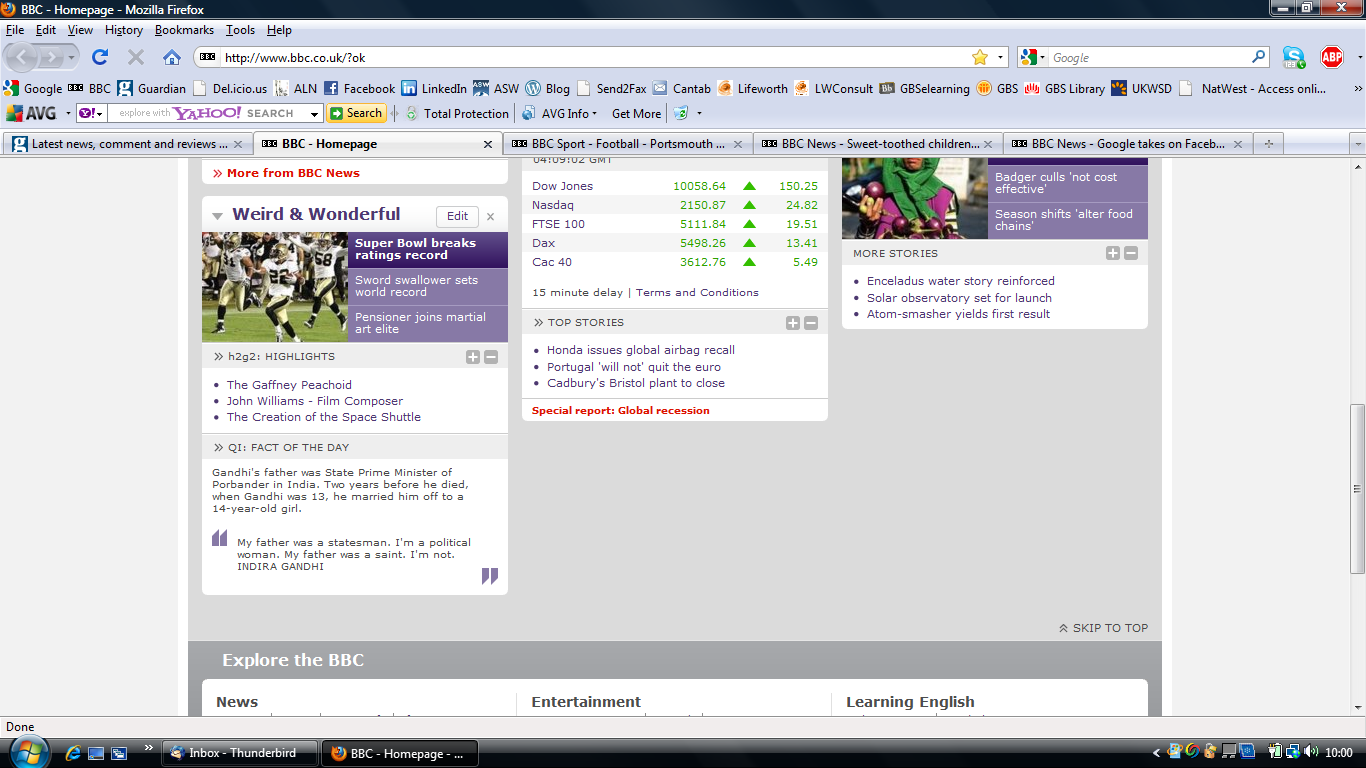
In a schoolboy error the BBC confused J Nehru with MK Gandhi on its homepage today.  A screen shot follows below. In its “Fact of the Day” it says:

Gandhi’s father was State Prime Minister of Porbander in India. Two years before he died, when Gandhi was 13, he married him off to a 14-year-old girl.

“My father was a statesman. I’m a political woman. My father was a saint. I’m not.” INDIRA GANDHI

Ms Indira Gandhi was speaking of her father Jawaharlal Nehru. The juxtaposition of the two statements on the BBC suggests they see a relation between the two Gandhis.
While it’s good to see MK Gandhi mentioned on the BBC, it’s a pity its done with such sloppiness. It’s not uncommon for famous names to be mentioned and their lives and insights into life just assumed. So many people like to quote Adam Smith in defence of current forms of capitalism, without any knowledge of his writings about the role of values and the importance of up-close ownership and face-to-face accountability through the market. Even in India the life and work of MK Gandhi is not looked at very closely, and his own views on economic life are ignored or mis-interpreted. For instance, Gandhi wrote about “economic trusteeship” being his view of how capitalism should operate. Today those few business leaders who have heard of that concept consider it means a paternalistic responsibility to employees and communities. Yet it does not – it demands accountability of those who control assets to those who are affected by that form of control. Otherwise, property rights should be revoked. It is therefore a concept of capital democracy. I develop this in the latest Lifeworth review of corporate responsibility, called Capitalism in Question. I quote from it:

“Indian independence leader, Mohandas K Gandhi, articulated a concept of ‘trusteeship’ in some of his writings. This arose from his view that everything is owned by everyone, and wealth is owned by those who generate it. Thus the one who controls an asset is not an owner but a trustee, being given control of that asset by society. Gandhi wrote “I am inviting those people who consider themselves as owners today to act as trustees, i.e., owners, not in their own right, but owners in the right of those whom they have exploited.”1 In the Harijan paper his views on trusteeship of property were later documented to clarify “It does not recognize any right of private ownership of property except so far as it may be permitted by society for its own welfare” and “under State-regulated trusteeship, an individual will not be free to hold or use his wealth for selfish satisfaction or in disregard of the interests of society.” He also wrote that “for the present owners of wealth… they will be allowed to retain the stewardship of their possessions and to use their talent, to increase the wealth, not for their own sakes, but for the sake of the nation and, therefore, without exploitation.”2 Gandhi did not develop these ideas further, as he had other preoccupations, such as generating economic self-sufficiency, inter-communal understanding, and the non-violent expulsion of the British Empire. The concept there remains to be developed and applied further.”

If people are now even confusing Nehru with Gandhi, perhaps it really is time for another look at some of the great leaders and thinkers of the past century, and what they might tell us about the future of our societies.

1Gandhi, M K. Gandhi’s Philosophy On Trusteeship, http://www.gandhi-manibhavan.org/gandhiphilosophy/philosophy_trusteeship.htm

2Gandhi, M K. (1946) Harijan, 31st March pg. 63-64. http://www.mkgandhi-sarvodaya.org/momgandhi/chap53.htm

The Final Annual Review from Lifeworth – challenging Capitalism!

For the past 9 years I have written an annual review of the corporate responsibility field. In each review I have focused on what I thought were key trends, and sought to promote heartfelt and progressive engagement in this field. 2010 is the final year of my writing quarterly reviews in the leading Journal of Corporate Citizenship. Next year, therefore, I will produce a new edited book, with co-author Ian Doyle, that analyses the last 5 years. Then, Ill focus less on written commentary and more on implementing the ideas and insights from the past decade.  So, as this is the final annual review, I thought it important to encourage us all to use this time of post-crisis reflection to go deeper, and see how our work might relate to the kind of economic transformations we need for a fair and sustainable world. Hence, when I saw how many people are now debating fundamental elements of “capitalism” I thought it important to bring this to the fore. Because, as the World Economic Forum draws to a close in Davos, the real debate about the future of our economic systems is only getting started… in the real world of people’s communities and businesses. The press release for the new review follows below.

Post-crisis, Capitalism now a focus for CSR, says Lifeworth Review

Press Release from Lifeworth. February 1st 2009.

Capitalism is up for debate, and that’s a good thing, according to a new review from a management consultancy. “The dual financial and climate crises are leading people in all walks of life to question the kind of economy that makes sense for their businesses, communities and families,” explains lead author of the review, Associate Professor Jem Bendell. “As well as some anger at bankers, the financial crisis has led many to ask deeper questions about finance in general and, therefore, about capitalism. From bars to seminars, bookshops to board meetings, capitalism is being discussed – openly and critically,” he claims.

Entitled “Capitalism in Question”, the annual review describes how politicians and even business leaders are calling for more critical assessment of what kind of economic system we need for a fair and sustainable future. The review from Lifeworth Consulting summarises over a dozen books that have been published in the last weeks that debate the relative merits of capitalism and what form of economic governance is needed post-crisis, and in a new era of economic power. “The majority of these new books seek to do something that previously seemed neither necessary or interesting − to defend capitalism,” says John Stuart of Greenleaf Publishing, which supports the review.

Bendell explains that defensiveness wont help. Referring to the “Restoring Trust” report overseen by Allianz, Barclays Capital, Blackstone, and Carlyle Group, among others, he said “seeking to defend one’s immediate interests, as the banks writing the recent World Economic Forum report clearly did, is not how we are going to discover together the next step in our economic evolution. Fearful people in incumbent institutions may waste our time with diversionary drivel, but real exploration of the core issues is unavoidable. The question now is who should participate and how.”

Co-author of the review, Lifeworth Consulting’s Ian Doyle, explained that “much of the corporate social responsibility, or CSR agenda, has been predicated on a belief that government is constrained by global finance and can, or should, only intervene in markets to a limited extent. The giving of huge amounts of money to private banks may suggest that global finance is still dominant, but it also shows that sometimes when called on to act, most governments will intervene in markets in dramatic ways. So it’s not unreasonable for people to look to their governments to now shape responsible business practice more than before. And that is what we are seeing.”

The review is a call for people to become more involved in exploring how to evolve economic systems to promote fair and sustainable societies, says Bendell. “We are calling for this kind of engagement because after doing nine years of quarterly responsible business trends analysis for the Journal of Corporate Citizenship, we have concluded that there is a nascent social movement for the transformation of business and finance. Behind the jargon of corporate social responsibility, corporate accountability, environmental management, social enterprise, and responsible finance, are people like you and me who want to change the way business does business and the way money makes money. As such we need to think through what we are aiming for, longer term, and how we can work in concert. We all need to look up from our projects and shape the unfolding programme of economic transformation.”

To contribute to the debate, Lifeworth offers a framework for democratising capitalism. As Bendell, who is also Lifeworth’s director explains, “It’s simply that we need more governance of capital by people who are directly affected by its ownership and control. From that one concept flow many implications for tax, currencies, stocks, and all social and environmental regulations. This democratisation of capitalism could be the ultimate goal of the corporate responsibility movement, and the seeds of this approach are already to be found in the ideas and practices of many people working on corporate responsibility today.”

A discussion of economic systems can seem distant from the day-to-day preoccupations of most executives and the academics who seek to educate them, but as Bendell suggests, “making such connections will be important if the corporate responsibility movement is to have a substantial and lasting effect on commerce and society.” In ‘Capitalism in Question’ some initial guidance is given for how business leaders and educators can play a socially progressive role at this time. Specific multi-stakeholder initiatives are recommended.

The review of trends in corporate responsibility during 2009 includes analysis of government stimulus packages, responsible tax management, responsible mining, responsible cosmetics and beauty businesses, as well as particular trends in Asian and Francophone countries. It also explores the potential of ‘design thinking’ for sustainable business innovation, and provides in-depth analysis of the implications of the Copenhagen climate summit.

“Deep changes will be required in economic governance if we are to achieve a sustainable society… Capitalism will change, there is no doubt, and it must change so that it delivers both private wealth and public good” explains Professor Malcolm McIntosh of the Asia Pacific Centre for Sustainable Enterprise. “As we enter a period of potential reconfiguration of economic governance, leaders of organisations will need to better understand the issues, actors and dynamics to be successful. Part of Griffith Business School in Australia, Professor McIntosh’s centre supported the free release of this review to promote creative thinking at a time of critical global challenges and because “the lead author Jem Bendell, is an important commentator on the world stage.”

Dr Bendell says there are important implications for management education. “In Griffith’s new “Graduate Certificate for Sustainable Enterprise” we help our students to navigate increasingly complex social and political contexts so they can find ways to prosper by being part of the solution.”

‘Capitalism in Question: The Lifeworth Annual Review of 2009’ is available in pdf for free download at http://www.lifeworth.com/consult/2010/02/annualreview/

Lifeworth’s responsible enterprise trends analysis during 2010 can be obtained by subscribing to the ‘Journal of Corporate Citizenship’. New subscribers to the journal before March 31st 2010 receive all 2009 copies for free. Visit http://www.greenleaf-publishing.com

Information on Griffith’s research centre and graduate certificate is available at http://www.asiapacificsustainableenterprise.com/

For media enquiries about ‘Capitalism in Question’ contact Jem Bendell via connect [at] lifeworth.com or +44(0)2071936102

A time to tweet

I didn’t want to sign up to Twitter because I thought it mad to want to blurt out stuff about what you are doing every minute of the day.

I see that Ricky Gervais and Steven Fry are quitting it, getting tired of blah blahing about things.

But during COP15 I realised twitter is a useful tool. As I clicked on the tag #COP15 it provided a form of real-time human-managed search engine, through the use of tinyurl.com or other forms of linking to webpages from twitter. Thus I saw it a great way to share your own work on matters of topical discussion.

So, I wont be tweeting about what I had for breakfast or who I met at lunch. But for another way to share what myself and my colleagues at Lifeworth are doing or putting out.

After I sent my first tweets I got 4 new followers in a minute.  Thanks guys.

My first tweets:

  1. jembendell

    @COP15 it was wrong 4 #business & #banks 2push4 #CapAndTrade 4 the #climate We must seek a global #carbon charge http://tinyurl.com/yz2f5c9

  2. jembendell

    @davos #WEF is right 2report values at heart of #FinancialCrisis but #davos isnt yet the answer to those #values. http://tinyurl.com/yc4paph

  3. jembendell

    #UN #fashion show is happening! Great when idea comes 2gether. Praise #ecochic. Step 4ward 4 #sustainable #luxury http://tinyurl.com/ykgkf6g

All of them posted from this internet cafe in India.  If someone buys me an iphone or googlephone you’ll be even better informed.  Just send the cash via paypal to connect@lifeworth.com

😉

Free Your Mind… from your Mind

“Our most intimate relationship is the one we have with our own minds. I was in a very dark place for a long time. Then one day I realised a simple thing. When I believed my own thoughts, I suffered. When I didn’t believe them, I didn’t suffer. Everything changed for me that day.”
– Byron Katie

“Make a list of [your] darkest, most aggravating, shameful beliefs – the poisonous, top secret, horrible judgements we reveal to no one – then choose the greatest shame of all and apply the four questions and turnaround”

1.Is it true?
2.Can you be absolutely sure that it’s true?
3.How do you react when you think that thought?
4.Who would you be without that thought?

“[Then] invert the original thought and give three examples of why this “turnaround” is as true as, or truer than, the original belief.

“According to Katie, any painful thought subjected to this inquiry loses its power to hurt us, since most of what foes on between our ears is a pack of lies.”

I did it, it helped.

All quotes excerpted from Mark Matousek’s book pg 127/8

More on him at http://www.markmatousek.com/

The UN and Fashion – its a new trend

My work in the last few years on sustainable luxury seemed to some to be a bit of a break with my more development and international policy focus, albeit on corporate responsibility. I sought to promote sustainable luxury for a range of reasons, but one was to leverage high end brands to help make sustainability sexy in urban middle class Asia as fast as possible. NGOs can’t do that. Gucci could. Well, it seems the wave of eco cool is sweeping China’s youth, even if not their Copehagen delegation.

This new work led me in new and unusual directions, even stepping out on a cat walk, at an eco fashion show in Hong Kong run by EcoChic Fashions, in October 08. But as I still lived in Geneva and was working on finishing a couple of projects with UNRISD and UNSSC, the UN was still in my mind. Earlier that year, by Lac Leman, Louise Barber of the UNOG had told me that 2009 was to be the international year of natural fibres (yes, really, it was), and 2010 the international year of biodiversity. So, I mused, why not hold an eco fashion show at the UN, to promote these ideas, and encourage industry engagement? And, of course, have the fun of seeing a cat walk in the middle of the UN. I connected her, Eduardo Escobedo at UNCTAD, and Christina Dean at Green2Greener, and with their dedicated colleagues, the event is now upon us.  And.. you can even attend! If you register. See below.

Perhaps international cooperation could become the new fashion?! It may not seem like that after COP15, but in light of that intergovernmental impasse, the more innovative ways the UN can catalyse change the better!

Redefining Sustainability in the International Agenda: Inspiring Greater Engagement in Biodiversity Issues

January 20–21, 2010

Room XIX – Palais des Nations, UN

Geneva, Switzerland

UNCTAD and Green2greener invite you  to come and join the more than 500 prominent figures from government, international organizations, and industry as they meet in Geneva on 20-21 January to call for action against the rapid loss of the world’s biodiversity.

This timely seminar will provide a collaborative platform to discuss the need to redefine sustainability. Through the viewpoint of the fashion and luxury industries, participants will gain a unique insight into the role that governments, businesses, and consumers can play in supporting biodiversity conservation and the sustainable use of natural resources.

Through interactive panel discussions and in-depth case studies, the 1.5 day seminar will cover issues such as

·         Redefining Sustainability: Why Biodiversity and Why Now?

·         How to Implement a Successful Sustainability Strategy

·         Educating and Engaging Consumers in Biodiversity Issues

·         The Rise of the Ethical Consumer and Eco-Fashion in the Mass Market

·         Luxury Brands as Sustainable Role Models

·         Environmental Traceability, Accountability and Certification

·         The Role of the Creative Industries in Developing Economies

·         The Role of Multi-Stakeholder Partnerships

·         Paving the road towards the CBD COP 10 and the revision of the International Biodiversity Targets.

Confirmed participants include representatives from business, international organizations, government, media and NGOs such as:

·            Ahmed Djoghlaf, Executive Secretary, Convention on Biological Diversity (CBD)

·            Willen Wijnstekers, Secretary-General, Convention on International Trade of Endangered Species (CITES)

·            Dermot Rowan, Managing Director, Orla Kiely

·            Burak Cakmak, Director CSR, Gucci Group

·            Giulia Di Tommaso, Director of Legal Policy and International Relations, Unilever

·            Jean-Fraçois Fournon, Global Creative Director, Saatchi & Saatchi Simko

·            Hans Steisslinger, Head R&D Natural Cosmetics, Weleda Group AG

·            Peter Ingwersen, Founder, Noir

·            Tamsin Blanchard, Style Director, The Telegraph Magazine

·            Sarah Ratty, Founder and CEO, Ciel

·            Alphadi, President & Founder, Festival International de la Mode Africaine

·            Jean-Luc Ansel, Director General, Cosmetic Valley

·            Isabel Berz, Director Fashion School, Istituto Europea di Design Madrid

·            Kate Dillon, Model and M.P.A. in international development

·            Tamsin LeJeune, Founder, Ethical Fashion Forum

·            Erin O’Conner, Model

·            Summer Rayne Oaks, Model and Sustainability Strategist, SRO

and many others….

This must-attend event has been co-organised by United Nations Conference on Trade and Development and Hong Kong charity Green2greener as part of the 2010 International Year of Biodiversity.

All activities will take place in Room XIX in the Palais des Nations (E-Building, third floor).

Pre-registration for the seminar is essential.

For further information, please contact Eduardo Escobedo at +41 22 917 5607 or by email eduardo.escobedo@unctad.org or visit http://www.unctad.org

True collaboration paves the way to divinity – year end update

“True collaboration paves the way to divinity”
The Mother (the founder of Auroville).

I write from Auroville, in India, a place that aspires “to be a universal town where men and women of all countries are able to live in peace and harmony, above all creeds, all politics and nationalities.” In that spirit, I wish you a happy holiday, doing whatever brings you closer to that sense of human unity. As with all things the aspirations exceed the material reality, but those aspirations for Auroville are still inspiring.

As I’ve been involved in producing some new resources in the past year, Im writing a general work update for the end of the year, to quickly update you on those outputs, some of which may be of use or interest.

At Lifeworth we have relaunched the corporate responsibilty jobs portal, which with thousands of jobs on it is now the most comprehensive source of opportunities in this field. We have also relaunched our consulting practice bringing together 18 associates in 9 countries with a focus on organisational strategies for social change. One of the main areas I’ve been focusing is the luxury sector. If interested, check out a programme for CNBC on eco luxury that I helped edit, and the report for WWF. I’m currently finishing a book on sustainable luxury management, which follows a recent book on luxury brands with one of Spain’s leading business women. The network I launched to connect professionals in the emerging sustainable luxury sector has now grown to over 600 participants, and we are the online network for the UN’s first major fashion show, happening in January. My societal aim for this work is to help affirm in people who are not usually reached by eco messages, that sustainable lifestyles are aspirational and fulfiling. My professional aim is to advise on strategy with elite organisations that can act quickly.

We have continued producing our annual reviews of trends in corporate responsibility, the 8th annual review focusing on how the rise of Asian societies is influencing, and will influence, the environmental and social dimensions of business practice worldwide. If you think your organisation could benefit from being recognised as a supporter of the next review, out in a month, do get in touch as we still seek an additional sponsor.

At Griffith Business School (GBS) in Australia we’ve successfully launched the new Asia Pacific Centre for Sustainable Enterprise, and a new Graduate Certificate in Sustainable Enterprise, which I developed and recently taught. I was pleased we came 5th outside the US in the Aspen rankings of responsible business MBAs; it will soon be 3 years since I began working with the Pro Vice Chancellor on his agenda of making GBS a leader in sustainability education, so it is good to see the impact. We recently hosted an Asia Pacific conference on corporate responsibility, and I interviewed a number of the delegates. I’m looking forward to achieving more with GBS in the coming year.

It’s now 14 years that I’ve worked to transform business and finance to make it more enabling of fair and sustainable societies. One question has remained throughout: how best to do contriubute to such change. However, Ive come to realise that the “how best” to create change question cant be answered definitively, and what’s important is to find people who have that same question underpinning their work. So my new question is whether I will meet enough people in this field who are commited to creating meaningful and lasting change, and so continually learning about that. It’s about coming together with people as part of a social movement to transform business and finance. I explored this in my latest book, The Corporate Responsibility Movement, published earlier this year. I recommend the introduction, which can be bought cheaply.

One of the tools of any movement is its mobilising structures, and networks are key to that. So In my last project for the UN I focused how organisations use networks for advocacy, and they could be better at it. The paper was critically constructive, but some of the criticisms didnt go down too well with the participants. That reminded me of the dangers of becoming attached to the idea that we are doers of good, so that our self esteem is threatened by any question whether we actually do good. The danger is we fail to see, to learn and adapt. I also relearned the importance of taking the time to work on the interpersonal. I continue to be reminded how our states of mind, our consciousness, are most important in us being effective in any efforts to improve something. The implications of that insight for professional practice are difficult, as it’s not something easily discussed or sold within an organisational setting. It’s something I hope to explore further through my board role in the Global Vision Institute, advisory board role in the Source of Synergy Foundation, and maybe discussions with people here in Auroville!

I’m here until mid-March so drop by if you are near. One local project Im helping with is the governance system for a community currency. Its leading me to reflect on whether support for local economies through some use of local currencies is one way that businesses could help address the systemic inequalities our current financial systems create. Meanwhile in Geneva, the CSR Geneva network I established with colleagues is thriving, with over 600 members and regular events. I look forward to helping organise events there in 2010, on transformational change.

If you are interested in accessing my earlier publications, nearly all of them are available on my personal website. I also link from there to my blog, where I comment on various things and, at times, even attempted poetry. You can also find me on Linked In and Facebook, and my other contact info follows below.

I plan and hope for various things in 2010, most of which take forward the areas outlined above. But who knows, maybe a benefactor will come along and collaborate to unfold our common divinity.

Thanks for reading through this big list of things… I hope one of the links proves helpful. I plan to only send out such generic emails every few years, so if you want to hear from Lifeworth Consulting more often, then subscribe, or if you want to hear from me more often, subscribe to my personal site.

Happy Xmas.
Jem

New Consulting Site

I am delighted to announce the launch of the new Lifeworth Consulting website. It maps out what is key about what we do, and allows us to share some of the outputs of our work, such as our publications. There are three ways to navigate the site. First, you can select from the main menu. From here you can see an outline of “what” we do, including the services of strategy, creativity, communications, liaison and education:. In addition is takes you to information on the work programmes we have, including Authentic Luxury, Enterprise Trends and Engaging Change. Clicking on “with” will show you who we have been working with. If you want to see the 18 of us who are associated with Lifeworth Consulting, click on “who”. If you want to know the approach we take and the principles underlying our work, click on “how”. If you click on “Insight” you can access our latest “publications”, read our latest “news and views” or even watch us in “videos”.

Another way to navigate the site is to click on the tags in the *Jump To* box on the right hand column. The tags in this box will keep changing as the content evolves over time. A third way to delve into what we do is to click on news items, such as those in the *Where We Are* box, and then from there you can click on the category of the news item, to view related content.

We hope this will provide a way for you to get the information you need. If you like what we do, then click “connect” in the main menu to find out how to engage us, or sign up to our quarterly updates.

The site is driven by wordpress software. It again demonstrates the potential of open source software, after our new responsible enterprise careers portal, which is based on Drupal software. In the digital age, owning code is like owning the rights to using a pen and paper. I think it is in keeping with our transformative approach that we are now part of this open source movement.

Thanks to Sam Baja for working on the site for us, and thank you for visiting.

Dr. Jem Bendell
Founder/Director of Lifeworth and Lifeworth Consulting

Thousands of Jobs Hunted Down for You

There are over 2000 jobs currently on Lifeworth’s job site. After 8 years providing information on jobs and events in the field of responsible enterprise, our website has evolved. Now we automatically pull together relevant jobs and events from dozens of websites. We can even send you a weekly email with only those jobs and events that match your interests. But that’s only if you log into Lifeworth.com and specify your interests in your “employment profile”. If not, then you will receive an email from us once a month, which is what you originally signed up for.

You can, at any time, visit the site, and browse or search the jobs and events. You can also upload your own, for free! If you want your Resume/CV to do the job hunting for you, then sign in and upload it on your employment profile, and employers and recruiters may contact you directly.

All subscribers to our old system have received an email with new login details. Apologies if it was a bit brief. If you can not locate that email, then go to the following page, and enter the email you originally subscribed with and you will generate a new password: http://www.lifeworth.com/user/password

Or, you can always create a new account at http://www.lifeworth.com/user/register

The new terms and conditions for the service are listed on the site.

We hope you find it this a useful service, helping you keep abreast of jobs and events in your field, without having to do the searching yourself!

Sustainable Enterprise Summer School in Australia

Study sustainable enterprise in Brisbane, with world experts, during the Australian summer, and be half way to a Graduate Certificate in Sustainable Enterprise.  The two 5 day intensive courses are taught from November 28th and January 16th, by Dr Jem Bendell and Professor Malcolm McIntosh at Griffith Business School. Sign up by October 23rd, using the course links below.

The summer school is offered by the new Asia Pacific Centre for Sustainable Enterprise and comprises:

Stakeholder Management (7507GBS)
28 November – 2 December 2009 (inclusive)

This course provides students with a greater understanding of the business-society relations that shape sustainable enterprise and finance. Participants explore the various organisations constituting the business environment and the different ways of engaging them. The latest challenges in investor relations, consumer relations, government relations, and relations with non-governmental organisations are explored, covering topics such as sustainable marketing and responsible investment. More on the course is at http://www3.griffith.edu.au/03/STIP4/app?page=CourseEntry&service=external&sp=S7507GBS

Sustainable Enterprise, Leadership and Change (7508GBS)
16 January – 20 January 2010 (inclusive)

This course enables students to integrate their understanding of, and invigorate their commitment to, the generation of sustainable enterprise. Students will explore enterprise solutions to societal challenges, such as social disadvantage and biodiversity conservation. With visits to relevant organisations and communities, and development of sustainable enterprise plans, students will learn concepts, styles and skills of leadership that are relevant to sustainable enterprise. More on the course is at http://www3.griffith.edu.au/03/STIP4/app?page=CourseEntry&service=external&sp=S7508GBStgraduate-courses.

The Tutors

Stakeholder Management is taught by Dr Jem Bendell, who has been promoting and supporting responsible business as a consultant, academic and entrepreneur for 14 years. As a director of the progressive professional services firm, Lifeworth, he has worked with corporations, NGOs and United Nations agencies on corporate responsibility issues in over a dozen countries. He is a leading international commentator on corporate responsibility, with over 50 publications on this subject, including three books, a column and four United Nations reports. He has helped create a number of innovative responsible enterprise initiatives, such as the Marine Stewardship Council, and his work has been credited with inspiring the formation of the UN Global Compact, the world’s largest corporate responsibility initiative. He is an expert in cross-sector partnering, and in recent years has become a specialist in sustainable luxury, appearing at conferences and on television about the future of the industry.

Sustainable Enterprise, Leadership and Change is taught by Professor Malcolm McIntosh,  a writer, broadcaster and teacher on corporate citizenship, sustainability and accountability. Professor McIntosh has pioneered teaching corporate responsibility and sustainability in universities in the UK, Japan, Australia, New Zealand and South Africa and been involved in publishing over ten books in this area and producing films for BBC TV. He has been a Special Advisor to the UN Secretary-General’s Global Compact, and has worked for UNEP, the ILO and UNDP and many global corporations, including Shell, BP, Pfizer and ABB and a number of INGOs. He has been an adviser to the governments of the UK, Norway and Canada on CSR strategy. He was Founding-Editor of the Journal of Corporate Citizenship. He is the Founding Director of Griffith’s new Asia Pacific Centre for Sustainable Enterprise.

Part of the South Bank campus
Jem
Jem
Malcolm
Malcolm

What will success look like for the CSR Movement?

In recent months Ive been talking more widely about the existence of a new social movement of people who are making business and finance contribute to a world that is sustainable and fair. Im talking more with social entrepreneurs and social activists, and I find many people who have a sense of urgency and leadership are surprised at my view, as they regard mainstream CR or CSR as an effort to maintain the corporate status quo, not fundamentally transform it. In response I agree that much CSR is lacking, but I point to those initiatives, projects and people within the corporate world who are working of more systemic transformations of markets – whether through influencing standards, regulations, mindsets or financing systems. Yet, in these conversations, I realise that we dont have a clear set of successes to point to – so many of the examples are about the incredible efforts that people are making, rather than the results being achieved. Any movement needs to know what success looks like. So, it was interesting last month to hear a CR leader, Simon Zadek, ask a class of students to reflect on what they considered real CSR successes to date. I encourage you to reflect on these questions.

What is the most successful multistakeholder initiative and why?
What is the most important piece of CSR legislation, from a CSR perspective?
Think of three CSR CEOs who you believe have demonstrated CSR success, and what have they been successful at?
Think of a civil society leader who has promoted CSR really effectively?
What is it that you still dont know about CSR, and is critical to you future work?

Perhaps you could forward this email to your colleagues in your team, so you can discuss your responses together. I also invite you to post your responses on my blog, at https://jembendell.wordpress.com/

If you are interested in what it could mean for your own work to be part of a CSR movement,  I encourage you to get my book on the topic for your organisation’s library. “The Corporate Responsibility Movement”, available from.  http://www.greenleaf-publishing.com/productdetail.kmod?productid=2767

This message was included in the Lifeworth CSR jobs Bulletin for July.  To sign up for that bulletin, issued about once a month, visit http://lifeworth.com/main/sign-up/