Let’s not become attached to collapse

There are moments when life confronts us with such undeniable pain that our hearts split open. For many people I know, that moment came with the realisation that our civilization is unravelling – that the seas are rising, the forests are dying, and the systems built to sustain our comfort are breaking. In that shock, there can be a strange grace. For a time, we awaken from the trance of consumption, routine and ambition. We see more clearly the suffering of the Earth and of each other. That often inspires compassion, and a yearning to live differently. It is a process I’ve often described in my past writings. It is why I encourage people to talk about societal collapse more openly, including our desires to reduce harm. Which is why, when I founded the Deep Adaptation Forum in 2019, I proposed that its ethos would be to “embody and enable loving responses to our predicament, so that we reduce suffering while saving more of society and the natural world.” Over the years I have witnessed people of all races, creeds, and economic classes, find their own ways to pursue that noble goal. It’s something I celebrate in the newly released video of Chapter 12 from my book. However, I have had to accept that something quite different can happen when we awaken to collapse, which might suppress presence, service and creativity. I wonder if that happened in me and others who participate in communities formed around an awareness or acceptance of collapse. If you are in such a community, I hope the following reflections on not becoming attached to narratives about collapse will be useful. 

Continue reading “Let’s not become attached to collapse”

After the Alarm: Artificial Intelligence, metacrisis, and societal collapse.

The breakneck acceleration of Artificial Intelligence (AI) has moved the discourse on its benefits and perils from science fiction to boardroom and government-level concern. In the last few months there has been a series of articles by the BBC about AI trends and potential dystopias. One article was about how some leaders in AI are anticipating societal collapse and getting their bunkers ready. We also read that some ‘tech bros’ even want such a collapse, as their technotopian futures involve a break with life as we know it. One BBC article mentioned that the ‘AI Futures Project’ predicts AI may achieve ‘super intelligence’ by 2027 and then human extinction, or something like it, will occur within 5 years, via an AI deliberately engineering superbugs. Supposedly, it would do that after deciding that humans are a major problem without a remedy other than mass murder. I haven’t seen the authors of that study receive the kind of aggro I got since 2018 from predicting societal collapse due to climate change. Maybe that’s because we are used to sci-fi dramas where robots kill nearly everyone. But their prediction might be part of a ‘wake up call’ for wider societal engagement and responses to AI, so we might head off the worst scenarios. Maybe I’m naive, but these dystopias certainly woke me up a bit, and so here I am writing about AI and collapse. After the jolt, I read into the nature and scale of some risks, with the aim of exploring how people who want to behave well in these times of societal disruption and collapse — including myself — could use AI responsibly. That exploration is still ongoing. 

Continue reading “After the Alarm: Artificial Intelligence, metacrisis, and societal collapse.”

“Resilient Life” oracle cards for challenging times

Given what’s happening in the world, it can be tiring to stay engaged. But if we don’t remain involved in community life and some forms of political organising, then are we being true to ourselves? For me, the ongoing issue is how to stay engaged and maintain some balance in life. Over the years, I’ve benefited from knowing people who have found a deeper source of calm and creativity. They have helped me to both broaden my own activities and continue to engage in societal conversations, through my work on societal disruption, ‘metacrisis’ and collapse. My wish to help other people with similar intentions in this disruptive era moved me to create something I could not have imagined in my previous life – a pack of oracle cards for challenging times. 

Some of my friends have found resilience through spiritual teachings, while others learned from surviving various forms of suffering and tragedy. One such friend is Dean Powell, who I play devotional music with. He made a set of oracle cards for our ceremonies. They became helpful daily prompts for me to come back to what’s most important in life. So that inspired me to make a set of cards with him, so we could help others to find more resilience and resolve during challenging times. 

The “Resilient Life” cards also integrate some ideas from the frameworks of “Deep Adaptation” and “The Work that Reconnects”. Unlike other oracle cards, they don’t assume, or pretend, that our situations are stable and everything is possible. Instead, they help us find a realistic positivity, whatever the situation.  

Continue reading ““Resilient Life” oracle cards for challenging times”

Summary of Breaking Together

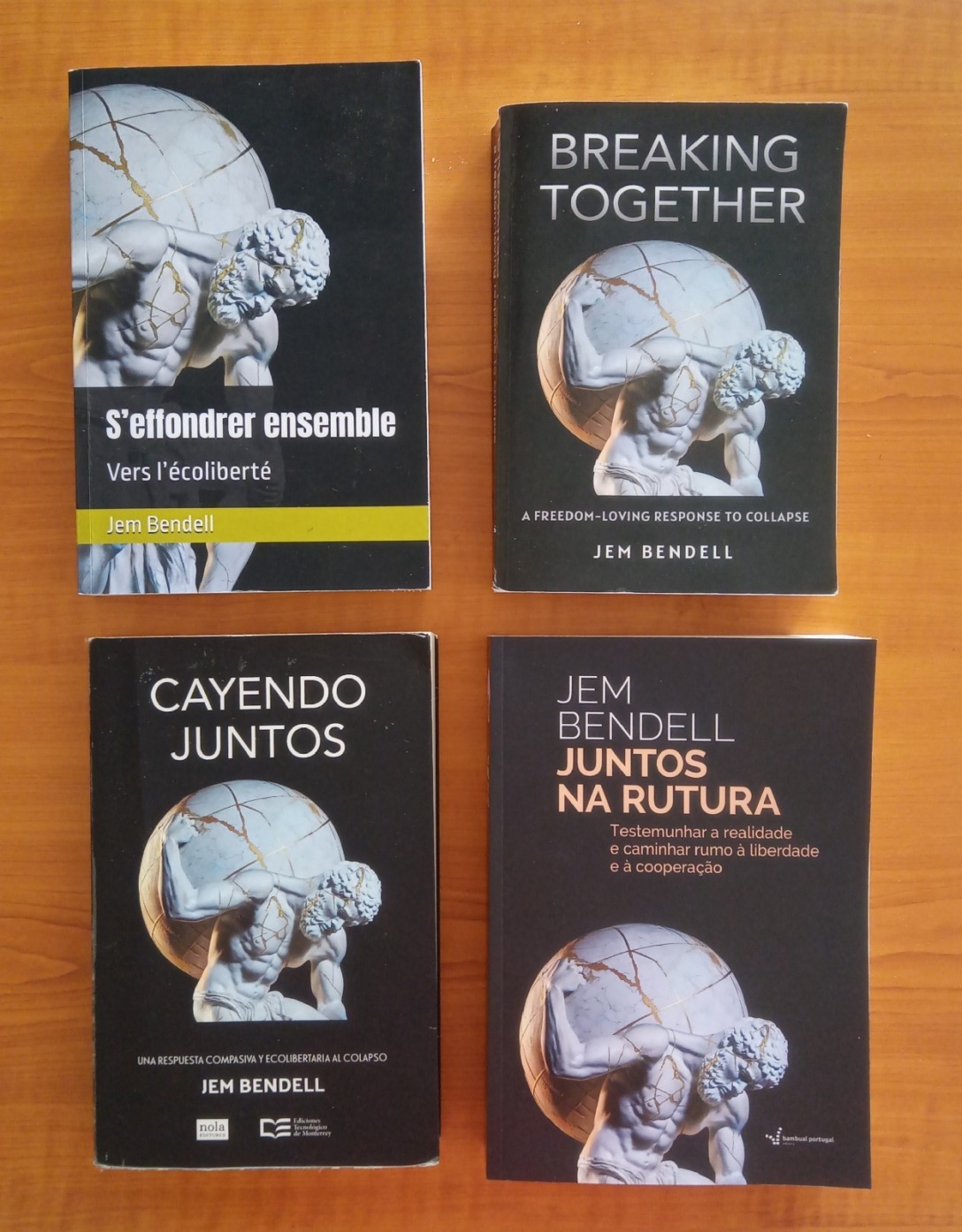
Portuguese is the fifth language that my book Breaking Together is available in. Many at the launch in Lisbon last month travelled from the countryside where they are working on community resilience. For them, the book Juntos Na Rutura provides a useful explanation to others about why they are promoting community economics. One of the interviews around the launch was with the Portuguese degrowth network, which is available on video.

After that inspirational boost, my next speech was to a more general audience in the UK, and I discovered how my analysis on the causes and implications of societal collapse can be easily misconstrued.  Therefore, I wrote a summary of the foundational concepts in my work, including concepts like Deep Adaptation, the Metacrisis, the Great Reclamation and Ecolibertarianism, to appear here on my homepage. In addition, I worked with a colleague to prepare a summary of some ideas in each chapter of Breaking Together, which I publish below.  

Continue reading “Summary of Breaking Together”

Centering Citizen Ownership: Britain is not for sale and Palestine is not for stealing.

The transcript of a speech delivered in Stroud, UK on 13th Sept 2025, by Professor Jem Bendell.

“Britain’s not for sale and Palestine’s not for stealing – defending and restoring citizenship ownership in the face of collapse.”

I am pleased to be back in ‘The People’s Republic of Stroud’. I first saw that phrase in the background of a talk entitled ‘heading for extinction’ by Gail Bradbrook back in 2018. People in the town of Stroud played a key role in the formation and growth of Extinction Rebellion, which sparked a new wave of environmentalism, bringing wider attention to the climate crisis. I mention that today, as I’m interested in connections between more commonly-owned assets, on the one hand, and a political voice on the other. Only with both of those do we increase the chances of coping better with a creeping collapse of the systems and opportunities we once had.

Today is unusual for me, as I am going to talk about politics. I have never given a speech before that is explicitly about politics. In the first half of 2017, I worked in front line politics with Jeremy Corbyn and his team. I advised on strategic communication, co-wrote speeches, and some of the manifesto. I went on to train some of the current backroom staff for PM Keir Starmer, including Morgan McSweeney. But I have never given a political speech myself. I feel now is the time to do that, because of what’s happening in Britain right now.

Continue reading “Centering Citizen Ownership: Britain is not for sale and Palestine is not for stealing.”

Critical Collapsology & the Future of the Left – info ahead of the Metacrisis Meeting

Richard Hames of Novara Media and his colleague Beau-Caprice Vetch, recently wrote an essay on what they call ‘critical collapsology’ to help stimulate collapse-aware innovation on the left of the political spectrum. They write:

“The question is not “when is it appropriate to lose hope once and for all?” But, instead, when are we required to give up on the specific forms of animating hope that structured much of 19th and 20th century left[wing] thought?”

You can read their full essay here. I asked AI for an 800-word summary, including a final paragraph assessing any resonance with the ecolibertarian ideas in my book Breaking Together. It follows below. 

Continue reading “Critical Collapsology & the Future of the Left – info ahead of the Metacrisis Meeting”

Let’s Turn the Tide on Surveillance – starting with radio biometrics

Do you ever feel a quietly gnawing discomfort at the direction technology is taking us? Not just a concern about screen addiction or misinformation, but a deeper unease: that a world is being built in which our presence, thoughts, and behaviours are constantly detected, catalogued and analysed, often without us even knowing? Perhaps it’s the sense that the tools of surveillance, often accepted for personal convenience or public security, are being normalized in all aspects of our lives. Perhaps it feels like a tide: as if an inevitable force of nature, rather than a set of human choices. 

I have known that feeling of uneasy resignation for some years. But recently I came across a new study which snapped me out of that torpor. Suddenly I wanted to be clearer on what I think is unacceptable, what should be resisted, and to identify some small steps to take. Consequently, I realise this issue of technosurveillance should be firmly on the political agendas of any serious political party or individual politician. So I want to share with you some ideas on that and why it matters within my particular niche of the environment, metacrisis, and societal collapse. 

Continue reading “Let’s Turn the Tide on Surveillance – starting with radio biometrics”

Systems are Breaking – and That’s Our Opportunity

A few months ago, I reconnected with a friend who I had worked with in initiative on ‘the sharing economy’. At the time, we were both ‘Young Global Leaders’ (YGLs) with the World Economic Forum. It was 2013, and we had volunteered our time to bring attention to how new technologies could be used to help everyone have a good life with less ecological impact. Personally, we were imagining a future of peer-to-peer resource sharing, community-based production, and cooperative ownership. Meeting up after years, we laughed that our work had oddly contributed to the World Economic Forum publishing the line that became infamous as a globalist’s dystopian injunction: “You will own nothing and be happy.”

Although we laughed, it was with a sense of ‘doomer humour’. My friend’s tone had shifted from a decade ago. She felt disappointment and defeat. “All we did,” she told me, “was write a love letter to the next wave of monopolists.” Her disillusionment was not unique. Many working in alternative economics—whether cooperatives, commons networks, or solidarity enterprises—feel similarly deflated. Despite huge efforts to get governments around the world to adopt policies to promote the ‘Social and Solidarity Economy’, the tide has been in the opposite direction. Monopoly capitalism has grown stronger, tightening its grip through unrestrained mergers and acquisitions, extractive digital platforms, and ‘techbro’ political interference. Now the big tech companies don’t compete in a free market, as they own the markets and can operate similarly to feudal lords. It’s why the Greek economist Yanis Varoufakis labels this era ‘technofeudalism’.

It’s easy to feel like we failed. But that pain—of giving so much for so little change—is not a reflection of personal failure. It’s a sign of deeper structural shifts….

You can read more of this article that I wrote for Shareable, on the new, yet old, agenda for the Social and Solidarity Economy, or join myself and like minds discussing this during a ‘metacrisis meeting.

Join the Metacrisis Meetings initiative to chat with like-minded folks…

We meet once a month (and soon, more often than that)

Here’s how we get serious about the awful monetary system

I have been hearing more of my environmentalist friends mention that the monetary and banking systems are driving a metacrisis, where nearly everything is getting worse, nearly everywhere. Like me, they have come to realise that by incentivising endless commodification, debt, and growth, an expansionist monetary system is at the root of so much of what’s going wrong. But most of them are at a loss for what to do about it. Why? Because it’s big, vague, and hard to understand. In my case, it took years of study to feel that I could speak clearly on the subject – finally taking to the TEDx stage in 2011. In the years since then, I met many environmentalists who were so overwhelmed by the topic that they went back to what was familiar to them: fighting plastics, pushing for stricter deforestation laws, or calling for lower carbon footprints. All are important. But if we ignore the expansionist monetary system that drives such harms, amongst others, our situation will only get worse. That’s why it is important that more of us do the ‘hard yards’ in learning about the nature of current monetary systems, what the alternatives are, and how to enable them. That is important, whatever our current assessment on the pace of societal disruption and collapse; although a breaking of old systems can create space for the alternatives. 

The mainstream still needs to wake up to money 

Today, when I look at leading green groups like WWF, Greenpeace, Friends of the Earth, I see that they are still focusing on what we did 20 years ago when I was head of the ‘markets and economic governance’ team at WWF-UK. For instance, they continue to criticise bank loans to oil or mining companies, but rarely mention how money itself is created

Continue reading “Here’s how we get serious about the awful monetary system”

Subcultures of collapse – will there be a convergence?

A couple of years ago, Richard Hames interviewed me for Novara Media on the topic of whether we might see a solidarity-based politics of collapse. That’s what I encouraged in Breaking Together, by presenting my particular philosophy for these times. Richard is unusual amongst journalists on the left of politics for taking societal collapse risk and readiness seriously. He writes a blog on a topic he calls ‘critical collapsology’. His latest piece explores seven subcultures on collapse and suggests there could be a convergence over time. That hypothesis raises some interesting questions, and so I’m sharing about it here, in advance of a webinar in a couple of months (part of a new ‘Metacrisis Meetings’ initiative).

Continue reading “Subcultures of collapse – will there be a convergence?”