“I wanted to punch the guy, but when I realised I couldn’t do that, I just switched off.”
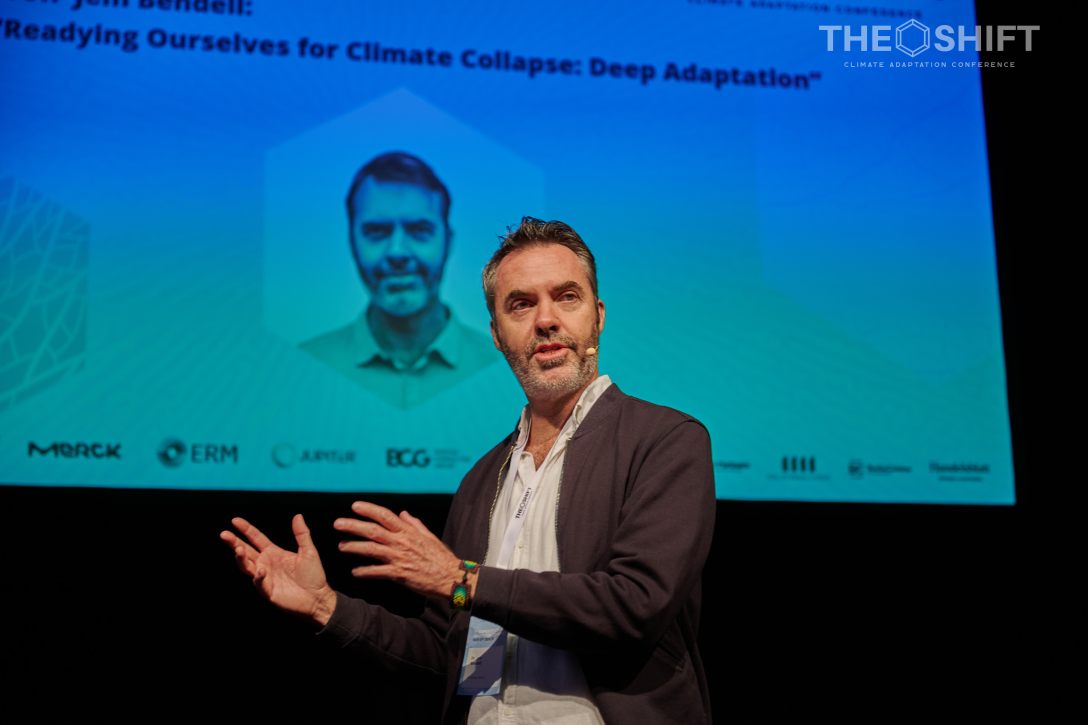
This was certainly a new kind of response to giving a speech. I’d just left the stage at a conference on adaptation to climate change, and was surrounded by people wanting to exchange a few words and contact details. “You really stimulated the audience, as we hoped you would,” one of the organisers said, smiling as he told me of the guy who liked my views so much that he wanted me to connect with his knuckles.
I’d already heard enthusiastic praise from another organiser, so I reacted to the negative feedback in dismissive fashion. “Anger is a way of responding to difficult information, situations and emotions. It gets us out of fear,” is more or less what I said. I continued with my mini lecture by saying “Fight or freeze are two normal responses to fear. It’s why I talked about the benefit of getting better with allowing, witnessing and working through difficult emotions. It’s also why we must recognise so much of our conversation in professional circles is to avoid conflict and emotional difficulty, using convenient narratives, that stop us from facing reality.” This all tripped off my tongue because being intellectual and slightly combative is my go-to response when under threat. However, I’m writing this essay because I was on the cusp of noticing that go-to response, and chose a different way to engage when experiencing conflict. If you also navigate strong emotions about the state of our world, I hope the following thoughts may be of use.
Although I resigned my academic position to increasingly focus on local resilience efforts in the country I have now emigrated to, Indonesia, during 2024 I will continue to share thoughts on collapse risk, readiness and response. I will do that in four ways – essay writing, podcast interviews, public lectures, and short courses. As long as world systems hold together until March 2025, and I stay fit and well (!!), then I will be speaking and teaching in Australia, Belgium, Hungary, Mexico, Switzerland, Germany, UK and the USA. In Belgium in March, I will be joined by Satish Kumar and Pablo Servigne. In April in Budapest I will be celebrating 5 years of the Deep Adaptation movement in the country with the largest national group.
My keynote talk Mexico in October will mark the launch of the Spanish language version of Breaking Together. Then I will head to Oakland (California) that month to teach. In November I will present at some international NGOs and the United Nations, in Geneva, which will also include the launch the French version of the book, before I head to Berlin to present there. I will conclude my book tour in Brazil in early 2025, to launch the Portuguese translation of the book.
Aside from events in those locations, I will teach an online course “Leading Through Collapse” twice a year, scheduled to be suitable for any time zone. Any income from these activities already has a destination… the regenerative farming school I’m co-developing here in Bali.
My aim with these events around the world is to support people who are bringing collapse-awareness to their professions and public, in different regions and languages. This is the first international tour I am doing for 7 years, and I don’t intend to do another for many years, if ever. Therefore, I don’t feel guilty about the flying involved, as, like me, I still encourage people to fly less and fly effectively i.e. we should think about what we are trying to accomplish. Of course, that is how we can reflect on why we do anything that has an impact on the environment. Having a better reason to travel than the largest polluter in the world, which is the US military (not including proxy wars), probably isn’t a high enough bar to set for ourselves, although puts things in perspective 😉
If you would like to receive information on my events or courses in one of the countries I just mentioned, then please sign up to the relevant notification list below.
Donate to keep Jem writing / Read his book Breaking Together / Read Jem’s key ideas on collapse / Subscribe to this blog / Study with Jem / Browse his latest posts / Read the Scholars’ Warning / Visit the Deep Adaptation Forum / Receive Jem’s Biannual Bulletin / Receive the Deep Adaptation Review / Watch some of Jem’s talks / Find Emotional Support / Jem’s actual views on Covid
In December 2020 over 600 academics signed an international Scholars’ Warning on societal disruption and collapse. It led to the formation of an initiative to help more scholars to engage publicly about their views on collapse risk, readiness and response. This is a quick summary of what has happened and what is in the pipeline.
The second public Scholars’ Warning letter appeared in the Independent Newspaper at the close of COP26 and was written about in a number of articles. It also appeared in French newspapers. Over 200 scholars responded within the 24 hours to sign and help the sense-making of journalists and others as the summit closed. If you agree with the sentiment of this latest letter, please share this video of some of the signatories reading it.
By registering their support for a more radical agenda on our climate predicament, including the need to discuss collapse risk, readiness and response, now journalists can find these scholars and bring these ideas to wider attention. One example is an ‘Inside Climate News’ article that interviewed a number of signatories.
This is the 5th in a 7-part essay on the type of policy innovations that would respond to the truth of the environmental predicament and, also, why most environmental professionals ignore such ideas to promote limited and limiting ideas instead. These ideas on a #RealGreenRevolution provide a contrast to current agendas, with the aim of encouraging a global environmental movement as a rights-based political force. In this part of the essay, I focus on financing initiatives, geoengineering (climate restoration and repair), reparations and ecocide, migrating ecosystems, nuclear power and the difficult reality of systemic work on climate adaptation – nothing much to argue about then 😉
To receive each part of the essay, subscribe to my blog, using the box on the right (or right at the bottom of this post). To engage with other people who are responding to these ideas, either engage on the Deep Adaptation Leadership group on LinkedIn (where I will check in) or the Deep Adaptation group on Facebook, or by following the hashtag #RealGreenRevolution on twitter. A list of previous parts of this essay is available.
Over the past decades many pledges to fund climate action and other international causes, such as poverty reduction, have remained unfulfilled. Even though the pledged amounts fall short of what is required, and are peanuts compared to the bailouts for banks or spending on the military, nevertheless they are retracted when governments seek to cut expenditures on what they consider non-essential. The climate predicament is a shared global concern and therefore efforts on the whole #ClimatePlus agenda need a new global financing system. No longer must we rely on existing government budgets or the benevolence of richer nations and their future politicians. Therefore we need serious consideration of new forms of international seigniorage of monetary instruments.
“Grieve Play Love” is a 9 minute short film by Jem Bendell, set in Bali, released in March 2019.
The text of the voiceover follows below. A message from the filmmaker:
“In early 2018, my life changed. I studied climate science again for the first time in 25 years and discovered how bad it is. My estimation is that our complex consumer industrial societies won’t cope with the new pace of weather disruption to our agriculture. I published a paper on my conclusion, inviting deep adaptation to our climate tragedy, and was swamped with the response. Many people were and are, like me, traumatised by this realisation of a future societal collapse. I made this film for them. If that is where you are at, I hope it helps.
I made it where I was living at the time, in Indonesia, and drew on the beauty of nature and culture that still exists on this wonderful planet. You’ll see it’s a long way from a protest, political meeting or boardroom. But I hope the beauty in the film affirms once again what it is we love and stand for. How we live fully without pushing away difficult emotions triggered by awareness of our climate tragedy is going to have as many answers as there are people coming to this awareness. To help your own journey, I recommend connecting with others on this agenda at www.deepadaptation.info”
“All great and beautiful work has come of first gazing without shrinking into darkness” John Ruskin
Voiceover:
After we accept the full tragedy of climate change, what do we have left?
Most people I meet sense that life is meaningful. Belief in a future is one way we look for such meaning. A future for ourselves and our family, our community, country, and the planet.
It is why it is so difficult to accept where we are today. What future can we believe in now? And if that isn’t possible, where can we find meaning?
I left my job as a Professor and came to Bali to sink in to those questions.
And to grieve.
I grieved for my years lost to compromise. I grieved the loss of my identity. I grieved how I may not grow old. I grieved for those closest to me, and the fear and pain they may feel as things break down. I grieve for all humanity, and especially the young.
Within this despair, something else happened. My long-held defences began to melt away. I was opening-up.
Not everyone can leave to heal in a place this. But I want to tell you my story because so many of us now grieve over climate change.
Most Balinese seem so at ease with their life. In the temples in every household, children play at the symbolic graves of their grandparents. That’s not like our modern societies where we seem to hide death away. Could feeling the impermanence of everything be an invitation to experience life more fully?
I was drawn to connect more to myself, others and nature.
Breathwork, dance, fasting, improv theatre, chanting, circling and guided meditations.
I was opening to beauty and spontaneity. To connect without expectation. To create without certainty. And to welcome what’s transcendent into my life. I see that love can be the anchor during waves of anxiety, sadness and grief.
I was reminded of how my friend with terminal cancer experiences more gratitude and wonder. And how our last meeting was more beautiful due to the ending ahead. Awareness of the finite amount of time we all have on this Earth gives more power to the choices we make.
Your own path for grieving an environmental and social breakdown may not be like mine. But there is a path and it leads beyond despair.
So what of our future?
My vision is of a world where more of us are open to curious, kind and joyful connection with all life. My hope is we will discuss ideas without a want to prove ourselves right.
Because there will be tough decisions ahead. We can make universal love our compass as we enter an entirely new physical and psychological terrain.
And so, I was ready to re-engage with my profession, but with a faith to express my truth, however difficult. Opening a conference at the United Nations, there was really only one thing for me to say.
“We now know that many self-reinforcing feedbacks have begun to further warm the planet, threatening to take the future out of our hands. So if we don’t wake up from our delusions of what is pragmatic and appropriate, then shame on us.”
“…our intention for creating things needs, more often, to arise out of our love for humanity and creation…. The technology we seek is love.”
Feeling our pain at the ongoing destruction of life, we may find relief in the idea of a divine force beyond this time and place. But if doing so, let’s not withdraw from our fellow humanity. Climate chaos invites our loving immersion with life as we find it. We can rise into, not above, these times.
Alan Watts:
“The Earth is not a big rock, infested with living organisms, any more than your skeleton is bones infested with cells. The Earth is geological, yes, but this geological entity grows people. And so the existence of people is symptomatic of the kind of universe we live in.”
We may grieve the loss of life, and feel despair or anger at how this happened. But whenever it comes, human extinction will not be the end of consciousness or the cosmic story.
There is no way to escape despair. But there is a way through despair. It is to love love more than we fear death. So ours is not a time to curl up or turn away. It’s a time to dance like we’ve never danced before.
Before loss there was love.
After loss, love.
Before grief there was love.
After grief, love.
Our essence is never in danger.
When all else falls away,
Our essence can shine.
So, what does love invite of us now?
Grieve, Play, Love was co-directed by Jem and Joey. It was filmed, edited and sound engineered by Joey. It was written, voiced and produced by Jem. Jem and Joey met at http://www.connectionplayground.org
What with so much going on in the world to tire our eyeballs and adrenal glands, I’ll keep this Quarterly short. Please read on if you are interested in…
– getting to the root of the malaise in the world, that’s found in our monetary systems
– what environmentalists should do as we realise we won’t beat climate change, or
– some of the latest ideas on meaningful leadership in disturbing times
Otherwise, just delete, walk away from your device, breathe deeply, look at the wind swaying in the branches of the trees, and marvel at the wonder of being alive despite all the troubling stuff going on.
Still here? OK…
Money. It’s the root of all evil. Or rather, the way it’s issued. Things are changing fast, sometimes aggressively, as with demonetisation in India. What happens with money will shape the future of humanity. If there’s one free course you do this year it should be ours, starting Feb 19. Sign up here. Once you have done that course you can join us for our free Money and Society Summit in London in April. You will meet awesome people and be gently inducted into the global network of people who have had the veil taken from their eyes.
The summit is part of my University’s celebration of our 10th anniversary, where IFLAS is doing 10 free events. It will be the 2nd summit we have done, the first was in Bali (someone’s gotta). The video of the super speech my MOOC co-author Matthew is here.
You can also get qualified in this field with the Sustainable Exchange certificate course in London, for 5 days from April 19th. You can attend that for 600GBP without enrolling in the University (here). Or you can enrol, do assignments, and receive University credits of 20 points at Masters level, for 795GBP GBP for UK or EU students, and 1167GBP for others (here)
OK, enough sales talk. In November I had the privilege of giving a keynote speech to a group of climate scholars. It was a bit scary as I decided to talk about climate change as a tragedy, not challenge, and what that means for our future work. My background notes on the talk are here. Things are bad. I don’t hold back. I will post this link on our Sustainable Leaders Linked In group, so it would be good to hear your thoughts on the issues raised, over on that thread.
So what does meaningful leadership look like in disturbing times? I discussed this with consultant Mark Drewell in that enclave of contrarian cultural creatives who still drink great coffee and homebrews. The town of Totnes. He has had some “fun” chats with police about the coming collapse. As a paid speaker, not arrestee. We recorded it on Facebook Live, so you can see the recording here. That followed my first three attempts at IFLAS live conversations. Lynne Franks, is the PR and womens leadership guru, also known for inspiring the TV show Absolutely Fabulous. We discussed a bunch of things which we labelled “Eat, Pray, Lead” because we were so pleased with ourselves for catching up in Ubud. I also discuss with long term Bali resident Stephen, who is a world expert on complementary currencies. We discussed why development NGOs and donors aren’t very good at backing such innovations, so what next. I then caught up with fellow “Young Global Leader” Toshi, who founded and runs a dynamic NGO bringing eco tech to rural poor communities around the world. We discussed leadership. You can hear him here and feel useless by comparison. Or inspired. Yep, let’s try inspired.
Leadership is a theme that my university works on in various sectors, such as health and education, so we summarised our research and outputs in 2016 here.
If you want to work in developing leaders then the best course you can do for that is, obviously, an MA with me, at IFLAS, and it happens to be less than 8,000 pounds, and can be done with just 4 week-long visits to the UK. The feeder courses have got rave reviews, with people becoming new colleagues as a result (“best educational experience ever” said one senior manager of an environmental group). If interested, then the course info is here, and please contact me after looking at it.
Our MBAs are also focused on leadership and we launched our alumni network for them recently, bringing together hundreds of our executive students from around the world. We encourage ongoing reflective practice, and so I shared some thoughts on the books I read during 2016, and invited the alumni to do the same. My thoughts on those books are here. I recommend doing it as a gratifying exercise as well as a learning one.
London, April 22, Money and Society Summit, University of Cumbria London Campus, chairing and facilitating. Info here.
Barcelona, May 10-14, Complementary and Community Currency Summit, two papers plus co-facilitating PhD student workshop. Info here.
Lancaster, July 18, Critical Perspectives on Leadership, University of Cumbria. Limited external participation. Request attendance via pete.boyd@cumbria.ac.uk
Brussels, October 12-15, multiple panel presentations at the International Leadership Association conference, on Leadership in Turbulent Times. Info here.



You must be logged in to post a comment.