Although I’ve been immersed for years in the news and scholarship on the unsustainability of modern societies, it is difficult to keep all of that information at the forefront of my mind. Not only is it a ‘heavy’ topic, it uses a specific part of my mind, and perhaps my body and soul, to critique, synthesise and communicate on such issues. So after doing a dozen podcasts and talks since my book came out, I paused to make more time to develop my organic farm school and play music. I’ve also been enjoying teaching again, both online (join me?!) and in person (including the Bay Area in October). Looking back at the various interviews, I think the first one I did to mark the launch of Breaking Together is the one to watch. Dave Derby of Lowimpact invited a focus on what is most at fault for driving the collapse, as a starting point for discussing what we can do to soften the crash – for ourselves and others. That meant we explored the role of an expansionist monetary system, and alternatives to ‘green’ authoritarian panic as the science darkens and societies are disrupted. You can watch us discuss that here. But as many people prefer to read, I’ve checked the transcripts and compiled them into one document in this blog post.
Although there are many potential benefits from accepting societal collapse, there is nothing inherently beneficial about being right about one’s expectations of catastrophic change. Having held more accurate assessments than the majority doesn’t reduce the pain about what’s happening or what’s to come. It doesn’t compensate for the alienation experienced with those who would not see, or even condemned our clarity. It doesn’t compensate for the pain of witnessing the lost opportunities for people to process this reality for themselves. If there is any benefit in being right, it comes from how we acted with our awareness until now. Has it influenced us to do more of what we consider wholesome, and less of what we consider unwholesome? Has it meant we have tried to develop our capabilities for coping better as life becomes more difficult? Perhaps, also, to help others develop their own capabilities? You know the basics – mindfulness, letting go of old habits and expectations, and having a way to make sense of life in an era of collapse. For some of us, we can experience a liberation from past compromises and the permission to ‘go wild’. Without evolving ourselves in such ways, then feeling we were right could generate a further alienation, through a pointless sense of superiority. And what we definitely don’t want is to be isolated in our pain as things unfold, in the same way many of us have been isolated in our anticipation. So, when our outlook is confirmed by current observation, it is a time to assess whether we have made good use of our knowledge. Then, if not sure, to commit to try again.
“But the world’s climate was as hot as this in the past.”
Do you hear this a lot? I do. The obvious answer is “sure, it was especially hot when our planet was just a chunk of molten rock spun out from the Sun. But back in terra logica, the main issue for ecosystems and agriculture is the SPEED of climate change.”
The problem with this issue of the speed of change is that consensus in climate science moves very slowly. The more funding that went into climate science, the greater was the amount of research and people to find consensus amongst. That meant the key signals, like the 2017 paper predicting 1.5C by 2025, went largely unnoticed by institutional climatology – and was certainly not acted upon.[1]
In a 2021 chapter with Dr. Rupert Read and a top German climatologist, who chose to remain anonymous, we explained the limitations of mainstream climatology for telling us the real situation. We pointed to how, in fast moving crises with high hazards, there needs to be an ability to identify salient information rapidly. This even has a name: post-normal science.[2]
Last month, I spoke with the participants in a course hosted by the American cultural commentator Daniel Pinchbeck. The course was all about regenerative attitudes and initiatives. Before a Q&A, I was asked to share four key ideas that would be relevant to the lives of the participants. As I’ve talked about it so much already, I decided to skip the evidence basis for taking societal collapse seriously, and spoke about the changes I am seeing in myself and others, and how that might inspire them. The four things can be summarised as:
The weak but well-funded arguments for techno-optimism in the face of climate chaos have kept on coming. The latest were a series of articles in mainstream press about a book that claims renewable energy will sustain societies while stabilising the global climate. Brazilian researcher Claudia Gasparovic, offered a rapid debunking of the book’s arguments, in a post on LinkedIn. Similar arguments were put to the book’s author by journalist Rachel Donald for Mongabay. The weakness of techno-optimism on climate change was something I explored in my book Breaking Together. If you read Chapter 3, you will know that the idea modern societies can maintain current consumption patterns by switching to entirely renewable energy is one founded upon blindness to material dimensions of energy generation and storage. If you read Chapter 4, you will know that energy and carbon dioxide are two issues within a far broader problem of the ecological overshoot by modern societies. If you read Chapter 5, you will know that the momentum of change in our oceans and atmosphere, coupled with the dramatic loss of cooling aerosols and cloud-seeding forest cover, means we are already within a scary situation with climate.
We have launched our request for financial support for Bekandze Farm School, in Indonesia, to help small holders switch to organic and resilient farming methods.
If you have read my book Breaking Together, or simply seen the recent science and news on the environment, then you know we have entered an era of increasing disruption. Like many people, I want to respond in ways that reduce harm and create possibility. That is the aim of this new farm school in Indonesia. Already, we are helping more local farmers switch to organic and resilient forms of agriculture, as a basis for re-localising and regenerating the rural economy. But to establish ourselves as a viable training centre, with a lasting impact locally, and to communicate that globally, we need your help.
There was an interesting interview with Gavin Schmidt recently. He is one of the most senior climatologists in the world, heading up NASA’s department on climate science. Refreshingly, unlike the other senior climatologists, he didn’t sidestep how recent weather was not predicted by mainstream climatology. He told the American science celebrity Neil deGrasse Tyson that climatology significantly underpredicted current warming. He said there was “total failure” to predict what happened in 2023. See for yourself, for 3 minutes from 4 minutes in.
Gavin is one of the more approachable of the senior climatologists. He provided specific written criticisms of my 2018 Deep Adaptation paper. That was in stark contrast to others who misrepresented it, and me, so as to discourage people from considering that the party is over for modern societies.
As I type these words on January 25th 2024, we are breaking another all-time temperature record here in Bali. It is 32C degrees in the Ubud area, above the previous record of 31C for this day in history. The average maximum was once below 30C (see the image above). So when does such unusual weather indicate a new climate regime, rather than just a few unusually hot days? That should be a matter of scientific analysis, not ideological posturing. If we are analytical, the answer depends on the data on long-term trends and the possible reasons for such trends. As I have recently become an organic farmer, this information is even more important to ascertain, because it influences what and when to plant, as well as how much protection from water and temperature stress we should invest in. So I am going to share with you what I found out about Bali’s weather, and what this means for those of us who live in this region. I also think it has implications for people everywhere, so wherever you are, please read on…
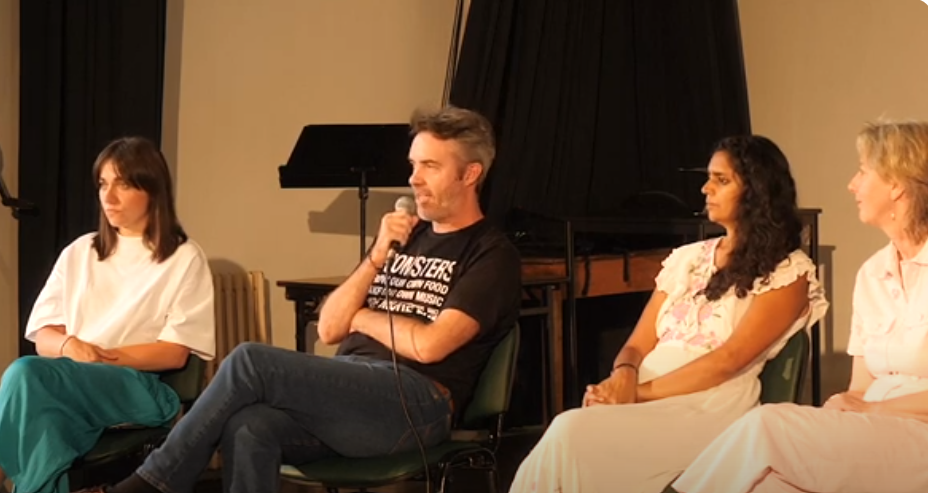
A new video is out, where concerns about climate change being a hoax designed to control the public were addressed by a panel of environmentalists. The event occurred in the English town of Glastonbury, which hosted a number of discussions on this topic in 2023. One trigger for this focus was probably a speech at a council meeting by the campaigner Sandy Adams back in March. She argued against the “15 minute city” agenda, with claims that ‘climate change’ is a hoax to excuse draconian controls on our lives. The freedom she was talking about was the driving of cars, rather than walking, cycling or bussing around. As people can cycle across Glastonbury in less than 15 minutes, and the local government had no proposals on ‘15 minute cities,’ the councillors of this small town were somewhat perplexed by Ms Adams. Nevertheless, the video of her speech went viral, with the claim that resistance works! It appears that targeting non-existent proposals is the ‘secret sauce’ for this kind of instantly gratifying campaigning.
Many local residents of Glastonbury had other ideas. A group of them decided to host a conference on the more troubling news about climate change – what to do if we can’t stop it disrupting our communities through direct and indirect impacts. During a hot afternoon in June, a panel took questions from the audience. Reflecting the arguments promoted by Sandy Adams’ viral video, the first question was about whether the mainstream narrative on climate is incorrect – and being used to control us. The Green Party Mayor of Glastonbury, a co-founder of Extinction Rebellion, two podcast hosts and myself, a Professor in the field of sustainability, offered our reflections on this issue. You can see the discussion, alongside a range of other topics, in a video of the Q&A, below.
The residents invited discussion of a wide range of topics, arising from a workshop that used the updated Deep Adaptation framework. That includes a 5th R on the ‘reclamation’ of our power in the face of societal disruption and collapse. Rachel Donald (Planet Critical) spoke of reclaiming the power of contribution by leaving behind security to build a community. Amisha Ghadiali (All That We Are) spoke of reclaiming beauty as divine, not trapped in a sanitised aesthetic. Gail Bradbrook (Extinction Rebellion) spoke of reclaiming pride in one’s own psychological patterns and capabilities. Indra Donfrancesco (Mayor of Glastonbury) spoke of reclaiming her town for positive environmental actions rather than just protests. I spoke of my personal reclaiming of my ‘OK-ness’ with aiming small, despite my cultural conditioning to strive to succeed at scale.
Discussions ranged from caring for loved ones to whether localisation needs a complementary effort at international political influence. It demonstrated what a wide, compassionate and creative agenda can emerge from accepting the gravity of our ecological crisis. However, I also welcomed a couple of questions about whether the UN, IPCC and others might be hoaxing us on climate. That’s because I am part of a growing movement of freedom-loving environmentalists, who object to the corporate capture of the climate agenda. As one questioner alluded to, during the early years of the pandemic, we were poorly served by an old guard of green leaders and commentators, who kowtowed to the big corporate agendas that were masquerading as sensible policies on public health. Unfortunately, that lack of green leadership means the ‘medical freedom movement’ has become an easy target for infiltration by the oil lobby, who are sowing doubt about our changing climate. As I argue in Breaking Together, just because some globalists have bad ideas about responding to a climate crisis which they helped to create, doesn’t mean there isn’t a major problem for us to address with urgency.
Whether we are interested in freedom or the environment, or both, we can help each other escape the false narratives coming from corporate influence on those issues. The false narratives can be appealing, as they distract from the painful reality of a global and uncontrollable ecological disaster. However, time will demonstrate both the extent of the ecological predicament, and the futility of those responses favoured by corporate elites. I believe the sooner people move beyond distractions to explore how they wish to live in this era of societal disruption and collapse, the better it will be for themselves, others and wider nature.
Donate to keep Jem writing / Read his book Breaking Together / Ask JemBot a question / Read Jem’s key ideas on collapse / Subscribe to this blog / Study with Jem / Browse his latest posts / Read the Scholars’ Warning / Visit the Deep Adaptation Forum / Receive Jem’s Biannual Bulletin / Receive the Deep Adaptation Review / Watch some of Jem’s talks / Find Emotional Support / Jem’s actual views on Covid
Receive announcements of my talks and courses in 2024:
The chatbots that use artificial intelligence (AI) are changing the way some people research and write. I have not yet used a chatbot to help me write any of my scholarly texts, which is probably why I remain rather verbose! The tech took off too late to affect my research process for Breaking Together, although I squeezed in a quote from a dialogue on freedom that my colleague Matthew had with ChatGPT. But there is an interesting new way that such chatbots can be used – as interfaces with specific publications, or collections of works. For instance, ChatPDF has been launched so people can interrogate academic articles with a chatbot. Some publishers are now looking at providing chatbot interfaces to some of their books. So when I heard that the awesome nonprofit Servicespace.org is helping to create chatbots for some authors, I decided to create one for people to engage with my new book. Consequently, JemBot was ‘born’.
News of JemBot within the Deep Adaptation Facebook group generated a range of reactions. Some people see AI as the latest creation of a doomed techno-obsessed culture. Some see it as endangering societal systems. They might be right, but that doesn’t mean we don’t deploy it for straightforward and positive reasons. As with all technology, the key issue is ownership, intention, use and governance.










You must be logged in to post a comment.