Let’s Turn the Tide on Surveillance – starting with radio biometrics

Do you ever feel a quietly gnawing discomfort at the direction technology is taking us? Not just a concern about screen addiction or misinformation, but a deeper unease: that a world is being built in which our presence, thoughts, and behaviours are constantly detected, catalogued and analysed, often without us even knowing? Perhaps it’s the sense that the tools of surveillance, often accepted for personal convenience or public security, are being normalized in all aspects of our lives. Perhaps it feels like a tide: as if an inevitable force of nature, rather than a set of human choices. 

I have known that feeling of uneasy resignation for some years. But recently I came across a new study which snapped me out of that torpor. Suddenly I wanted to be clearer on what I think is unacceptable, what should be resisted, and to identify some small steps to take. Consequently, I realise this issue of technosurveillance should be firmly on the political agendas of any serious political party or individual politician. So I want to share with you some ideas on that and why it matters within my particular niche of the environment, metacrisis, and societal collapse. 

Continue reading “Let’s Turn the Tide on Surveillance – starting with radio biometrics”

Systems are Breaking – and That’s Our Opportunity

A few months ago, I reconnected with a friend who I had worked with in initiative on ‘the sharing economy’. At the time, we were both ‘Young Global Leaders’ (YGLs) with the World Economic Forum. It was 2013, and we had volunteered our time to bring attention to how new technologies could be used to help everyone have a good life with less ecological impact. Personally, we were imagining a future of peer-to-peer resource sharing, community-based production, and cooperative ownership. Meeting up after years, we laughed that our work had oddly contributed to the World Economic Forum publishing the line that became infamous as a globalist’s dystopian injunction: “You will own nothing and be happy.”

Although we laughed, it was with a sense of ‘doomer humour’. My friend’s tone had shifted from a decade ago. She felt disappointment and defeat. “All we did,” she told me, “was write a love letter to the next wave of monopolists.” Her disillusionment was not unique. Many working in alternative economics—whether cooperatives, commons networks, or solidarity enterprises—feel similarly deflated. Despite huge efforts to get governments around the world to adopt policies to promote the ‘Social and Solidarity Economy’, the tide has been in the opposite direction. Monopoly capitalism has grown stronger, tightening its grip through unrestrained mergers and acquisitions, extractive digital platforms, and ‘techbro’ political interference. Now the big tech companies don’t compete in a free market, as they own the markets and can operate similarly to feudal lords. It’s why the Greek economist Yanis Varoufakis labels this era ‘technofeudalism’.

It’s easy to feel like we failed. But that pain—of giving so much for so little change—is not a reflection of personal failure. It’s a sign of deeper structural shifts….

You can read more of this article that I wrote for Shareable, on the new, yet old, agenda for the Social and Solidarity Economy, or join myself and like minds discussing this during a ‘metacrisis meeting.

Join the Metacrisis Meetings initiative to chat with like-minded folks…

We meet once a month (and soon, more often than that)

On Sociocracy: if we won’t escape patriarchy with new rules on meetings, then how?

I once quit a Men’s Group because the rules about the way we would engage each other seemed to become a shield rather than an enabler of connection and support. The group had been really important in my life for two years. Meeting every Monday, we used some process tools from the Mankind Project (MKP), but were not strict about the format, letting each week’s volunteer facilitator to guide us. We benefitted from many of the participants being skilled in facilitating specific processes that we might want to use to become unstuck with an issue in our lives. But over time, the MKP ideas and processes began to structure all meetings. Once that occurred, I noticed a couple of men participated in a different way. Previously we had been gathering as trusting friends wanting to both help each other and benefit from each other. The processes for our meetings were secondary to that. But now, some men were not expressing a brotherly sensitivity, but rather a desire to know the processes, do them correctly, and that we should all be committed to that. One man said he wasn’t with us to be friends but to do ‘the work’. At that time, I pondered whether to express a ‘withhold’, as they call it in the MKP, and probably dominate the rest of that meeting with exploring and releasing my feelings about his approach. Instead, I guessed that the group had shifted and people wanted more of the processes. I now wonder if that was a mistake. Both myself and the co-founder of the group quit soon after.

Continue reading “On Sociocracy: if we won’t escape patriarchy with new rules on meetings, then how?”

Some help with being fully alive during a metacrisis and collapse

Despite more of the world waking up to disruption and collapse, and even experiencing it, does it still feel lonely at times to live with your understanding of what’s happening? 

There are many strange ways of understanding what’s happening, which serve factional interests and prejudices (something I call ‘collapsis’). 

Then there are people who seem to have adjusted to this upsetting situation by prioritising being nice to their online connections and not getting into difficult activities like resisting oppression or addressing their own impacts in the world. 

But if we feel alienated we won’t be as present to possibility as we could be. And we won’t enjoy the capabilities and blessings that we still have. So, if you want to enjoy being curious, radical and fully engaged in this metacritical era of collapse, I’m inviting you to join a small community of likeminds. 

Continue reading “Some help with being fully alive during a metacrisis and collapse”

Here’s how we get serious about the awful monetary system

I have been hearing more of my environmentalist friends mention that the monetary and banking systems are driving a metacrisis, where nearly everything is getting worse, nearly everywhere. Like me, they have come to realise that by incentivising endless commodification, debt, and growth, an expansionist monetary system is at the root of so much of what’s going wrong. But most of them are at a loss for what to do about it. Why? Because it’s big, vague, and hard to understand. In my case, it took years of study to feel that I could speak clearly on the subject – finally taking to the TEDx stage in 2011. In the years since then, I met many environmentalists who were so overwhelmed by the topic that they went back to what was familiar to them: fighting plastics, pushing for stricter deforestation laws, or calling for lower carbon footprints. All are important. But if we ignore the expansionist monetary system that drives such harms, amongst others, our situation will only get worse. That’s why it is important that more of us do the ‘hard yards’ in learning about the nature of current monetary systems, what the alternatives are, and how to enable them. That is important, whatever our current assessment on the pace of societal disruption and collapse; although a breaking of old systems can create space for the alternatives. 

The mainstream still needs to wake up to money 

Today, when I look at leading green groups like WWF, Greenpeace, Friends of the Earth, I see that they are still focusing on what we did 20 years ago when I was head of the ‘markets and economic governance’ team at WWF-UK. For instance, they continue to criticise bank loans to oil or mining companies, but rarely mention how money itself is created

Continue reading “Here’s how we get serious about the awful monetary system”

What the farmers say

In my experience, it is rare to hear farmers from the Global South discussing their challenges and aspirations, and what might be useful support to receive from successful restaurateurs and resort owners. That’s why I’m delighted to release a short film that brings you the voices of organic and regenerative farmers in dialogue with others in the food business sector in Bali, Indonesia. 

After 2 years of operation as a demonstration farm, school, and event space for organic and regenerative agriculture, at Bekandze Farm we hosted a meeting of organic farmers, distributors, NGOs and food retailers. The participants discussed why organic farming is such a small part of agriculture in Bali, despite the opportunities provided by the environment and the visitor economy. After discussing the challenges, we explored potential solutions for scaling organic farming on the island, and more widely in Indonesia. Achieving that would help all the people on the island, as it would increase their food security by decreasing dependence on agrochemicals. In that sense, organic and regenerative methods of farming are also methods of collapse preparedness, or practical Deep Adaptation. 

Continue reading “What the farmers say”

Subcultures of collapse – will there be a convergence?

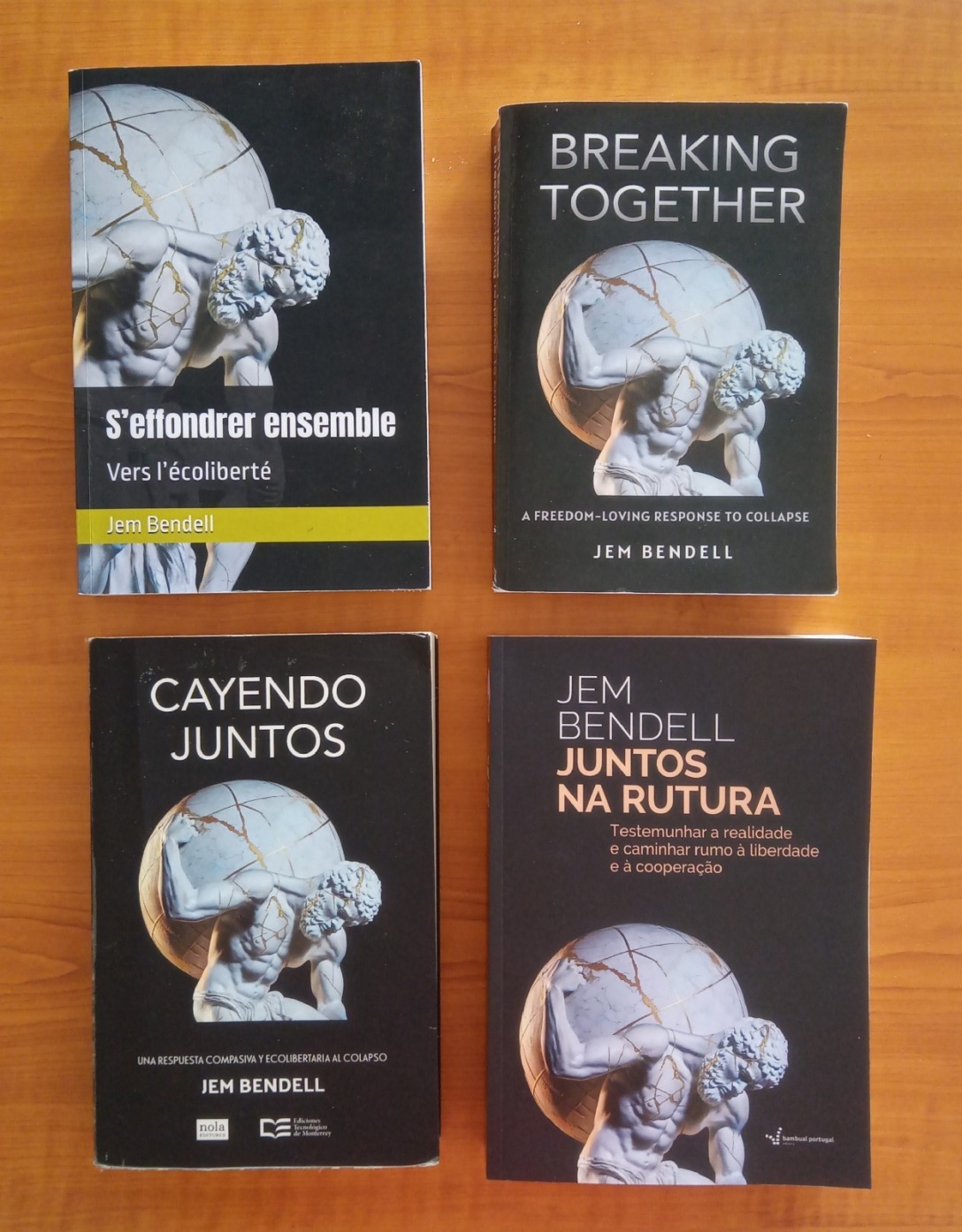
A couple of years ago, Richard Hames interviewed me for Novara Media on the topic of whether we might see a solidarity-based politics of collapse. That’s what I encouraged in Breaking Together, by presenting my particular philosophy for these times. Richard is unusual amongst journalists on the left of politics for taking societal collapse risk and readiness seriously. He writes a blog on a topic he calls ‘critical collapsology’. His latest piece explores seven subcultures on collapse and suggests there could be a convergence over time. That hypothesis raises some interesting questions, and so I’m sharing about it here, in advance of a webinar in a couple of months (part of a new ‘Metacrisis Meetings’ initiative).

Continue reading “Subcultures of collapse – will there be a convergence?”

Why Isn’t Organic the Norm in Bali?

The Ubud Food Festival concluded yesterday here in Bali, Indonesia. I spoke at an event on how to work better with nature to achieve greater food security. I was invited due to my co-founding of an organic farm school, and was pleased to attend as we encourage collaboration amongst restaurants to scale up organic farming. Our crowdfund to help with that is still a few thousand short of the necessary target. In preparation for the event, I drafted some notes on what I’d say. They follow below. If you can support us, please take a moment to contribute. Thx, Jem

It’s a pleasure to be here with you in Ubud — a town that’s become an international symbol of nature-based spirituality, conscious living, and the pursuit of wellness. 

Let me start with a question: How many of you would prefer to eat organic food, that’s food grown without any chemicals? And now — how many of you know that you always eat organic food here in Bali?

Continue reading “Why Isn’t Organic the Norm in Bali?”

The 5Rs of Deep Adaptation

The 5Rs of Deep Adaptation is a framework that I developed to guide the reflections and conversations of individuals, organisations and communities when they aim to reduce suffering as they face, or experience, societal collapse. I developed it after I concluded that we were not talking about our personal concerns and conclusions about collapse because we did not know how to talk about it. That meant conversations were often abruptly ended with phrases like “we can’t conclude that or we will have nothing to work towards.” I thought that when our conversations stopped like that, we were losing the time and opportunity to reduce suffering and save more of society and the natural world. 

Over the years, the framework has helped many of us to talk collapse. Some or all of the 5R framework has been used in many communities around the world, from environmental initiatives to psychotherapy groups, from faith-based groups to activist movements, and from educational institutions to those analysing business futures. There are even academic papers that reflect on the use of the framework in different settings [1]. So in this article I will summarise the framework and then invite the creatives amongst you to share your depictions of the framework graphically. 

Continue reading “The 5Rs of Deep Adaptation”

The Magic of the Metacrisis

The following is a talk I gave to open the 2nd Alumni Gathering for the course ‘Leading Through Collapse.’ After 7 years we ended teaching the course, but invited the 300+ alumni to gather. The talk is available as a video, and transcript. I touch on some issues about how to remain outward in our focus, and the importance of thinking about what terms might help engage people in the transformative opportunities of accepting our predicament. Thx for watching or reading! Jem

Subscribe / Support / Study / Essays

May 9th 2025, from Indonesia

Collapse is undeniably painful, especially for those directly affected, and it’s difficult to witness when it unfolds. However, within this process, there are spaces of possibility that arise when we stop denying the reality of our situation. A collapse of systems, while disorienting, also makes room for transformation.

In our relative privilege, many of us have been shy to speak about any of these upsides to what is otherwise a tragic situation. But I have come to realise that there could be a benefit for others, not just ourselves, if we are more open about those upsides. Because the way we are transformed can make us more open to others, and help people to recognise that there can be positive ways to live in this era of collapse.

Continue reading “The Magic of the Metacrisis”