Some reasonable essays on collapse

In my annual personal update (not the Deep Adaptation Review), I included a summary of the essays I wrote in 2024. I thought it useful also to post these to my blog. I group the essays by topics of: integrating collapse awareness into your working life, the broad trends in Deep Adaptation, the political implications of collapse awareness, making sense of the latest climate data and science, plus personal reflections on motivations in this age of consequences. Next year I will be writing less, as I focus more on the organic farm school (please help!) and music (new single: Aspirations). I hope that both my book and these essays will support your own life choices. For more support, consider joining our online short course. Thx, Jem

Integrating collapse awareness into your working life

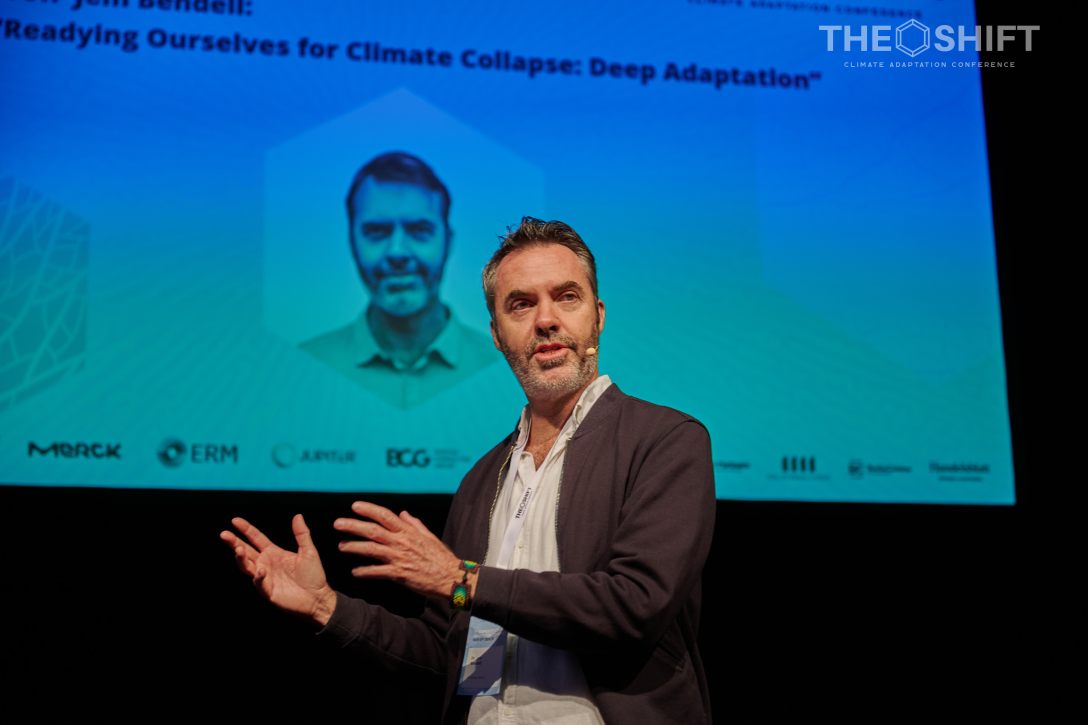
The essay Keeping your job at the end of the world (as we know it) addresses the conundrum facing many people who are questioning everything due to collapse anticipation, but can’t quit their job, for financial or other reasons. Written to coincide with a speech at Griffith Business School, where he was an Adjunct Professor, Jem Bendell discusses ideas rarely, if ever, heard in professional contexts. That is because he not only mentions people who have chosen to “keep serving (reveal and recommit in post)” or “repurpose your job (refocus in post)” but also those who de-prioritise their employer’s interests. This includes “quit quietly (retire in post)” and even to “sabotage non-violently (rebel in post).”

Continue reading “Some reasonable essays on collapse”

Collapse-relevant publications in 2024

The Deep Adaptation Review is an independently produced look back at the year on the topic of collapse readiness. There are a few sections in it, with one of them covering interesting new publications. I want to share with you that part, below. The full review is available here, where you can also subscribe to receive it once a year. Thx, Jem

Publications in 2024

Perhaps the most important paper on climate in the past year was co-authored by a range of leading climate scientists, including those who have actively vilified scholars whom they consider to be too alarmist or doomist. The 2024 ‘state of the climate report’ was co-authored by Professor Michael Mann and concluded “We find ourselves amid an abrupt climate upheaval, a dire situation never before encountered in the annals of human existence.” It should be noted that even the analyses so despised by Mann and others just six years ago, such as the Deep Adaptation paper, did not conclude that the planet is already experiencing abrupt climate change. Don’t expect apologies, however, or a depth of reflection into why so many climatologists undermined the more alarmist and radical response to the science over recent years. That’s despite very real negative consequences in the lives of activists and others. 

Continue reading “Collapse-relevant publications in 2024”

Holding Space for Strong Emotions

“I wanted to punch the guy, but when I realised I couldn’t do that, I just switched off.”

This was certainly a new kind of response to giving a speech. I’d just left the stage at a conference on adaptation to climate change, and was surrounded by people wanting to exchange a few words and contact details. “You really stimulated the audience, as we hoped you would,” one of the organisers said, smiling as he told me of the guy who liked my views so much that he wanted me to connect with his knuckles.

I’d already heard enthusiastic praise from another organiser, so I reacted to the negative feedback in dismissive fashion. “Anger is a way of responding to difficult information, situations and emotions. It gets us out of fear,” is more or less what I said. I continued with my mini lecture by saying “Fight or freeze are two normal responses to fear. It’s why I talked about the benefit of getting better with allowing, witnessing and working through difficult emotions. It’s also why we must recognise so much of our conversation in professional circles is to avoid conflict and emotional difficulty, using convenient narratives, that stop us from facing reality.” This all tripped off my tongue because being intellectual and slightly combative is my go-to response when under threat. However, I’m writing this essay because I was on the cusp of noticing that go-to response, and chose a different way to engage when experiencing conflict. If you also navigate strong emotions about the state of our world, I hope the following thoughts may be of use.

Continue reading “Holding Space for Strong Emotions”

The Politics of Collapse: uncommon conversations for unprecedented times

“Are you leaving just before the election in case there is trouble?”

I was asked this a couple of times in San Francisco, during the week before the US election. That told me of the anxiety that some people were feeling in the run up to the vote. Nearly every time my conversations turned to politics, I heard people express their incomprehension about others supporting a candidate that they do not. I did not hear merely a concern about different priorities. Rather, I heard the belief that other people are stupid or bad. The anti-Trump voters focused on the bad things about him and ignored the real grievances that were motivating people to vote Republican. The pro-Trump voters focused on the bad things that the current US administration has done and ignored the real concerns about the former President. In both directions there appeared to be a belief that they had superior information, intelligence and ethics. When I noted that people are demonising those they disagree with, in ways that ignore real concerns, everyone I chatted with agreed that such negativity towards fellow citizens is not helpful, and that the political situation in the USA is depressing. That got me thinking about how more of us need to be if we are to develop new forms of politics suited to an era of societal disruption and collapse.

Continue reading “The Politics of Collapse: uncommon conversations for unprecedented times”

Not Sweating on Others Waking Up – thoughts after a Temazcal

The analysis and message of Breaking Together has been resonating with some people who work closely with indigenous leaders across Latin America. That is one reason we published it in Spanish as Cayendo Juntos. Due to their work with indigenous elders, my hosts organised a Temazcal, or spiritual sweat lodge, for my birthday. It was led by Don Alvaro, a cofounder of the Elders of Teotihuacan. That’s the area where he and his ancestors have lived, which is famous for its Aztec Pyramids. My experience that day helped me to realise I still have a long way to go in ‘letting go’ of attachment to the impact of my efforts, and the importance of such letting go for my future in this era of collapse.

Don Alvaro’s comments before we entered the sweat lodge may have been influenced by the fact it was October 12th, the day when Columbus first stepped foot in the Americas in 1492. Some call it ‘Invasion Day’. Don Alvaro explained some of the basic ideas of his culture that have been suppressed in the 500 years since then. Such as the obvious fact that we are part of nature and not in charge of it. Plus, the reality that the natural world is itself sacred, rather than just parts of it, or those aspects that we imagine to be separate from nature. 

Continue reading “Not Sweating on Others Waking Up – thoughts after a Temazcal”

The Freedom in Truth – launching ‘Cayendo Juntos’

Transcript of speech given at the Monterrey Book Festival (Feria Internacional del Libro Monterrey), Mexico, 6th October 2024, to launch Cayendo Juntos, the Spanish edition of Breaking Together.

I am pleased to have reached you here in Monterrey just before the close of this remarkable event – one of the largest book fairs in the world. It is probably best that I was kept back until the final day, so that I wouldn’t spoil the mood of your previous days here. Because what I am going to talk about is not very fun. In fact, it is so heavy that I don’t talk about it much in public. But coming to Mexico felt important to me. That’s because I believe that Latin America, more generally, can play a significant role in softening the collapse of modern societies around the world. Three different areas of wisdom and struggle from this region offer signposts for how our human race might cope with the consequences of having overshot planetary limits and poisoned our living home. Those traditions are liberation theology, anti-imperialism, and indigenous cultures. So I’m honoured to be invited to offer my own ideas into your rich mix of intellectual traditions in Latin America.

For over 30 years this event has showcased a breadth of ideas in the Spanish language. Both fiction and non-fiction. I believe that is still a valid distinction, is it not? I know some people do wonder. I saw a sign in a bookshop that they had moved their apocalyptic fiction books into their current affairs section. Maybe one day they’ll move their current affairs books into the section for apocalyptic fiction.  

Continue reading “The Freedom in Truth – launching ‘Cayendo Juntos’”

The Francophone World in an Era of Collapse

If modern societies are breaking down, is there a political movement ready to soften the collapse and begin anew? Or do we need new ideas and organisations for collective action? Might a local focus be the only meaningful approach as industrial consumer systems decline? Or is this a period that calls for greater international solidarity with those suffering the most? I think the conversations and initiatives in the Francophone world will provide us many insights on these questions, for a number of reasons, which I’ll come to in a moment. That’s why I will celebrate the release of the free ebook version of S’effondrer Ensemble, with a gathering in Grenoble, France on October 30th. I will be joined by some members of the translation team and other special guests who are leading in the field of climate adaptation. If you can make it to Minimistan for 6pm, it will be a chance to meet others who are taking this topic seriously (just come, you don’t need to register). 

Continue reading “The Francophone World in an Era of Collapse”

Goodbye Academia

A year ago I took (very) early retirement from academia, and was given the title Emeritus Professor upon leaving. Looking back, I am grateful for the academic freedom I enjoyed at the University of Cumbria. Although there were exacting demands for generating income through MA and MBA courses, the University had a tradition of critical inquiry, interdisciplinarity and experiential learning. Without that freedom I could not have developed my understanding in a range of fields to be able to write the book Breaking Together – and to teach leadership the way I do today. I had always been a polymath and read philosophy about ways of knowing. I was fascinated by the pros and cons of the ways that different academic disciplines constructed their focus, forms of evidence and criteria for conclusions. Therefore, I developed a form of ‘critical interdisciplinary research analysis’, where one interrogates research from different disciplines with a prime focus on real world salience and an awareness of there being limiting assumptions within any field of inquiry. Unfortunately, academia militates against this approach by incentivising career researchers to specialise. Meanwhile, many non-scientists defer to the claims from institutionalised specialists and their peak bodies. That is an understandable reaction, although pretty lazy when coming from scholars and public commentators on our environmental predicament. As the reality with climate change appears to be far worse than what was predicted, some of that deference will reduce, along with the hostility towards better analyses. If you are interested in this matter, please see (or listen to) Chapter 7 of Breaking Together

Continue reading “Goodbye Academia”

The Nine Lies of the Fake Green Fairytale

Essay shared to coincide with my speech at the 2024 Festival of Dangerous Ideas.

Self-deception is rife within the environmental profession and movement. Some denial or disavowal is not surprising, due to how upsetting it is to focus on an unfolding tragedy. But our vulnerability to self-deception has been hijacked by the self interests of the rich and powerful, to spin a ‘fake green fairytale’. Their story distracts us from the truth of the damage done, that to come, and what our options might be. Indeed, their fairytale prevents us from rebelling to try to make this a fairer disaster, or a more gentle and just collapse of the societies we live in. Averting wider rebellion might be why the fairytale receives loads of funding for books, awards, feature articles and documentaries, as well as videos for popular YouTube channels. That’s why, like me, you might not have realised for years that it is a fairytale. In this essay I will explain the nine lies that comprise this ‘fake green fairytale’ before explaining how much damage is being done to both people and planet from the dominance of this story within contemporary environmentalism.

Continue reading “The Nine Lies of the Fake Green Fairytale”