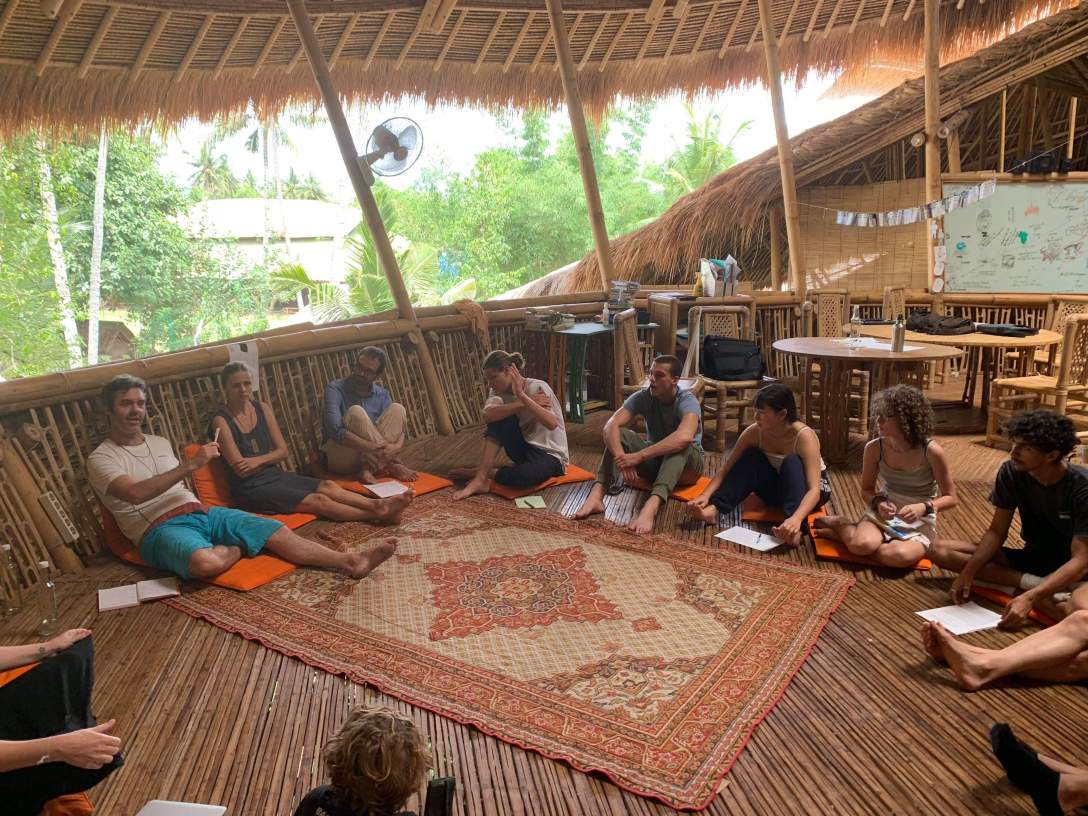
Visiting the Green School in Bali in 2018 was a revelation for me. I met students who were bravely facing the troubling science on how badly we modern humans have damaged the biosphere and climate. I explained the bad news about what that probably means for the future of our societies, and witnessed them discussing how they might integrate that into their future plans. I was so impressed with the way they engaged the topic, I made a film about them! Seven years on, I went back to the school, to share some lessons from my regenerative farm and training centre in Bali. I discovered the Green School staff have evolved their understanding of ‘green’ to embrace “regenerativity’ as their mission. Discussing with parents, I realised that this aspiration to pursue ‘regenerativity’ could give new impetus for action on our changing climate, including both attempts to reduce its pace and negative impacts, as well as reshape how we live well in an era of disruption and collapse. However, I also heard one teacher who seemed to use the term more as a nod to environmental care without admitting the pain of failure that is now associated with the concept of ‘sustainability’. Coming away from the School, I took time to consider what the concept of regeneration might add to a realistic agenda on the metacrisis of economic, social, ecological and political disruption that is unfolding around us. That got me asking the question: who or what can I nurture due to my love of Life? After decades of working on sustainability, from the highest levels of the UN to the grassroots of a farm, this felt like a moment for evolving my focus, and so I’ve written this essay to share about it.
In the following lines, I am going to explore the potential and the pitfalls of the regenerative agenda as a response to our unfolding metacrisis. On climate, it is important to recognise that regenerating key living systems is not just an adjunct to emissions reduction but should be a core part of our climate response. It is also important to see that for the concept of regeneration to be meaningful beyond our climate predicament, we must acknowledge the profound failures — scientific, economic, political, and cultural — that have led us to this point. After discussing those, I will share some thoughts on how the term ‘regenerativity’ might be used authentically to convene genuine action, or misused to obscure the same failed ideas. I’ll explain how I’ve concluded the concept can offer a deeply personal and practical signpost for living with love and purpose in an era of metacrisis and collapse. It’s why I’ll conclude this essay by proposing ‘regeneration’ as a 6th R within the Deep Adaptation framework.
Panecological climatology
For decades, climate action has been a story of subtraction. The central metric has been carbon and our primary goal has been emissions reduction. This narrow calculus, while critical, is proving insufficient. Not only are most economies remaining carbon heavy, the agenda has been framed as limiting damage from one factor, carbon emissions. Instead, both recent climate observations, and growing bodies of research, point to the role of large forests and healthy oceans in modulating the world’s climate through seeding clouds which reflect the sun’s rays. If that is new to you, please check my essay on the topic, or the work of Dr Anna Makarieva. The findings of such research tell us that attempts to regenerate the planet’s living systems from a degraded state should be more central to climate action in future. The principle, capability and agenda known as ‘regenerativity’ could encapsulate that planetary imperative, if it is conceptualised honestly, and in light of the failures of our past attempts at sustainability. Moreover, efforts to regenerate both degraded ecosystems and human cultures offer pathways for attempting to adapt to inevitable disruptions from our changing climate – the situation many now term the ‘metacrisis’.
The conventional carbon-centric view is missing the forest for the trees, quite literally. It treats the climate as a simple atmospheric chemistry problem. Yet, as emerging ‘panecological’ analysis emphasises, Earth’s thermostat is affected by humans not just by our greenhouse gas emissions, but by our impacts on the dynamics of major ecosystems — particularly vast forests and healthy oceans. These are not passive carbon sinks but active climate modulators. The great boreal and tropical forests, for instance, do more than store carbon. Through the release of bacteria and pollen, they seed clouds that directly cool their regions, and beyond, by reflecting solar radiation. There is evidence that the condensation processes also draw in air from the oceans, creating a ‘biotic pump’ that affects the Earth’s energy balance. Similarly, a thriving ocean teeming with the right kinds of phytoplankton doesn’t merely absorb CO₂ as it is the source of over half the world’s cloud-condensation nuclei, via the production of dimethyl sulfide. The functioning of these systems directly shapes planetary albedo, or reflectivity, and thus temperatures around the world.
A regenerative agenda could respond to this profound interdependence. That is because it brings our attention to restoring, renewing, and revitalising our environmental, social, and cultural systems. Environmentally, the focus is on healing ecosystems. That involves soil health, habitats, biodiversity, and cleaning up toxics and plastics. But it could also involve restoring the innate cooling capacity of the planet. This means regenerating forests for their cloud-seeding and biotic pump, not just their timber or carbon credits. It means restoring marine health for climate regulation, not just fish stocks. The goal can be to enable these systems to return to their climate-modulating potential once again.
Critically, this regenerative lens could transform how we think about regulations, investments, and subsidies in response to a climate emergency. Because the most potent climate technology available is Life itself. Therefore, funding large-scale ecosystem restoration — from mangrove swamps to peatlands to seabed grasslands — becomes an investment in natural climate engineering. Of course it also buys the potential for enhanced biodiversity, water security, and community resilience, alongside the beautiful intrinsic value of wild habitats. In comparison, those focusing on expensive and energy-hungry machines to capture carbon from air, or trialling means of atmospheric blocking of the sun, can be seen as misunderstanding the complexity of climate within the homeostatic processes of a living planet.
In addition to the wider climate cooling potential of repairing ecosystems, large forests can also help to moderate some of the local effects of more variable and extreme weather. Therefore, environmental regeneration can be seen as part of the process of adapting to climate change. For instance, rather than just erecting higher seawalls, a regenerative strategy could revive coastal mangrove ecosystems that attenuate storm surges, nurture fisheries, and sequester carbon. For farmers confronting aridification, it means regenerating the soil’s sponge-like capacity through agroecology, reducing irrigation needs while protecting yields. For cities, it could mean creating more water-retentive green spaces to help manage floods.
Of course the climate adaptation of human societies is as much about culture, politics and economics than it is about ecosystems. By including these aspects of our lived experience, the concept of ‘regenerativity’ may help promote a more holistic understanding of climate chaos and what to do about it. For instance, socially and culturally, we could seek to promote forms of organisation and community that promote well-being and creativity, without relying on further consumption or economic growth. I say ‘could’, because to attempt that authentically, and at scale, we must not sideline politics and economics from our analysis and agenda.
Transformative failures
One thing I appreciate about the term ‘regenerativity’ is the implicit acceptance of failure. Otherwise, would we only have stuff to generate, not re-generate? If our environment, society and culture weren’t so badly degraded, would we not be talking about greater expansion, improvement, conservation, persistence, or sustainability? So when using the term regeneration authentically, rather than tactically or superficially, we need to acknowledge what it is that has failed, degraded and died, and what we are learning from that.
I think the concept of regeneration can point us to scientific, economic, political and cultural or spiritual failures, which have culminated in the unfolding ecological failure. Scientifically, those of us modern humans who care about each other and wider Life, have failed to comprehensively understand the complex interactions of living systems in ways that might inform transformative activism and policy agendas. Economically, we have failed to accept that an expansionist monetary system and portfolio-maximising investment strategies have combined to blast through ecological limits, engineer unnecessary wants, and distort public understanding of what is good and true. Politically, we have failed to generate national and international political movements and policy agendas that are sufficiently free from domestic corruption and transnational capitalist control to put people and planet first and foremost. Culturally and spiritually, we modern humans, on average, have failed to experience our interbeing with the environment sufficiently to protect it from harm, and therefore ourselves.
Together these failures can be observed in the poverty of the modern environmental movement and professions themselves. Professionalisation of environmental concern transformed effort into a technocratic project with neither honesty nor soul. Most of us ended up being campaigners for, or officers of, one faction of global capital involved in lower-carbon energy, promoting the ‘fake green fairytale’ of a managed transition to an electric wonderland where we don’t have to give up anything (something I explained on ABC radio in Australia). Instead, any meaningful use of the concept of ‘regeneration’ or ‘regenerativity’ must involve accepting our personal and collective wounds, the need for healing and regrowing. It means that we, and our organisations, are involved in nurturing Life, in its various forms.
For decades I worked with some peak institutions in the world on the topics of Sustainable Development and Corporate Sustainability, such as the United Nations, World Economic Forum and large NGOs. I’ve heard former colleagues sound personally disheartened and dismayed by failure, while maintaining a public charade of positivity about their work. They have been wanting to find a way of incorporating the tragic decline and disruption, while maintaining their professional status, income, and sense of purpose. As a result, some are moving into the idea that adaptation to climate change is the new agenda to lead on. Others are adopting ‘regeneration’ as their label. They say versions of: “sustainability was about being less bad, but in this situation of great loss, we need managers, leaders and entrepreneurs committed to regeneration”. That represents an attempt to recognise failure while avoiding looking at how one has been bystanding that failure, or even helped it to occur through one’s own career choices and the role of one’s profession.
I don’t blame them. We tend to crave upbeat stories. Even about death, with all the consequences for society that produces. But what such misleading framing of ‘regeneration’ could mean is that many people miss the opportunity for a deeper reckoning, learning, and transformation in their own lives. One of those learnings is that a cause of past failure has been the financial and societal incentives for people in business, government and civil society to express delusional and toxic optimism rather than explain truths which threaten our support for incumbent power. Unfortunately, the sloppy and opportunistic use of regenerativity discourse by consultants and NGOs could mislead people about where to find really authentic and committed folks, who are incorporating a recognition of systemic failure in their desire to nurture Life. More broadly, the chance for a general public awakening on ecological breakdown to then generate transformative agendas, which naturally challenge or move beyond capitalism and imperialism, could be sunk under the deluge of people claiming they are about ‘regenerativity’.
The power of a term is how it convenes
I’m not claiming there is only one true definition of regeneration and regenerativity. Like any concept, it is a social construction, and we would waste a huge amount of time and energy to chase the impossibility of an uncontested correct definition. Even if we adopt the concept in a devout way, we must admit we don’t actually know if there is much ecological regeneration-by-humans possible at scale in the context of a destabilising climate. We humans fall into the trap of reification – because there is a word for something, and a history about that word, we think there is a tangible something it corresponds to, rather than pointing at an arbitrary grouping of diverse contextual unfolding effemeral phenomena. That goes for most concepts. Buddhists (and critical discourse theorists) say for all concepts. This realisation doesn’t mean we give up on trying to be clear about what we mean, and why, when we use terms; it means we think critically about what ideas, framings and narratives enable or hamper different parts of society and ways of being. It means we recognise the value of a concept that helps people with similar concerns and intentions to find each other. It means we assess our own use of the term, to make sure we aren’t repackaging our old efforts, or overselling small projects to help the powerful tell a palliative fairytale for all. This approach to concepts is part of the ‘critical wisdom’ we must cultivate in ourselves and society if we are to lessen the harms of living in a metacrisis (as explained in Chapter 8 of my book).
An academic study reported in 2024 that “notions of regeneration have entered discourses in several fields that are relevant for sustainability, including, among others, ecology, agriculture, economics, management, sociology, psychology and chemistry.” Amongst those fields, agriculture and economics seems most vibrant. Regenerative agriculture, as we understand it at Bekandze Farm, is a land-management practice that actively seeks to improve soils, increase biodiversity, and maintain water cycles, so that the farming can restore the ecosystem of the land rather than depleting it. Similarly, regenerative economics is a framework that views the economy not as a machine to be optimized, but as a living system embedded within the natural world. The idea is there can be economic activities which restore, heal and build the health of social and ecological systems. The concept has been developed by Daniel Christian Wahl and others to apply to whole cultures. That means we design or defend human societies that actively restore, heal and enhance the health and vitality of social and ecological systems.
With all that in mind, we could ask ourselves more complicated questions than what a regenerative farm, such as my own, could look like. Will there be a regenerative automobile? A regenerative global financial institution? A regenerative medical profession? If regeneration involves the nurturing of Life, then the bar is set quite high. Could an automobile, whether hybrid or electric, ever be truly regenerating nature and society? It is unlikely — especially if you consider the full life cycle. Instead, projects to help people live closer to work, and use public transport to get there, would be far more Life-nurturing, in various ways. Put that way, I can see an honest use of the term not appealing to corporate executives and consultants and business school academics, who prefer buzz terms to promote themselves to prospective clients and students. It is one reason why I am pleased to have quit my professorship and now work freelance in support of those who aren’t afraid to ask the tough questions of themselves, organisations and society (the Metacrisis Meetings Initiative).
Having this awareness that any term is as valuable as what it does or doesn’t enable, means that we can also look at the potential shadows of the term regeneration, or regenerativity. One shadow could be the subtle reassertion of ‘anthropocentrism’ or human-supremacy, where we imagine that humanity must fix wider nature, rather than rediscover a way to live in harmony and partnership with our environment, much like a ‘keystone species’ (something I explore in the latter half of my book Breaking Together). Another shadow could be the exclusive nature of the conversation it invites us into: as only those who aren’t just trying to cope with difficulties are able to discuss how to align their lives with regenerativity. Recognising possible shadows does not negate a concept, or mean everyone who uses the concept is ignoring the shadow: instead, that recognition helps us to address potential limitations, if we wish.
Deep Adaptation, regeneration and me
For those of you who have followed my work on societal disruption and collapse, might be wondering how an embrace of the concept of regeneration might fit with the existing framework of Deep Adaptation (DA). If you don’t know about that concept, suffice to say it means seeking to adapt personally and collectively to the societal disruption and collapse that arise, directly or indirectly, from climate change and ecological damage . Deep Adaptation was the title of a paper I wrote which went viral, with over a million downloads. Over the years I have noticed many people inspired by their anticipation, acceptance or experience of societal collapse, have been moved to work on nurturing life in particular or in general. They aren’t attached to outcome, but become re-connected with what they most value and cherish, which includes the living world, loved ones, and the processes of creation. In addition, I have been aware that the existing DA framework of 5Rs does not invite much attention to our environment. Therefore, I think it would be useful to support more discussion of what and whom we are nurturing within the context of metacrisis and collapse. Therefore, I am proposing ‘regeneration’ as the sixth R in the DA framework for reflection and conversation. The question we can ask ourselves is: What or whom can we nurture due to our love of Life? Putting it more simply, we can ask: how am I nurturing Life?
Asking myself that question, I realised that some of my choices in the years since I became collapse aware have been aligned with this Life-nurturing sentiment. At the simplest level, I started rescuing kittens! Initially they were for other people to adopt, as I had bad allergies. But finally, I gave in and rescued one for myself from the Buddhist temple in the north of the island — and overcame my allergies. Then I rescued his likely nephew from the same temple 2 years later. I found them in distress, as I was co-hosting meditation and kirtan retreats at that temple. I have now co-hosted 17, as my small way to enable, in myself and the other participants, both inner calm and outer curiosity, in an interfaith setting. That is also why I play in bands that host kirtans and cacao ceremonies, and am now a dance leader in training, with the Sufi-founded Dances of Universal Peace. It is also why I produced Oracle Cards to help people return to gratitude, wonder and agency in the face of the metacrisis.
These personal activities may seem less obviously regenerative than the organic farm and farm school I founded, but they have been more central to my sense and expression of love and care. I hope we can find a new business partner or donor who shares similar perspectives and intentions, so we can build the facilities to open a small residential school. I won’t feel attached to that outcome, or sacrifice to get there, as I know that a shift towards a more nurturing intention will express itself in many ways, depending how life unfolds. In that process, I recognise how important it will be to have fellow travellers. It’s why I welcomed the personal focus of questions put to me by podcasters by Carlotta and Catie, and why I will be joining one of the peer mentoring groups of the Metacrisis Initiative (…with the deadline for first cohort of the peer mentoring coming soon).
Back to climate chaos, and beyond
Our predicament of a rapidly destabilising climate, and overshoot of the capacity of the Earth to sustain humanity, cannot be responded to by subtraction alone. We must couple urgent emissions reductions with a bold, additive strategy of ecological renewal. A panecological understanding of life on Earth points to how a relatively stable climate was a product of a healthy biosphere. By embracing regenerativity as the principle of shaping ways of living that generate more life, health, and potential than they consume, I hope we broaden our field of vision and action on the environmental tragedy that has been unfolding around us. Human survival may depend on recognising that the best way to stabilise our atmosphere is to re-animate our Earth, rather than submit it further to machines.
Ultimately, regeneration is not a new metric to be achieved, nor a project to save humanity so it can persist a little longer on Earth. Instead, it can be part of the conversation as we reorient our very being — a shift from asking “how long can we last?” to “how fully can we live?” As a new question within the Deep Adaptation framework, it invites us to regard our ‘success’ not in years of survival, but in the depth of our connection to the living world, the creativity we unleash in service of life, and the love we cultivate in the face of loss. It means some of us embracing our role as a ‘keystone species’, not by controlling the planet, but by participating in its healing, and in doing so, healing ourselves. Regeneration, therefore, can invite a conversation about the quality of our existence on this earth, not merely its duration.
I hope Green School and other educational centres that adopt concepts like regeneration can do so while avoiding any rebranding of failed organisational dynamics and social change strategies, or accidentally sidestepping the lessons from decades of effort on sustainability and social justice. Instead, educational institutions can approach the concept of regeneration with ‘critical wisdom’ to help their students and staff explore a meaningful way of living through metacrisis, disruption, and even societal collapse. It looks like with Regeneration27 and related initiatives, many at the school are taking this matter seriously — I’m hoping to see some ripples.
Thx, Jemx
—
If you have the financial means to help us develop Bekandze Farm School into a destination with accommodation, please get in touch via www.bekandze.net or info@bekandze.net ….If with lesser means, but a wish to help promote organic farming in Indonesia, please consider our crowdfund. If you are in Bali in May or August 2026, please consider our weekend retreats at the temple.
Join the Metacrisis Initiative
If a member, then you can see the meetings and decide if you want to join either the salons, the peer mentoring, or both.





You must be logged in to post a comment.