After Angry Acceptance: Fifteen Unhelpful Responses to Anticipating Collapse

Since I began to pay attention to how people respond to their anticipation of collapse, I have learned that the responses are far more diverse than I could have ever imagined before I stopped suppressing my own anticipation. After the Deep Adaptation paper came out I wrote about the myriad responses that seemed reasonable to me at the time. I shared that to encourage the idea there is not just one right way to respond to an anticipation of collapse. Over the last few years, I have become more aware of how some people are responding in less than helpful ways to their own conclusion that societal collapse is probable, inevitable or already beginning. Given that collapse anticipation triggers difficult emotions, unhelpful responses can be expected, and yet as such anticipation spreads, it will be helpful to identify problematic responses so we can invite people away from them. With that aim, I will summarise some of them in this essay, with labels for each, to enable future discussion.

Continue reading “After Angry Acceptance: Fifteen Unhelpful Responses to Anticipating Collapse”
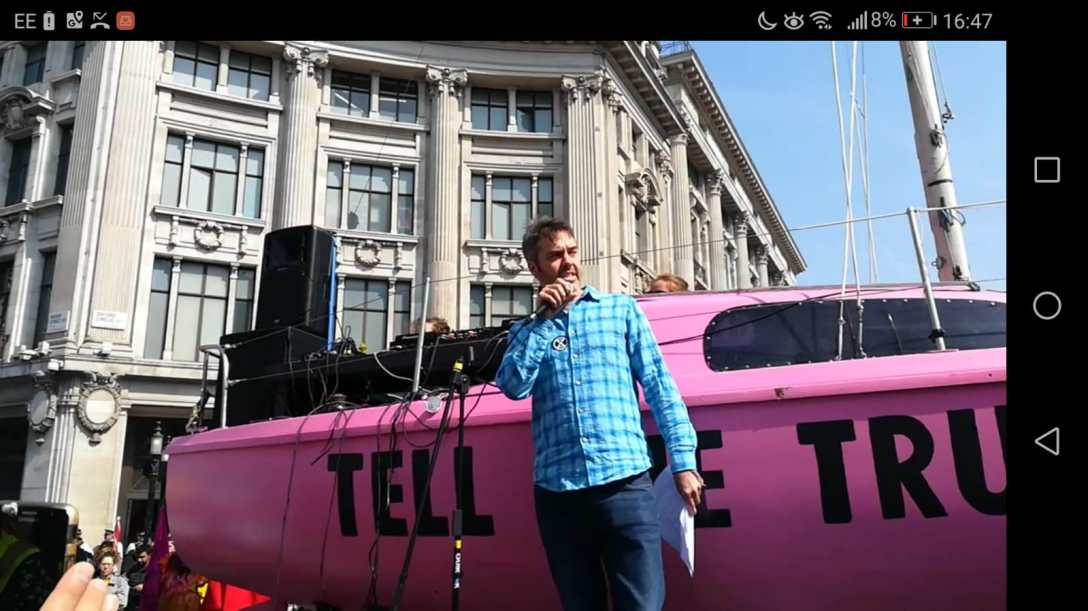
Jem Bendell presents to Extinction Rebellion on honesty about disruptions ahead

[Study Deep Adaptation with Jem Bendell for one time only in 2021, with an online course from the University of Cumbria].

On May 8th, Professor Jem Bendell joined a panel with Vandana Shiva, Brian Eno, and Charles Eisenstein, to promote the rise of Extinction Rebellion in the USA.

Rough transcript of the talk

“Just over two years ago the international rebellion in London brought the attention of the British media and public to climate change for a period of two weeks in a way I have never seen before in 30 years of working on the environment. I witnessed people in my field of corporate sustainability suddenly saying yes, it has become an existential crisis and we need the government to lead systemic change. 

Two years on, we can see that hasn’t happened. Carbon emissions are once again growing fast, while the destruction of natural habitats continues. That’s not surprising as the established elites in all countries that I know about have not tried to change the economic system which pushes us to continue that destruction.

Continue reading “Jem Bendell presents to Extinction Rebellion on honesty about disruptions ahead”

An Ode to Mauna Loa

An Ode to Mauna Loa: Breaking together with the living One

At 421.21 ppm
Feedback screams its piercing sound
Rising rates after lockdown
We’re falling down
the Long Mountain of Life

We’ll turn away no more
As the breaking of Life
returns to our threshold.

What was pretended now breaks apart
Both in us and around
We’re breaking together with the living One.

Continue reading “An Ode to Mauna Loa”

Facilitating wisdom not fascism – the #DeepAdaptation way

How might we help increasingly distressed societies avoid a descent into authoritarian and or fascist governments? 

This is a question on the minds and hearts of many people who anticipate further disruption, breakdown or even collapse of societies due to the direct and indirect impacts of environmental change. Even with the COVID-19 pandemic, we witness stupid, corrupt, repressive and diversionary responses from many governments, on the one side, and outlandish clickbait criticism on the other, which does not bode so well for us during further disruptions due to environmental damage. 

Continue reading “Facilitating wisdom not fascism – the #DeepAdaptation way”

What Is It Too Late for? Poem to Mark the Scientist Rebellion

“Why We Rebel? Scientists have spent decades writing papers, advising government, briefing the press: all have failed. What is the point in documenting in ever greater detail the catastrophe we face, if we are not willing to do anything about it?” Scientist Rebellion, 2021

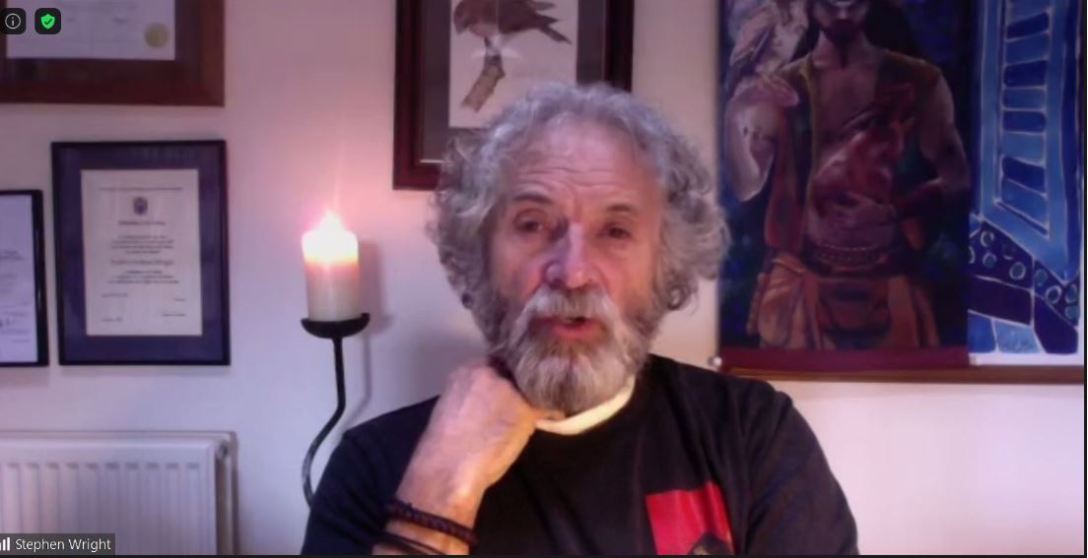
Some have called it a 4-day climate hunger strike. During my solidarity fast with the Scientist Rebellion, I took time out to reflect on how I am feeling and what I think I know at this time. Not for producing structured arguments, but for welcoming any integrative knowing of self, society and nature. To help, I attended morning sessions with other fasters, hosted by the Reverend Steven Wright of Sacred Space, Cumbria. I felt lucky and grateful to have such a wonderful invitation to presence and purpose, as well as to have the camaraderie of fellow fasters. As a result, I had another go at poetry, on the theme of discovering what is most important when we let go of old stories of self, other, society and nature. An audio recording of the poem is below, on my youtube channel.

Rev Wright hosting the morning reflections and prayers with scientist rebels
Continue reading “What Is It Too Late for? Poem to Mark the Scientist Rebellion”

The Deep Adaptation Quarterly – March 2021

To receive a copy of this newsletter every 3 months in your inbox, subscribe here.

Editorial from Jem Bendell

Although lockdowns have warped my sense of time, and perhaps yours too, it is actually more than 3 months since the last Deep Adaptation Quarterly. There was a hiatus, as I focused on new work after leaving the Deep Adaptation Forum at the end of September, and the Forum team re-organised for their post-Jem era. It has been great to see volunteers step up to now join the small Core Team of organisers, with Kat Soares becoming the new coordinator of the Forum. She is in a team of 4 freelancers working part time to coordinate over a hundred volunteers around the world to support people with finding meaningful ways of living creatively from their collapse anticipation. As they need to cover their basic costs, it would be useful if you can chip in now, as any donations given to them by the end of March will be matched by a donor.

Continue reading “The Deep Adaptation Quarterly – March 2021”

An environmentalism from and for the majority – insights from women in #deepadaptation

Guest post by Simona Vaitkute, Holding Group, Deep Adaptation Forum.

When talking about the climate crisis, it is jarring to hear an invitation to be horrified, feel helpless, and sit with the pain, when the dominant response in Western culture is to look away, or adopt greener lifestyle changes while faithfully waiting for technology to rescue us.

In their interviews last year with Dr. Jem Bendell, four educators and activists— Dr. Vanessa Andreotti, Skeena Rathor, Amisha Ghadiali, and Nonty Sabic—suggest we learn how to respond to the climate tragedy from people who have experienced trauma, oppression, and discrimination. More of us in the Global North are moving into a position similar to that of many indigenous peoples when Europeans landed on their shores with guns and diseases: our familiar world is about to crumble and we cannot stop the change from coming. Millions of people in the Global South are already suffering from climate change, with warming temperatures and unpredictable weather patterns driving economic hardship, food insecurity, and migration. And it is going to get worse. Even in the West, where people like me still remain largely sheltered from the worst effects, “people are looking for ways of addressing the anxiety and depression of dealing with the imminent end of the world as we know it,” says Dr. Vanessa Andreotti, Canada Research Chair in Race, Inequalities and Global Change. She spoke from Peru, where she works with local indigenous communities. Some of these communities live, and even manage to thrive, in conditions that affluent westerners would define as breakdown—i.e. without access to supermarkets, gas stations, banks, the energy grid, tap water, and treated sewage.

Continue reading “An environmentalism from and for the majority – insights from women in #deepadaptation”

A Different Kind of Hope with #DeepAdaptation in Southern India

So much activity does not happen online, and does not get seen online. And thank goodness for that! As I research what is happening around the world as people wake up to the likelihood of a more unstable future, I am feeling grateful and reassured that so many of us want to make a difference, and can, even if small, or fragile, or transient. As I used to live in Southern India, I was excited to hear what is happening there, and this guest blog is the result. If you have your own local story to tell, please contact the blog team at the Deep Adaptation Forum.


Lakshmi Venugopal, member of Deep Adaptation Auroville and Founder, Inner Climate Academy.

As an Indian woman returning from abroad, I was attracted to the international spirit of Auroville, an intentional community in Southern India. Both Indians and foreigners seek to live a life that is a holistic application of the principles of Sri Aurobindo. We seek not to separate the spiritual realm from our livelihoods and lifestyles. Therefore, for decades, the people of Auroville have sought to live more gently on the land and with each other. That holistic approach to conscious living may be the reason why the Deep Adaptation concept and framework has been flourishing here in our corner of Tamil Nadu, with implications for our wider region. As I witnessed the international discussions online in the field of collapse anticipation and Deep Adaptation in particular, I have wondered whether there are many people like us in the Global South, but whose experiences and initiatives are being overlooked. I wondered whether it might help to share what we are doing, so we might learn from each other, inspire others, and perhaps even shape the international agenda.

Continue reading “A Different Kind of Hope with #DeepAdaptation in Southern India”

Launching a Scholars Warning initiative

This is a copy of the letter sent to 500+ signatories to the international scholars warning on societal disruption and collapse, from Dr Jem Bendell and Dr Pablo Servigne, announcing the launch of an initiative to help more scholars engage publicly on collapse risk and readiness. A version in French follows below.

The Scholars Warning letter on the risks of societal collapse was published in The Guardian and Le Monde in December 2020. By the end of the year, it had been signed by over 500 scientists and scholars from over 30 countries, representing dozens of academic disciplines including climatology, environmental science, psychology and sociology.

Thank you for signing this public invitation for more sober and kind conversations about how to respond well to our global predicament. The full list of your fellow signatories is available.

video of some of the signatories reading the letter to camera was also released through Facing Future TV. The full-length version of the letter is available and it has been published in German, Croatian, Spanish, Hungarian, as well as French. A list of the translations is available. You can follow engagement with the letter on twitter via @scholarswarning

Continue reading “Launching a Scholars Warning initiative”

The harms of innocence and normality in the face of climate disruption

Dr. Rene Suša is a coauthor with members of the Gesturing Towards Decolonial Futures collective, of a chapter in the forthcoming book on Deep Adaptation, which is now available for advance purchase. In this guest blog, he explores how desires for innocence and “normality” can make us cause even more harm in the long term, as societies are disrupted due to environmental change.

Slightly over a year ago, our collective Gesturing Towards Decolonial Futures was invited to contribute a chapter to the Deep Adaptation: Navigating Realities of Climate Chaos book, edited by Jem Bendell and Rupert Read. Our writing focused on the subject of mapping different responses to climate change and potential climate collapse. At that time, we mapped four main groups of responses (romantic, revolutionary, rational, reactionary) that we were able to observe in our work with various social justice movements, sustainability initiatives, policy makers, advocates and activists, mostly in the global North.  We did not, and still do not, consider this mapping as exhaustive of all possibilities, deterministic or fixed, but rather as a provisional tool that helped us outline some of the prevailing (problematic) patterns that we were able to observe in the four main groups of responses to climate change, identify some key absences and disavowals, and mobilise further conversations and reflections. One of the main reasons why we engage with this topic, is, because in our work with various (mostly Indigenous) communities in the global South, as well as with marginalized communities in the North, we have been noticing that it is often them and their immediate surroundings that suffer the most direct and gravest consequences of our denials, inconsideration, irresponsibility and self-centredness. 

Continue reading “The harms of innocence and normality in the face of climate disruption”