Dropping Demons with Chamunda – as scientists rebel for life

On March 25th I will be fasting for 4 days in solidarity with a nonviolent Scientists Rebellion. I am looking forward to joining dozens of other scholars online each day, being hosted by Reverend Stephen Wright, as we reflect on our place in the world. If you are an academic please consider joining us. I have booked my annual leave and intend a bit of a brain fast, away from my research and inbox!

I may have another go at poetry. Here is something I wrote last month, after a Kirtan, as I explored the insights from Hinduism on the sacred feminine, based on the stories about the Goddess Chamunda.

Dropping Demons with Chamunda

If you think you know who you are singing to, then you are not singing to me.

If you think you know who you are praying to, then you are not praying to me.

Continue reading “Dropping Demons with Chamunda – as scientists rebel for life”

Deep Adaptation – the book

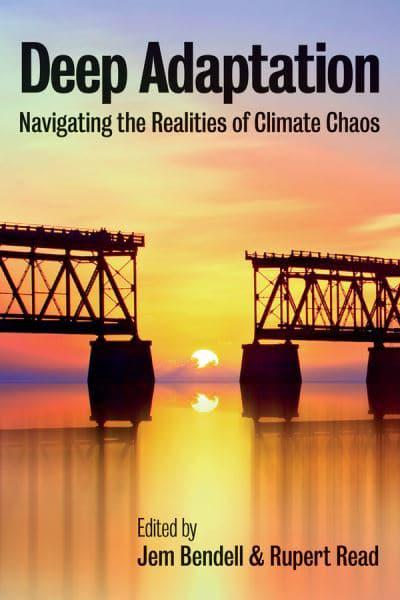
How on Earth do we begin to talk to each other and work from a starting point of experiencing or anticipating societal disruption and even collapse?

It needs to become the biggest conversation, with views from different contexts. I am still learning as I talk to more and more people from around the world. Some of them share their thoughts in this book, including Rene Suša, Sharon Stein, Vanessa Andreotti, Tereza Čajkova, and Dino Siwek, who are scholars and activists in decolonization efforts, and XR’s Skeena Rathor, who works on co-liberation from the systemic oppressions that underlie environmental destruction. With this detailed attention to the causes of climate chaos, I hope the book helps support a sober and non-divisive approach to navigating the implications.

Continue reading “Deep Adaptation – the book”

Should we discuss our anticipation of collapse?

This is the foreword to “The Responsibility of Communicating Difficult Truths About Climate Influenced Societal Disruption and Collapse: An Introduction to Psychological Research” which provides a synthesis of some relevant peer-reviewed literature within the field of psychology. An audio of this foreword is available.

Professor Jem Bendell, University of Cumbria, UK.

Your anxiety or even emotional distress about the situation with the climate is normal, sane, healthy and even righteous. Those difficult emotions you have been feeling may also be a painful gateway to a different expression of who you are, depending on how we support each other in that process of change.

Continue reading “Should we discuss our anticipation of collapse?”

Why make time to feel when there is a world to save?

My steps with integrating international development and deep adaptation.

Guest post by Dr Malika Virah Sawmy.

It’s heart breaking to witness how intentions are real and absolutely beautiful in international development. Everyone wants a more beautiful and fairer world. But the issue is how we manifest those intentions. How do we manifest the more beautiful world our heart knows is possible, to quote Charles Eisenstein.

Sadly, when you work in international development, you have, what I think, are two main coping mechanisms to deal with our work in the context of an unfolding global crisis with climate chaos – and what has been termed by scientists as a period of biological annihilation.

Continue reading “Why make time to feel when there is a world to save?”

As non-violence is non-negotiable we must have tough conversations

The commitment to nonviolence in climate activism and deep adaptation is a central principle and we must criticise anyone who suggests otherwise. The risks of tolerating any deviation from this principle are too great & therefore we have no choice but to risk painful reactions, even from colleagues, when confronting it.

Trying to reduce harm and the antecedents of harm during societal disruption and collapse is not going to be pretty. I launched the Deep Adaptation Forum (DAF) as a safe space for people to help each other process difficult emotions and work out what next in life to reduce harm, save more of the natural world and seek meaning and joy in the process. It has been wonderful to see the voluntary commitment from people around the world to grow the activities. I left the daily operations in September 2020 and on February 8th this year I tendered my resignation from DAF’s non-executive board, called the Holding Group. That is the final step of me stepping away, in line with my knowledge of the research that shows we humans are susceptible to the counterproductive self-infantilising process of arguing about ‘leader’ character and views rather than taking responsibility ourselves. I am delighted that two experienced women from the Global South have agreed to be nominated in my place and look forward to seeing them communicating about Deep Adaptation.

Continue reading “As non-violence is non-negotiable we must have tough conversations”

Discuss #DeepAdaptation with experts in 2021

My Deep Adaptation Q&As are back for 2021. In these discussions, a guest shares their own perspective on what matters to them as we consider, or respond to, societal disruption and collapse.  The Deep Adaptation framework is for dialogue, without one right way of responding to our environmental predicament, or one source of knowledge on that. Therefore, I host these Q&As to broaden the discussion – and discussants – on the matter of societal disruption. All previous Q&As are available, with guests including Vanessa Andreotti, Skeena Rathor, Joanna Macy and Charles Eisenstein.

Continue reading “Discuss #DeepAdaptation with experts in 2021”

COVID and Climate Change – why XR must visit the WHO

New research confirms the role of climate change in making diseases like COVID-19, which come from wildlife, more likely, by direct and indirect effects, working in concert with other environmental damage.

Yep, shocking.

I use the words “more likely” and “like” in that sentence, reflecting scientific method and norm for communicating conclusions. In hypercomplex systems where isolating individual variables and establishing specific connections between events is difficult, that should not limit our ability to draw conclusions about probabilities, especially when they have massive implications for life on Earth.

Continue reading “COVID and Climate Change – why XR must visit the WHO”

Taking Climate Adaptation to Heart – talks by Jem Bendell

If you are currently trying to make better sense of societal disruptions and your future in a climate-disturbed world, then I believe ‘Deep Adaptation’ to be of use to you. It is the ethos and framework for a movement of people who consider the collapse of industrial consumer societies to be either probable, inevitable or already unfolding. We are seeking to reduce harm, save more of the natural world, and learn in the process. We tend to be agnostic about what might occur after any societal collapse.

This post in my blog links to a selection of introductory videos.

Continue reading “Taking Climate Adaptation to Heart – talks by Jem Bendell”

Still being academic – writings on management, environment and Deep Adaptation in 2020 by Prof Jem Bendell

In 2020 I co-authored some academic resources on management, environment and ‘deep adaptation’. Here is a quick summary and links, in case you are interested in these topics to a degree where you read or listen to academic outputs on them.

In an academic journal article, with Dr Katie Willocks of Lancaster University and Prof Richard Little, of Impact International, we explored ways of supporting learning within hospitals. In particular, we showed how the ideology of top-down managerialism can militate against a recognition of the motivation of staff in the caring professions, and side-line support for them to be better able to solve workplace disagreements as a means of professional learning. It’s basic common sense to seek to help not hinder nurses and doctors, but the dark forces of bureaucracy and commercialisation are so widespread in late modernity that it can be useful to challenge them empirically, as we have done in this paper.

Willocks, Katie, Bendell, J. and Little, R. (2020) Professional Learning from Disturbances in Healthcare: Managerialism and Compassion. International Journal of Management, Knowledge and Learning, 9 (1). Download here.

Continue reading “Still being academic – writings on management, environment and Deep Adaptation in 2020 by Prof Jem Bendell”