Climate Hoax Questions and More Besides

A new video is out, where concerns about climate change being a hoax designed to control the public were addressed by a panel of environmentalists. The event occurred in the English town of Glastonbury, which hosted a number of discussions on this topic in 2023. One trigger for this focus was probably a speech at a council meeting by the campaigner Sandy Adams back in March. She argued against the “15 minute city” agenda, with claims that ‘climate change’ is a hoax to excuse draconian controls on our lives. The freedom she was talking about was the driving of cars, rather than walking, cycling or bussing around. As people can cycle across Glastonbury in less than 15 minutes, and the local government had no proposals on ‘15 minute cities,’ the councillors of this small town were somewhat perplexed by Ms Adams. Nevertheless, the video of her speech went viral, with the claim that resistance works! It appears that targeting non-existent proposals is the ‘secret sauce’ for this kind of instantly gratifying campaigning. 

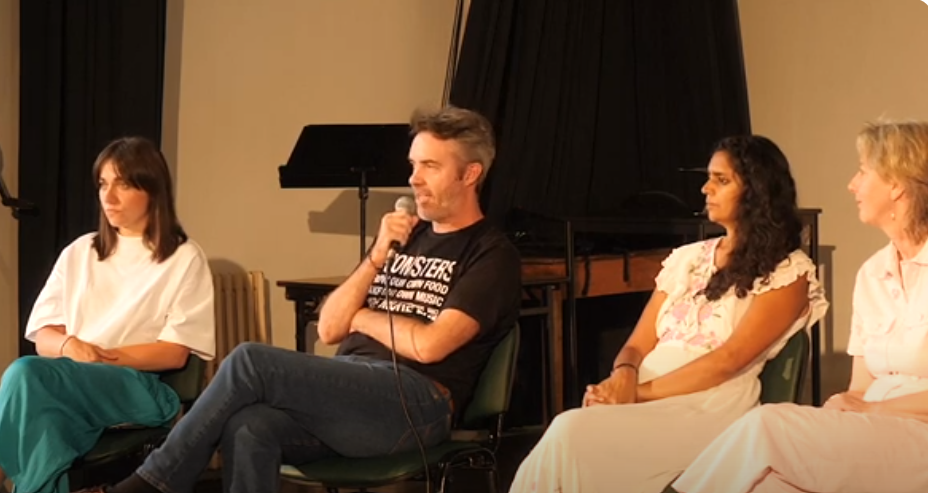
Many local residents of Glastonbury had other ideas. A group of them decided to host a conference on the more troubling news about climate change – what to do if we can’t stop it disrupting our communities through direct and indirect impacts. During a hot afternoon in June, a panel took questions from the audience. Reflecting the arguments promoted by Sandy Adams’ viral video, the first question was about whether the mainstream narrative on climate is incorrect – and being used to control us. The Green Party Mayor of Glastonbury, a co-founder of Extinction Rebellion, two podcast hosts and myself, a Professor in the field of sustainability, offered our reflections on this issue. You can see the discussion, alongside a range of other topics, in a video of the Q&A, below.

The residents invited discussion of a wide range of topics, arising from a workshop that used the updated Deep Adaptation framework. That includes a 5th R on the ‘reclamation’ of our power in the face of societal disruption and collapse. Rachel Donald (Planet Critical) spoke of reclaiming the power of contribution by leaving behind security to build a community. Amisha Ghadiali (All That We Are) spoke of reclaiming beauty as divine, not trapped in a sanitised aesthetic. Gail Bradbrook (Extinction Rebellion) spoke of reclaiming pride in one’s own psychological patterns and capabilities. Indra Donfrancesco (Mayor of Glastonbury) spoke of reclaiming her town for positive environmental actions rather than just protests. I spoke of my personal reclaiming of my ‘OK-ness’ with aiming small, despite my cultural conditioning to strive to succeed at scale. 

Discussions ranged from caring for loved ones to whether localisation needs a complementary effort at international political influence. It demonstrated what a wide, compassionate and creative agenda can emerge from accepting the gravity of our ecological crisis. However, I also welcomed a couple of questions about whether the UN, IPCC and others might be hoaxing us on climate. That’s because I am part of a growing movement of freedom-loving environmentalists, who object to the corporate capture of the climate agenda. As one questioner alluded to, during the early years of the pandemic, we were poorly served by an old guard of green leaders and commentators, who kowtowed to the big corporate agendas that were masquerading as sensible policies on public health. Unfortunately, that lack of green leadership means the ‘medical freedom movement’ has become an easy target for infiltration by the oil lobby, who are sowing doubt about our changing climate. As I argue in Breaking Together, just because some globalists have bad ideas about responding to a climate crisis which they helped to create, doesn’t mean there isn’t a major problem for us to address with urgency.

Whether we are interested in freedom or the environment, or both, we can help each other escape the false narratives coming from corporate influence on those issues. The false narratives can be appealing, as they distract from the painful reality of a global and uncontrollable ecological disaster. However, time will demonstrate both the extent of the ecological predicament, and the futility of those responses favoured by corporate elites. I believe the sooner people move beyond distractions to explore how they wish to live in this era of societal disruption and collapse, the better it will be for themselves, others and wider nature.

The discussions prompted by the series of events in Glastonbury led me to write a public letter entitled “Dear Freedom-Loving Friends! We need to talk about your recent scepticism on climate change,” which referenced the science in my book (you can listen to the chapter on climate without a fee). 

Subscribe / Support / Study / Essays / Covid

The Q&A was part of an event that featured talks by Jem Bendell and Gail Bradbrook, and a performance of poetry by Rachel Donald. It launched the book Breaking Together, including the release of a free epub version. A more in-depth Q&A about the book was hosted separately by Low Impact.

Donate to keep Jem writing / Read his book Breaking Together / Ask JemBot a question / Read Jem’s key ideas on collapse / Subscribe to this blog / Study with Jem / Browse his latest posts / Read the Scholars’ Warning / Visit the Deep Adaptation Forum / Receive Jem’s Biannual Bulletin / Receive the Deep Adaptation Review / Watch some of Jem’s talks / Find Emotional Support / Jem’s actual views on Covid

Receive announcements of my talks and courses in 2024:

Jem in Brisbane, March 2024

Jem in Brussels and Budapest, April 2024

Jem in Mexico, October 2024

Jem in California, November 2024

Visions of a post-doom world

Was Jesus Christ a Buddhist monk? That is the subject of a few books and films which focus on the many years between childhood and the time of his preaching that are recorded in the Bible. The BBC documentary featured evidence from a Buddhist Temple that mentioned a famous teacher from afar, with the local name for Jesus. Learning from different wisdom traditions makes a lot of sense. So perhaps ‘the son of God’ might have explored that as well. I mention this speculative history because both Christianity and Buddhism have been important to my own experience and understanding of the world. In more recent times, I have focused more on learning from Buddhist insight, partly because it has been new to me. This is reflected in the name of our farm school, which is the Sanskrit word for healing through transcending separations: Bekandze Farm. The word features prominently in the Medicine Buddha Mantra, which is one of the oldest and most popular. This was the background to why I was delighted to appear in the podcast series “Buddha at the Gas Pump”. I wrote some reflections about that discussion with Rick Archer, and posted them as an article on LinkedIn. In the pod we discussed the question of whether or not we need, or benefit, from a vision of a better future, in the material realm, including humans or wider life on Earth. Below I cross-post the article. For it I used the JemBot to summarise a few of the ideas in my book Breaking Together. If you want to go deeper into any of these ideas, then studying with me is possible, twice online and twice in person, during 2024.

Subscribe / Support / Study / Essays

My other past writings on LinkedIn are here.

Continue reading “Visions of a post-doom world”

Talking Collapse at Christmas

[a version of this post went to 5k subs of my biannual bulletin]

What are you going to talk about over the coming holiday period? There is a lot of sad stuff going on in the world, which seems impossible to either influence or ignore. There is the temptation to utter platitudes about peace on Earth, or hoping it will be better next year. But you are reading these words. So we both know you are made of sterner stuff than that. How about trying a different tack entirely? Something like: “It appears to me that all this terrible news is part of a pattern. Modern societies are crumbing and the elites are causing more damage as they try to hold on to their power. These are aspects of societal collapse, and we need to start accepting it, so we can discuss what to do about it. It looks like we need to change our hopes and plans for the future.” Yes, the time has come for you to be a ‘party pooper’ …but at least one with purpose.

For a few years I didn’t want to poop any parties. I felt apprehensive about promoting my views on collapse, as I knew how emotionally unsettling it can be to realise the tragic and dangerous situation we are all facing. Instead, I thought people who were already aware of the situation would benefit by hearing from people who were responding to their collapse anticipation, or acceptance, in positive ways – and so I hosted 30+ guests in the Deep Adaptation Q&As. Over the years, my reticence to speak out has changed. That is because, although societal collapse is still taboo in mainstream media and politics, a huge proportion of the general public already experience how normal life is unravelling and that the ecological situation is unavoidably frightening. I want to help more people make sense of this situation and consider their options. As the initiative ‘Just Collapse’ often repeats, it is time to talk about societal collapse. That is why this year I released the book Breaking Together and began to #TalkCollapse in a variety of podcasts and some interviews in mainstream media. In this post, I’ll sum up some of that audio and video from the past year. It will give you a number of options of what to share with people you talk about collapse with in the coming weeks, months, and beyond.

Continue reading “Talking Collapse at Christmas”

Approaching the 5th Anniversary of the Deep Adaptation Forum

On the one hand, it feels like yesterday. On the other hand, like a parallel universe. I could be talking about many things, but this time, I am reflecting on the formation of the Deep Adaptation Forum. It’s almost 5 years since I created a Facebook group for people who wanted to discuss their own ‘deep adaptation’ to societal collapse. Soon after that we launched a website (using Ning), for people to connect with each other more deeply than one can do on Facebook. Those were two of the first steps in the creation of the Deep Adaptation Forum (DAF), as a network that facilitates dialogue and collaboration on reducing harm in the face of societal collapse. I left the organising team over three years ago but have watched it evolve through the enthusiasm of volunteers from around the world. Recently, I was asked to offer some short recollections and suggestions. That request came from the current team who are stewarding DAF into a new phase of service of the people around the globe who want to be their best selves as societies become more disrupted due to environmental change and related impacts. What follows below are the thoughts I shared with them…

“My initial motivation for founding the Deep Adaptation Forum (DAF) was to connect together the people who were reaching out to me after reading the Deep Adaptation (DA) paper, released in 2018. The diversity of people and questioning was huge, and reflected how the collapse of societies affects everything imaginable. I resisted requests from some potential funders for it to become a think tank or lobby group, and instead advanced ways of gathering for open-hearted, open-minded and meaningful dialogue. Emotional support was a key part of that, but not the only intention. Fortunately, some individuals with a little bit of cash agreed, so that I could begin to consider hiring some freelancers to collaborate on the project.

Continue reading “Approaching the 5th Anniversary of the Deep Adaptation Forum”

Deep Spirituality in an Era of Collapse

Reverend Stephen G Wright

[This essay is available as an audio, narrated by Jem Bendell]

As a follower of the contemplative-mystic Way for many decades, and written about it, guided others in it, even set up a School to ‘teach’ it, in recent years I’ve taken the idea and community of Deep Adaptation into deep discernment – to consider its impact upon my spiritual life and that of others. The unfolding ecological disaster, and its implications for our societies, is something I observe and experience from that contemplative-mystic approach to life. I have come to believe that deep adaptation will be spiritual or there will be no deep adaptation at all. By which, I mean that there will be no softening of the collapse of societies, for people or wider nature, unless more of us discover and prioritise our own spiritual response to this predicament. That is not a summons to fluffy feel-good spiritual experiences to keep the horrors at bay. It is a summons to fierce and profound inquiry, a deep plunge into the joypain of existence, and a wholly (holy!) different perspective on reality and what it is to be human in that reality. Such a Way lifts (or sinks) us into an utterly different relationship and perception of life; of self and that which is beyond the self. Without that we shall persist in limited perceptions of what it is to be human and part of all of life. Without it we would continue deploying our good intentions and rearranging bits and pieces of ordinary reality without fundamentally changing our relationship to that reality.

Continue reading “Deep Spirituality in an Era of Collapse”

A climate of trauma

The unfolding environmental tragedy arose from collective human trauma and the response to it has been shaped by that trauma – including COP28. Fortunately, there is a wave of activity emerging to help.

An audio narration of this essay is available.

When I first heard someone explain that the climate crisis is a result of our collective human trauma, I was a bit confused. ‘Speak for yourself mate,’ I thought. I hadn’t been feeling particularly traumatised about life – just worried about the damage we are doing to the environment. Surely the climate crisis is a pollution problem which our political and economic systems aren’t allowing us to respond to properly, I thought? So how could people’s emotional injuries be involved in such systemic problems? It didn’t make sense to me. Over the years, as I have learned more about what is meant by collective trauma, and what is at the root of the destructiveness of modern societies, I changed my tune. I have come to understand what people mean when they say the climate crisis, like the ecological crisis more broadly, results from our collective trauma. By that, I mean the subtle and lasting psychological wounds that most of us have from growing up in societies that maintain stories of reality that generate fears about ourselves and each other. Therefore, a trauma-informed approach to the climate crisis can open up new areas for individual and collective action, as the climate becomes more unstable. This trauma lens can also help explain why the response to the environmental crisis has been so inadequate, and even why environmentally-useless climate summits have become so popular. As the world’s climate professionals turn their attention to COP28 in Dubai, highlighting the subtle but pervasive role of trauma in influencing our behaviours can bring wider attention to this important topic and open new arenas for meaningful action on the environmental predicament. That is why I am pleased to participate in the trauma-aware Climate Consciousness online summit that runs in parallel with the deathly programme in Dubai.  

Continue reading “A climate of trauma”

Engage the book “Breaking Together” with an AI chatbot

The chatbots that use artificial intelligence (AI) are changing the way some people research and write. I have not yet used a chatbot to help me write any of my scholarly texts, which is probably why I remain rather verbose! The tech took off too late to affect my research process for Breaking Together, although I squeezed in a quote from a dialogue on freedom that my colleague Matthew had with ChatGPT. But there is an interesting new way that such chatbots can be used – as interfaces with specific publications, or collections of works. For instance, ChatPDF has been launched so people can interrogate academic articles with a chatbot. Some publishers are now looking at providing chatbot interfaces to some of their books. So when I heard that the awesome nonprofit Servicespace.org is helping to create chatbots for some authors, I decided to create one for people to engage with my new book. Consequently, JemBot was ‘born’.

News of JemBot within the Deep Adaptation Facebook group generated a range of reactions. Some people see AI as the latest creation of a doomed techno-obsessed culture. Some see it as endangering societal systems. They might be right, but that doesn’t mean we don’t deploy it for straightforward and positive reasons. As with all technology, the key issue is ownership, intention, use and governance. 

Continue reading “Engage the book “Breaking Together” with an AI chatbot”

The Covid Sham Continues

Establishment lies about Covid-19 continue. In the UK, currently there is an inquiry into the pandemic. It is as much of a sham as the mainstream media’s coverage of it. Due to a bereavement, I’m briefly back in the country, and watched the 6 o’clock ITV news for the first time in a long while. Their viewers were encouraged to assume that lockdowns were a good idea. That’s ignoring evidence from comparing the policies of various countries which has shown that lockdowns didn’t help curb the disease, while also generating widespread damage to both physical and mental health. That’s before we even consider the damage to small businesses and ordinary people’s incomes. The viewer was also encouraged to think the only alternative to lockdowns would be a callousness in letting the virus kill the elderly and vulnerable. There was nothing mentioned about other interventions that could have helped, such as air filtration systems or helping symptomatic workers to stay home. Learning meaningful lessons to curb Covid-19 transmission is incredibly important, as the virus remains an ongoing threat to long-term health due to recurring and persistent reinfections. If you are unsure what I’m talking about, or want to see official evidence and scientific papers for what I’ve just stated, then please review my essays on the topic, since October 2021.

Continue reading “The Covid Sham Continues”

Talking with relatives about societal collapse

I’d just spent the last few minutes demolishing the fanaticism of the belief that technology will fix all the problems in the world. As we were coming to the end of our conversation, Daniel Pinchbeck asked me what I could say that’s positive about my conclusion that we have entered an era of societal collapse. I was sitting in my father’s living room, having returned due to him passing away just a few days earlier. I suddenly realised how grateful I am for how my father and I became closer to each other in the last few years. Probably one reason is how I changed since I felt the grief of what is happening in the world, as well as the potential proximity of death for both myself and everyone I know. I hadn’t talked a lot with Dad about my findings on the environmental predicament or the implications for society. But it had come up, and he had been more attentive to the news on climate change as a result. Perhaps that helped him to be more open and appreciative himself. I didn’t ask. But something changed for us over the last few years. That feels like a very personal and unexpected benefit from anticipating societal collapse. It’s an example of what I call ‘breaking together’ not apart. We won’t all react that way, but it’s a real possibility for many of us. Talking about that seems far more true to me than the elaborate ideas some people have about the emergence of an ecological civilisation or a collective higher consciousness after a collapse. I’d happily swap such stories of brighter tomorrows for some extra kindness between more of us today. Especially as we see such appalling and unnecessary violence around the world right now. 

My conversation with Daniel reminded me of what I wrote in the introduction of my book about my stumbling efforts at chatting about societal collapse risk, readiness and response with my parents. In case that is a challenge you are also grappling with, I felt like sharing some of that experience. Therefore, below is an excerpt from my book where I write about it, and then some simple advice on how to approach talking with relatives, and others, about this topic. My chat with Daniel is available here, and a slightly odd transcript (as it didn’t pick up on sarcasm) is here

Subscribe / Support / Study / Essays

Continue reading “Talking with relatives about societal collapse”

Money systems at the root of omnicide

Poly, perma, meta, multi, omni… social commentators today like to put a prefix in front of ‘crisis’. Their common idea is that something generically bad is happening in modern societies. Whatever their prefix, using the word ‘crisis’ is misleading, as it suggests those bad things can be overcome. But most of them can’t, as shown by research on the global causes of the global disruptions, chronicled in my new book. Instead, there is a general breaking of the economic, political and environmental systems that maintain modern life. To recognize that is to open a can of worms – including a judgement against the systems, hierarchies and worldviews which brought us to this point. Which is why the commentators for mainstream media, and populist alternative media, will keep saying we are in the ‘whatever-crisis’. One problem with their rhetoric is it delays the potential learning about how we got into this mess, and delays a rethinking of priorities ahead of further declines, breakdowns and collapse. In my book Breaking Together I explain how monetary systems are both the underlying reason we got into this mess and the reason we can’t get out of it. That mess is total, as we humans are manipulated, coerced and rewarded to feel, think and behave in ways that oppress and destroy all life… a kind of omnicide. One example is how an expansionist monetary system not only empowers all corporations to grow, but also necessitates them to grow, including those involved in making war. Therefore, rather than us humans becoming more violent over time, the logic of the system demands more war. These monetary systems are also the reason why elites in corporations and governments will make matters more difficult, as biophysical and economic systems further degrade.

Continue reading “Money systems at the root of omnicide”