
Subscribe to continue reading
Become a paid subscriber to get access to the rest of this post and other exclusive content.
living with metacrisis and collapse
Become a paid subscriber to get access to the rest of this post and other exclusive content.

I was surprised recently that someone close to me likely had Covid-19 again less than 3 months after her previous infection. She didn’t take a test for it either time, but the symptoms suggested it wasn’t the flu. Fever, headache, lethargy, loss of smell, but no sneezing or phlegm. As the initial symptoms didn’t put her in bed, sick, we didn’t take it too seriously. But this second infection has lingered, and created recurring lethargy and insomnia, while also bringing back some old health problems. That encouraged me to look into the latest information on Covid-19. What I found concerned me. I am sharing about it here for the same reasons I did so in the past. Since looking into it more closely in 2021, I have thought that the policy orthodoxy on Covid-19 has been counterproductive. Additionally, I have been concerned that most commentators in the environmental field are aligned with the orthodoxy and thereby turning many people away from the environmental cause. Thirdly, pandemics have often played a key role in societal breakdowns and transformations in the past, and so the risks of the Covid-19 pandemic, and future ones, is within my field of analysis and comment. Looking back, one sad aspect of speaking out over the last four years has been that many people assumed that questioning the orthodoxy means caring less about this disease, or public health in general. Such prejudice was produced by Big Pharma and their supporters in politics, the medical establishment, and mass media. In sharing on Covid-19 now, I don’t expect to have much influence, but if some of you, my readers, take the following ideas seriously enough to check them out for yourself, then at least a few of you might benefit.
My past essays on the topic were always well referenced, and I provided links to credible sources, such as official data sets or peer-reviewed papers. I wanted to be as factual and precise as possible, and avoid the misleading spin from various commentators. This post will not be like that. I write not to influence agendas but to nudge those of you who follow my blog to act to be healthier than you might otherwise be… that’s if you look into the information for yourself and agree. You could use an AI chatbot to check some of my statements that will follow and look for relevant data. I think if we don’t do our own checking then we don’t convince ourselves enough to change behaviours.
Anyway, here goes, with my personal message on Covid-19…
Continue reading “A Personal Message on Covid-19”
Given what’s happening in the world, it can be tiring to stay engaged. But if we don’t remain involved in community life and some forms of political organising, then are we being true to ourselves? For me, the ongoing issue is how to stay engaged and maintain some balance in life. Over the years, I’ve benefited from knowing people who have found a deeper source of calm and creativity. They have helped me to both broaden my own activities and continue to engage in societal conversations, through my work on societal disruption, ‘metacrisis’ and collapse. My wish to help other people with similar intentions in this disruptive era moved me to create something I could not have imagined in my previous life – a pack of oracle cards for challenging times.
Some of my friends have found resilience through spiritual teachings, while others learned from surviving various forms of suffering and tragedy. One such friend is Dean Powell, who I play devotional music with. He made a set of oracle cards for our ceremonies. They became helpful daily prompts for me to come back to what’s most important in life. So that inspired me to make a set of cards with him, so we could help others to find more resilience and resolve during challenging times.
The “Resilient Life” cards also integrate some ideas from the frameworks of “Deep Adaptation” and “The Work that Reconnects”. Unlike other oracle cards, they don’t assume, or pretend, that our situations are stable and everything is possible. Instead, they help us find a realistic positivity, whatever the situation.
Continue reading ““Resilient Life” oracle cards for challenging times”
In this era of societal disruption and metacrisis, international climate summits provide us a Shakespearean display of the human craving for credible myths to avoid daunting truths. Four lanes of greed carve through one of the remaining lungs and heat-shields of our planet — and this month it speeds 50,000 souls towards reassuring each other that they are noble, not needy, and well-informed, not foolish. Earlier this year, the summit secretariat rushed to tell everyone that this new highway through the Amazon Rainforest would have been built anyway. They’d probably heard how new roads cause – and then enable – deforestation. The Brazilian government responded with some more commitments on rainforest protection. That’s promising, but they still give permits to dig up the Amazon for the metals under the trees. The mirage shimmering above the asphalt, seen by delegates as they approach the city of Belem, is a symbol for what passes as scientific curiosity, environmental care, and responsible leadership on the world stage in 2025.
Ahead of the latest tropical junket, I spoke with the Climate Emergency Forum about what the climate has been telling us through the crazy temperature readings over the last two years. The changes can’t be explained through carbon gases alone. There are various contributing factors — and an important one is that human activity has badly disrupted the biohydrological processes where large forests and oceans naturally seed clouds. I explained the need for a paradigm shift in climatology and related activism and policy, and mentioned my recent essay on the topic, where I summarise the evidence. As many people have followed my analysis on the topic since 2018, I thought it important to summarise my latest understanding — beyond ‘carbon-centrism’.
Continue reading “The Mirage of Climate Action at the Summit in Brazil”
In a time of metacrisis, disruption and collapse, many of us yearn for deeper spiritual meaning but aren’t attracted to institutional religion. We also sense that growing recognition of humanity’s predicament could prompt a spiritual awakening, at least for some. This means many of us aren’t sure where to turn to find either advice or community, or to invite others together for that. That has been my situation. Personally, I have benefitted from Buddhist and Daoist philosophy and practice, nature-based Indigenous wisdom, and mystic strands of Christianity, as I shared in a ‘Buddha At The Gas Pump’ interview and now integrate into my music. I now want to go deeper and further with others. In the New Year, we launch the Metacrisis Mentors programme, where we will draw upon a variety of wisdom traditions to explore, in challenging times: what is mine to do and how am I to be?
In January, we will announce more about the programme, which will be open to all members of the Metacrisis Meetings initiative. One of the key texts will be Heartfullness: The Way of Contemplation by Reverend Stephen G. Wright. A former palliative nurse, academic, and ordained inter-faith minister, Dr. Wright has cultivated decades of wisdom at the intersection of caregiving, contemplation, and mystical inquiry. His voice is deeply rooted in the lived experience of guiding seekers and spiritual nomads — those who feel estranged from dogma but still feel the call of the sacred.
Continue reading “Heartfullness: The Way of Contemplation”Become a paid subscriber to get access to the rest of this post and other exclusive content.
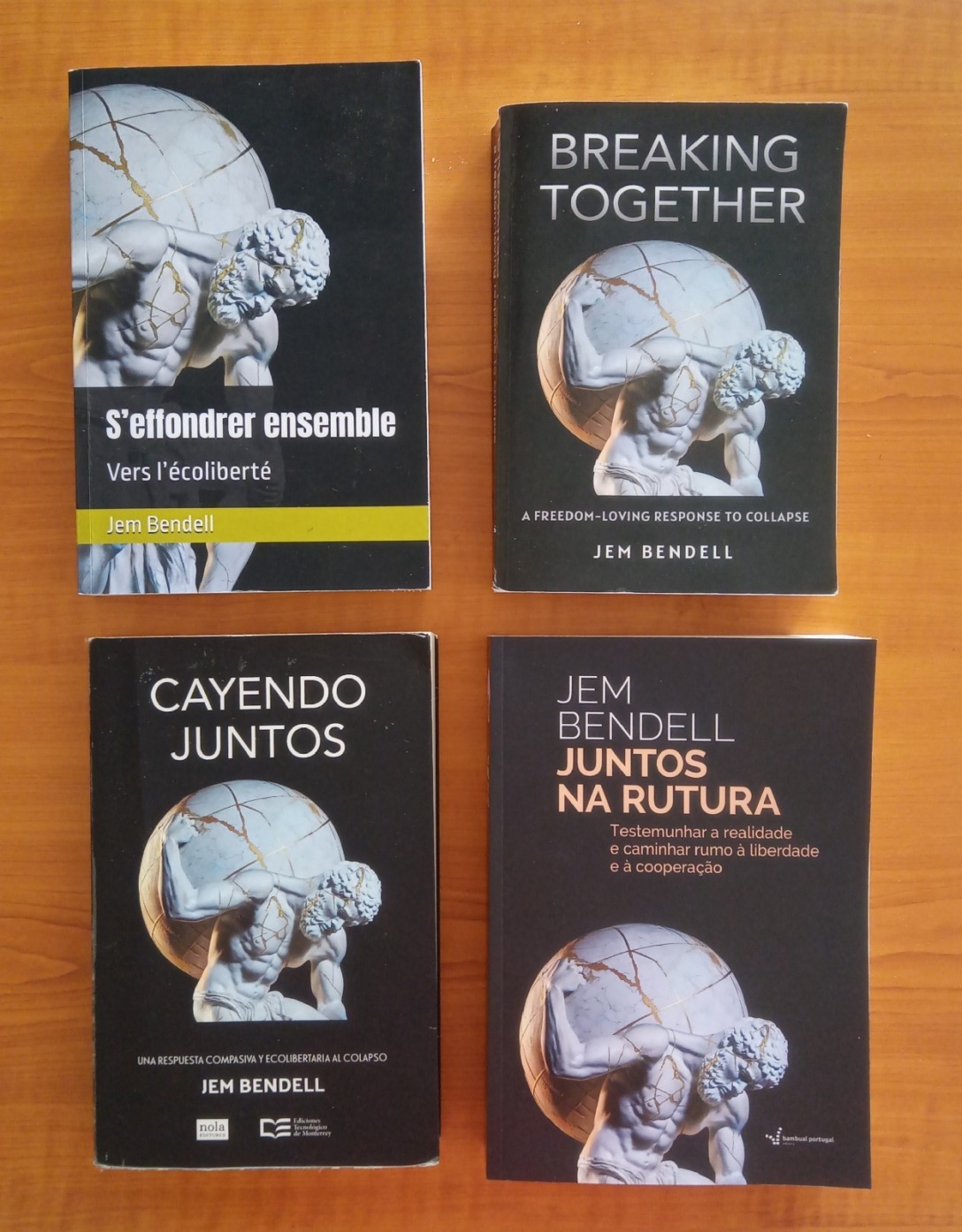
Portuguese is the fifth language that my book Breaking Together is available in. Many at the launch in Lisbon last month travelled from the countryside where they are working on community resilience. For them, the book Juntos Na Rutura provides a useful explanation to others about why they are promoting community economics. One of the interviews around the launch was with the Portuguese degrowth network, which is available on video.
After that inspirational boost, my next speech was to a more general audience in the UK, and I discovered how my analysis on the causes and implications of societal collapse can be easily misconstrued. Therefore, I wrote a summary of the foundational concepts in my work, including concepts like Deep Adaptation, the Metacrisis, the Great Reclamation and Ecolibertarianism, to appear here on my homepage. In addition, I worked with a colleague to prepare a summary of some ideas in each chapter of Breaking Together, which I publish below.
Continue reading “Summary of Breaking Together”
After my essay on September 5th on the need for a pan-ecological understanding of climate change and how to respond to it, I received a range of feedback and questions. “Does it change your anticipation of collapse,” was one question. Ahead of next week’s Metacrisis Meeting on this topic, in this blog I am sharing my provisional answers. An 800-word summary of my essay on the topic can be found below the following FAQ.
The renowned Professor Bill Rees, who popularised the concept of ecological footprint, welcomed the climate dogmas essay as follows:
“Most climate science sees climate as mainly a physical system with scant attention to systems ecology… Your essay goes a step beyond, to see the climate as a biophysical phenomenon, as a product of the interactions among the physical drivers— atmospheric gases, the solar flux, etc. — and biological processes both marine and terrestrial. I.e., it forces recognition that the climate system cannot be understood in isolation from the biosphere. To acknowledge and fully understand the role of the oceans (e.g., dimethyl sulfide), forest cover, soils production, evapotranspiration, etc. and their effects on atmospheric gases (hydrological cycle), albedo, heat balance , etc. would be a massive leap forward for climate science. I suspect, as your article implies, it would go a long way toward revealing why (more or less in the words of top US climate scientist Gavin Schmidt) present climate models cannot explain what’s actually been happening for the past decade or so… I agree completely that what you are calling a ‘pan-ecological paradigm’ would “recognise that the pervasiveness and complexity of living systems” and that related bio-processes “are salient to any natural phenomena” including the climate systems.
As a sociologist and transdisciplinary research analyst, rather than a climatologist or ecologist, I am grateful for such feedback, and hope it encourages you to read the essay and look at the sources and references I link to from it.
Continue reading “Restoring Forest Cover and Ocean Health as the Frontline in the Climate Fight – an FAQ”
If we are truly in a situation of ‘metacrisis’ then the foundations of our understanding of life and death are being challenged. It feels that way for many people who conclude that the upheavals of recent years are aspects of a breakdown in ‘normal’ life. Such a deep disturbance can be fertile ground for rethinking dominant ideas we received from our culture. For some, that can involve rethinking our relationship to religion, spirituality and the divine. That has brought me to a point of recognising that the cultural mis-shaping of our shared interpretations of personal experiences of non-separation and existential gratitude, are at the root of widespread destruction and exploitation. Even without the scandals and violent histories, institutionalised religion has a lot to answer for. Beyond that, exploring an enlivening and empowering spirituality can be an amazing outcome of the metacrisis. It doesn’t make the bad stuff go away, but it can change how we respond to it.
I was born into Christianity, in the Anglican tradition. It took me until my 50s to look into the content of those Gospels that were excluded from the official canon. One of those is the Gospel of Mary Magdalene. Upon studying it, I composed a mantra that draws from one of its phrases about the sacred interbeing of all that exists. I performed the mantra at a musical gathering, or Kirtan, which occurred on the day of the feast of Mary Magdalene (July 22nd, 2025). The band had not heard it or rehearsed it before, but as we had Ezca dancing with us, I wanted to record the occasion – and the video follows below. The result is a bit messy, musically, but I think it conveys some of the feeling of the moment. The chords and words of the mantra follow at the end of these reflections.
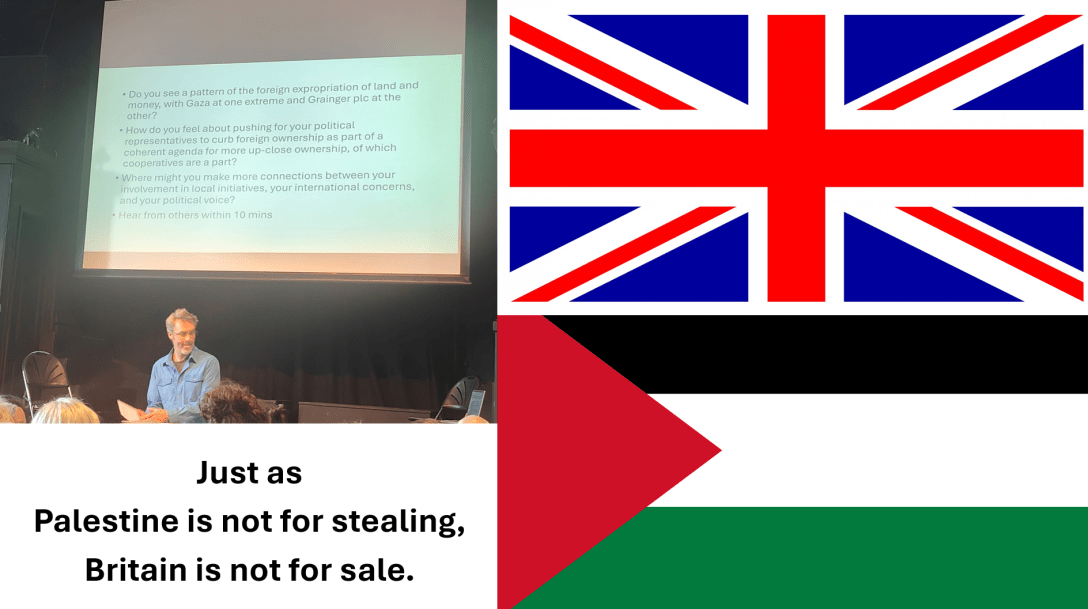
The transcript of a speech delivered in Stroud, UK on 13th Sept 2025, by Professor Jem Bendell.
“Britain’s not for sale and Palestine’s not for stealing – defending and restoring citizenship ownership in the face of collapse.”
I am pleased to be back in ‘The People’s Republic of Stroud’. I first saw that phrase in the background of a talk entitled ‘heading for extinction’ by Gail Bradbrook back in 2018. People in the town of Stroud played a key role in the formation and growth of Extinction Rebellion, which sparked a new wave of environmentalism, bringing wider attention to the climate crisis. I mention that today, as I’m interested in connections between more commonly-owned assets, on the one hand, and a political voice on the other. Only with both of those do we increase the chances of coping better with a creeping collapse of the systems and opportunities we once had.
Today is unusual for me, as I am going to talk about politics. I have never given a speech before that is explicitly about politics. In the first half of 2017, I worked in front line politics with Jeremy Corbyn and his team. I advised on strategic communication, co-wrote speeches, and some of the manifesto. I went on to train some of the current backroom staff for PM Keir Starmer, including Morgan McSweeney. But I have never given a political speech myself. I feel now is the time to do that, because of what’s happening in Britain right now.
Continue reading “Centering Citizen Ownership: Britain is not for sale and Palestine is not for stealing.”
You must be logged in to post a comment.