I invited an essay from a conservationist who recently worked in the crucible of US politics, and is now seeking ways to bring more authentic attention to ecological realities.
By Aaron Vandiver
Over the past several decades, environmentalism has been driven far from its roots. What began as a movement grounded in ecological understanding, love for the living Earth, and resistance to industrial destruction has been reduced to a narrow technical problem: carbon emissions.
When, on this blog, Professor Jem Bendell explains a pan-ecological perspective, he is calling us back to a truth environmentalists once grasped intuitively. As Rachel Carson wrote, “Nothing in nature exists alone.” Forests, oceans, soils, coral reefs, and natural hydrological cycles are, as philosopher Charles Eisenstein puts it, the “vital organs” and systems of a living Earth. A mechanical climate model focused on atmospheric physics and emissions cannot capture this living dimension. As Professor Bill Rees put it in response to Jem’s essay, climate is not primarily a physical system but a “biophysical” one. Recognizing this requires elevating biology — life itself — to the same status that physics and chemistry have enjoyed in the institutions of science on environment and climate.
As with many countries in the Western world, the UK has seen a rise of ethno-nationalist politics in recent years. One politician who led the Brexit agenda to leave the EU, is Nigel Farage. Not being able to blame the Eurocrats anymore, the lie took hold that Britain’s ills could be blamed on poor immigrants rather than greedy elites. Recently, Farage has come under fire for his alleged expressions of antisemitism. Although that focused on his childhood, his appearances on the podcast of alt-right conspiracy theorist Alex Jones was also discussed. During an appearance, Farage claimed that ‘globalists’ are trying to override national sovereignty by creating one world government. Some critics have claimed that it was ‘dogwhistling’ about threats from Jewish elites. The concern arises because Jones and Farage claim there are evil cabals of people, rather than members of a transnational capitalist class, who are serving the extractive demands of international capital. They don’t discuss capitalism in an intelligent way, because then they would be criticising their friends, funders, and the system that has promoted their views to huge audiences. Discussions in the mass media about who ‘globalists’ are and whether we should be concerned about them (and the structures of capital they serve) could be welcomed, if those discussions go beyond the lazy and nasty tropes of antisemitism. Unfortunately, such discussions seem difficult to have in the UK and elsewhere, as political discussion is often febrile and superficial. I was reminded of that recently in the town of Stroud, where one independent newspaper seems to have generated new debates and fractures between people who previously worked together for social change. In this essay, I want to share what I noticed from reading that newspaper and from experiencing the community fractures that emerge around its arguments. If the mass media weren’t so badly misinforming people in order to protect elites, perhaps this situation would not be so difficult. But in such a poor information system, there is work to get people talking about what can be done together at community level as life gets increasingly difficult for so many.
The breakneck acceleration of Artificial Intelligence (AI) has moved the discourse on its benefits and perils from science fiction to boardroom and government-level concern. In the last few months there has been a series of articles by the BBC about AI trends and potential dystopias. One article was about how some leaders in AI are anticipating societal collapse and getting their bunkers ready. We also read that some ‘tech bros’ even want such a collapse, as their technotopian futures involve a break with life as we know it. One BBC article mentioned that the ‘AI Futures Project’ predicts AI may achieve ‘super intelligence’ by 2027 and then human extinction, or something like it, will occur within 5 years, via an AI deliberately engineering superbugs. Supposedly, it would do that after deciding that humans are a major problem without a remedy other than mass murder. I haven’t seen the authors of that study receive the kind of aggro I got since 2018 from predicting societal collapse due to climate change. Maybe that’s because we are used to sci-fi dramas where robots kill nearly everyone. But their prediction might be part of a ‘wake up call’ for wider societal engagement and responses to AI, so we might head off the worst scenarios. Maybe I’m naive, but these dystopias certainly woke me up a bit, and so here I am writing about AI and collapse. After the jolt, I read into the nature and scale of some risks, with the aim of exploring how people who want to behave well in these times of societal disruption and collapse — including myself — could use AI responsibly. That exploration is still ongoing.
The one talk that I’m scheduled to give in the UK this year is at the Festival of Commoning in Stroud. My reason for that is my support of what Michel Bauwens describes as cosmolocalism [0] in the face of collapse, and what I term the ‘Great Reclamation’ of our power. It is best explained and illustrated by one of the organisers of the Festival, Dave Darby, in a guest article…
“All civilisations collapse in the end. The Roman Empire is long gone, along with the ancient Greeks, Egyptians and Sumerians. Will the global civilisation of corporate capitalism buck the trend? Of course not, but how long does it have left? In such a complex system, it is impossible to predict when there will be a sudden shift, but there is good evidence that the process of breakdown has already begun. Damage to soils, water tables, forests, the oceans and climate is occurring alongside economic and political upheaval. No longer is this a theoretical matter about the distant future, but something we should be preparing for today. But how?
“I wanted to punch the guy, but when I realised I couldn’t do that, I just switched off.”
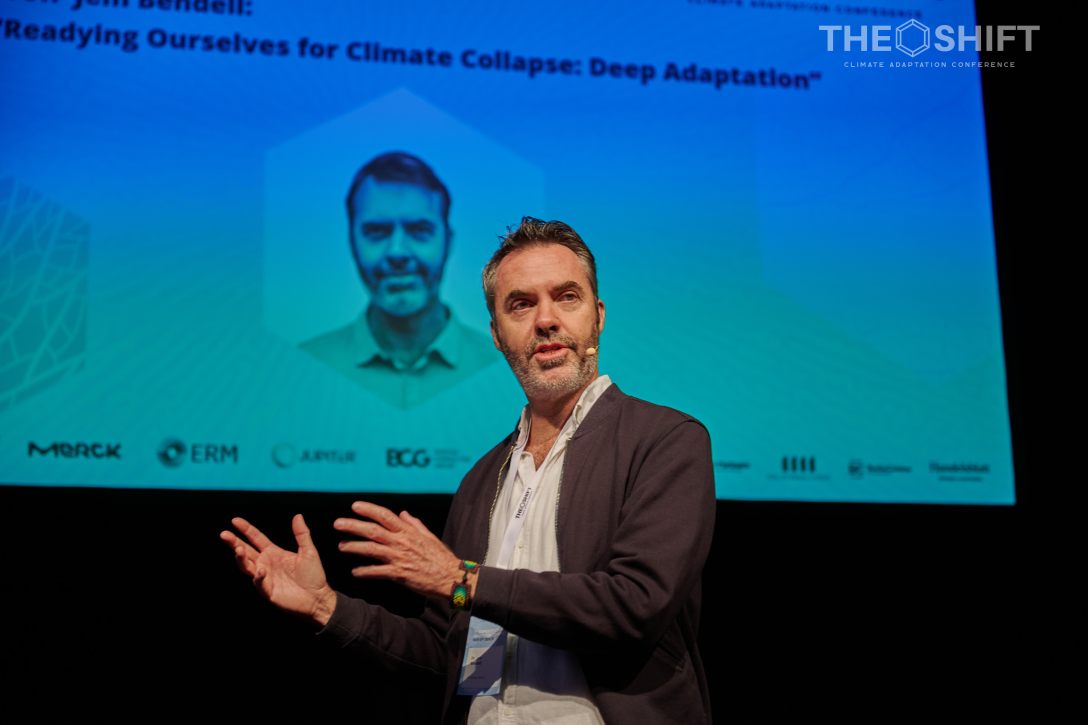
This was certainly a new kind of response to giving a speech. I’d just left the stage at a conference on adaptation to climate change, and was surrounded by people wanting to exchange a few words and contact details. “You really stimulated the audience, as we hoped you would,” one of the organisers said, smiling as he told me of the guy who liked my views so much that he wanted me to connect with his knuckles.
I’d already heard enthusiastic praise from another organiser, so I reacted to the negative feedback in dismissive fashion. “Anger is a way of responding to difficult information, situations and emotions. It gets us out of fear,” is more or less what I said. I continued with my mini lecture by saying “Fight or freeze are two normal responses to fear. It’s why I talked about the benefit of getting better with allowing, witnessing and working through difficult emotions. It’s also why we must recognise so much of our conversation in professional circles is to avoid conflict and emotional difficulty, using convenient narratives, that stop us from facing reality.” This all tripped off my tongue because being intellectual and slightly combative is my go-to response when under threat. However, I’m writing this essay because I was on the cusp of noticing that go-to response, and chose a different way to engage when experiencing conflict. If you also navigate strong emotions about the state of our world, I hope the following thoughts may be of use.
Essay shared to coincide with my speech at the 2024 Festival of Dangerous Ideas.
Self-deception is rife within the environmental profession and movement. Some denial or disavowal is not surprising, due to how upsetting it is to focus on an unfolding tragedy. But our vulnerability to self-deception has been hijacked by the self interests of the rich and powerful, to spin a ‘fake green fairytale’. Their story distracts us from the truth of the damage done, that to come, and what our options might be. Indeed, their fairytale prevents us from rebelling to try to make this a fairer disaster, or a more gentle and just collapse of the societies we live in. Averting wider rebellion might be why the fairytale receives loads of funding for books, awards, feature articles and documentaries, as well as videos for popular YouTube channels. That’s why, like me, you might not have realised for years that it is a fairytale. In this essay I will explain the nine lies that comprise this ‘fake green fairytale’ before explaining how much damage is being done to both people and planet from the dominance of this story within contemporary environmentalism.
As modern societies experience further disruption and decline, how can our work in organizations help more of us ‘break together’ not apart?
Once people reach the conclusion that societies are not just being continually disrupted but that we are in a situation of actual breakdown, not everyone can quit their job and do something new. After doubt transitions into shock, grief, and anger, not everyone can ‘go wild’ like many ‘doomsters’ do. Nor would we want everyone to! How to integrate an acceptance of societal collapse into one’s professional job in a large organisation is therefore a huge issue. However, until now I did not find anyone in the field of organisational development who could try that. This intransigence even existed amongst experts on ‘sustainability’ and so moved me to write an article last year that summarised the ways they were maintaining their denial. However, five years after the Deep Adaptation (DA) movement took off, it appears that the situation is opening up a bit, as I noted in the latest DA Review. The recent engagement with both DA and my new book ‘Breaking Together’ by world-leading sustainability advisors and trainers R3-0.org, is another indicator of change. Some management consultants may prefer to speak of a polycrisis of ongoing disruption, rather than the unfolding collapse of industrial consumer societies – but an opening has appeared, nevertheless. Therefore, in this essay I will offer some initial ideas for how to work on societal collapse risk, readiness, and response, within organisations.
There is now much peer-reviewed science on the medicinal benefits of various natural foods. Which is obvious as humans have been healthy and recovering from disease since… um… well… prehistory.
So science is playing catch up with traditional and community knowledge on how to help stay healthy and recover when we get sick. But that wisdom is studiously ignored by medical bureaucracies that have been trained to only accept large clinical trials of the type that (mostly Western) pharmaceutical companies can pay for. It means that esteemed institutions like the World Health Organisation (WHO) mostly ignore what is being done with healing plants in many countries. Worse, their staff devoutly and proudly ignore it as a matter of professional and personal identity as being strictly “scientific.” I know that because I worked as a consultant with them before. And there is evidence that millions are suffering as a result of their conceit.
This is the 2nd in a 7-part essay on the type of policy innovations that would respond to the truth of the environmental predicament and, also, why most environmental professionals ignore such ideas to promote limited and limiting ideas instead. These ideas on a #RealGreenRevolution provide a contrast to current agendas, with the aim of encouraging a global environmental movement as a rights-based political force. In this essay I focus on that sexy topic of taxation, and how to transform it to provide the price signals and funds to radically alter behaviours in fair ways.
To receive each part of the essay, subscribe to my blog, using the box on the right. To engage with other people who are responding to these ideas, either engage on the Deep Adaptation Leadership group on LinkedIn (where I will check in) or the Deep Adaptation group on Facebook, or by following the hashtag #RealGreenRevolution on twitter. The introductory Part 1 provides context.
In 1997 one of the key ideas being discussed for how to help the whole planet reduce its carbon emissions was a taxation on carbon emissions. Using taxes to influence behaviours through market systems was something most governments had experience of and could be trialled quite easily. However, under the then US Vice President Al Gore, the delegation from the United States stopped that initiative and instead advanced the idea of creating markets for carbon permits. The resultant Kyoto Protocol started that process whereby we have witnessed polluters being given permits which they could then sell. Many environmental experts regurgitated the arguments of corporate public relations, that a cap-and-trade system would be better for the climate by identifying specific limits. Such carbon pie in our overheating sky was gobbled up by financial elites. The cap-and-trade systems have done little to nothing on carbon emissions, which have continued to rise ever faster around the world. I mention this history, as it is an example of how the mundane everyday influence of people working for corporations and governments focused on corporate interests can produce results that are ‘omnicidal’. That word means the killing of all life, and I use it because 1997 was the last chance humanity had to create a framework that could have slowed climate change sufficiently to avoid a manmade catastrophe for life on Earth. I don’t blame you Al, but the fact you are quoted with respect and excitement by environmentalists today suggests how ill informed, uncritical, timid and sycophantic to power the green movement and sector has become.
I ignored it for a while. But as a Prof, it was time to submit to Google Scholar and let their algorithms pass judgement on my work. So I’ve an h-index of 20 and an i10-index of 35, from over 2000 citations. Have I lost you yet? Well at least most of my publications are now in one place. My latest thoughts are on the “Impasse in Western Leadership” which I presented at a conference on leadership in Asia in January.
I continue to work with Dr Neil Sutherland and Richard Little on a collection on leadership and sustainability that arose from the Leading Wellbeing Research Festival last summer. On April 9 the team at IFLAS are hosting a reunion in Ambleside, which will be a great weekend to share relevant initiatives. These ideas relate to our new MA in Sustainable Leadership Development, which is designed to fit around the work of busy leaders. It kicks off with a week in the Lake District this September.
I now work part time with the University of Cumbria, and am adapting what I know to offer wilderness retreats for leadership development. Working with Georgia Wingfield Hayes, our first Leading Wild retreat is in Costa Rica in January next year. We conceived the Leading Wild retreats because we know the most powerful learning is difficult to enable in typical corporate formats. I like hosting learning where we are ready to let go of what brought us success and think afresh about the situation we face. A wilderness retreat invites that approach. 25% of revenues will go into forest conservation. It’s also 25% off if you book now!
Somewhat sooner, if you are in London on April 13th, please join us near the Docklands for a lecture by the founder of the Positive Money campaign, Ben Dyson. At 530pm he will talk about how government issuance of digital cash could kick start the UK economy and pay down the debt. It’s an opportunity for participants in our free online course on Money and Society to gather. Over 120 are currently completing this MOOC that I developed with Matthew Slater (Global Ecovillage Network) and 8+ will study our Certificate of Achievement in Sustainable Exchange in April. This will be co-tutored by Leander Bindewald, whose PhD at IFLAS on the (misleading) discourses of money is getting interesting. I’ll be sharing some of our ideas in a keynote at the Guild of Independent Currencies conference in Liverpool on April 20th.
In February I visited Melbourne to work with my colleagues at Trimantium Capital. They ran an event at Parliament House on the future of superannuation (pension) investments for a more sustainable Australia, and introduced tech investors from Silicon Valley to a range of Australian start-ups. En route back to the UK, I visited the Indian Institute of Directors, to discuss with board directors how we can encourage cultures and systems for firms to seek disruptive innovation for sustainable development. In 2016 I will be doing more work on “impact investing”, to promote the necessary transition to a better economy.
At the Indian Institute of Directors course for non executive directors, where I lectured
I’ve listed my future event attendance below… maybe see you in London, Lancaster, Lake District, Kuala Lumpur, Geneva, Tokyo, Brisbane, Melbourne, or Boston?








You must be logged in to post a comment.