“If the world is falling apart, and along with it our careers, why do we need coaches and mentors? If we dropped the idea of self-improvement we could save ourselves some time, stress and money! Isn’t it time we threw coaching, mentoring, and all that ‘leadership development’ stuff, into the bin of ‘what we did when we had a future and some budgets to play with’?”
As someone who quit being a director of a University institute working in leadership development, to become a ‘doomster’ who now experiments with farming and music, you might think I reached that type of nihilistic conclusion about professional development, and even personal development. But I didn’t. Instead, my collapse-awareness opened me up to new questions and interests, with some of that being being helped by coaches and mentors, both hired and informal. I feel like I have been ‘growing’ more since my collapse awareness. Yet there is a problem: I hear from professionals in the coaching space that collapse-awareness is still a niche view, with the mainstream behaving as if there is a future of shiny happy coaches holding hands with abundant clients. So in this essay I am sharing what I think about how coaching and mentoring can evolve during the metacrisis, and how we are approaching that in the Metacrisis Initiative.
In case you didn’t know, recent decades have seen professional coaching grow from a niche practice into a substantial global industry. Organisations such as the ICF, AC, EMCC, and EASC, have helped develop standards, competencies, and ethical frameworks to provide coaching and coaches more credibility in professional settings. Relatedly, a different stream of ‘life coaching’ has flourished in the field of personal development, often influenced by concepts that emphasise the power of intention in shaping our experience of life. Both of these strands have offered something valuable. I have seen how professional coaching has helped many of my friends in senior management, from business to the United Nations, to navigate their career and leadership challenges. I also witnessed how manifestation-oriented life coaching encouraged other friends, often self-employed, to recognise the role that mindset and attention play in shaping our experience. Receiving that latter mode of coaching in 2018 and 2019, helped me to respond to the explosion of attention to my work on the climate crisis at the time. Looking back, I think it gave me more confidence to speak from my heart and to focus on the new initiatives which I regarded as important at the time (the Deep Adaptation Forum and Extinction Rebellion).
Despite these upsides, I have always had a nagging feeling that those coaching approaches have some fundamental limitations. That nagging feeling grew as I talked with members of the psychotherapy profession on how they respond to emotions related to climate change. In 2019, I delivered a talk at a conference of counsellors and psychotherapists (the UKCP). I discovered that many therapists were receiving many clients who expressed fear and sadness about the climate situation, and were also feeling difficult emotions themselves. They explained how they did not feel it authentic to suggest to their clients that the threats could be managed and disasters averted. Since then, there has been a lot of work done in the field of climate psychology, although its penetration into wider counselling and psychotherapy is limited, and the influence of traditional concepts seems unhelpful (as discussed in a previous essay). In the related fields of professional coaching and life coaching, I have heard of some similar disquiet, and engaged in some coach-led climate-aware initiatives that exist to evolve principles and practices. However, looking at mainstream coaching and leadership development today, I do not see that much has changed.
After looking closer at mainstream coaching practices, and the critiques that others have made, I now conclude that such practices often mobilise underlying assumptions which limit their ability to fully meet the needs of the present moment. Those assumptions include the societal context of coaching, the personal purpose of coaching, and the commercial interest of providers. In this essay, I will explore the problems with such assumptions, and how coaching and mentoring must not overlook — instead, sometimes foreground — the profound social, ecological, and existential questions that are now pressing for so many of, whatever our professional situation. Drawing on insights from critical coaching, group practices, and the need for ‘critical wisdom’, I will explain why we are offering a new kind of peer mentoring within the Metacrisis Initiative. We use the term ‘metacrisis’ to refer to how many of today’s challenges and predicaments – ecological, social, economic, and cultural – are interwoven rather than separate, often with common causes, which destabilise our identities and worldviews, sometimes leading to maladaptive responses, but which also offer the potential for personal and collective transformation. Therefore, the evolving practice that I will outline below as ‘metacritical mentoring’ is designed to help participants help each other to live meaningfully and kindly in a fracturing world.
Limitations of some mainstream coaching
Around us we see that social and political tensions are rising, ecological stresses are intensifying, so that long-standing expectations of stability or progress now seem like old fantasies. That context means many of us are not simply seeking better performance, clearer goals, or more positive energy. Increasingly, we are questioning the direction of our work and lives altogether. Even our identities. For many of us, the questions becoming more pressing are not “How can I optimise my life?” but rather “What is mine to do in a troubled world?” and “How can I remain kind and curious when times are tough and the future feels uncertain?” If the context of professional coaching is assumed to be a stable society and the potential for a viable career, the extent to which such questions can be explored in a coaching context will be limited. That’s why something new is called for…
For 11 years as a full professor in the field of leadership development, I was interested in ‘critical leadership studies’, which enhanced my recognition of how power dynamics shape what we might consider to be positive behaviours in organisations. Such analysis is also relevant to coaching, with some practitioners describing themselves as involved in ‘critical coaching’ where the social, political, and economic forces shaping both clients’ lives and the coaching industry itself are foregrounded. Here ‘critical’ means systematically unpacking how ideas, methods, and norms in coaching are produced, legitimised, and promoted within particular power dynamics — and how they often reproduce power structures. Working from that perspective, mainstream coaching can be regarded as reinforcing neoliberal assumptions that personal success depends solely on individual effort, while ignoring structural inequalities such as gender, class, or race. One implication of such insight is to explore how these activities can enable collective empowerment rather than only self-improvement. Another implication is to give attention to how to democratise access to coaching knowledge — a topic I will return to in a moment.
Given the rapid changes in the world, these ideas from critical coaching are increasingly relevant. At a minimum, to stay relevant in a ‘metacrisis’, professional coaching and mentoring will need to respond to the changes in societal conditions rather than assume the relatively stable contexts in which many coaching models were originally developed. Once recognising such instability and disruption, the question of why that is happening must be part of the conversation. With that in mind, the normal emphasis on a coach’s apparent values-neutrality and client-centred orientation, could come to be regarded as avoiding a complex reality. That existing emphasis can arise from an earnest principle of not bringing a coaches’ values into the client relationship. But one can argue that is not possible, and so it is better to be transparent about values and views, and how they will be part of the coaching process, while avoiding attempts to inculcate values in a client. Clearly this issue is a delicate one to navigate well, and it might be easier, economically and psychologically, for some coaches to avoid it. Since 2021, the Global Code of Ethics on coaching and mentoring recognises the importance of any professional coach staying abreast of “societal or environmental needs,” but doesn’t require more than some attention to stakeholders’ interests when they begin a client relationship. Instead, best practice could be regarded as foregrounding values and views, within the context of a professional commitment of a coach to be curious rather than evangelising about a particular view. The experiences of some in the counselling and psychotherapy professions could be relevant here, as therapists aware of our environmental predicament have been supporting each other with their own emotional wellbeing, as well as how to navigate the tricky issue of hosting related conversations with clients (e.g. see the CPA). Professional coaches who are concerned about climate change are also grappling with these issues, including professionals within the CCA and the new Sustainability Coaching Coalition. In time, these initiatives will hopefully influence the wider field of coaching and mentoring, rather than being an interest group that is relevant to a subset of practitioners.
Some people think that the less career-focused coaching practices are more likely to help us in a changing world. In some cases, perhaps. But in my experience, manifestation-oriented life coaching encourages the people being coached to shift their attention away from difficult emotional states toward more generative energies. That can be transformative for people who have felt stuck with a preponderance of difficult emotions or self-limiting beliefs. However, if we are experiencing grief about ecological loss, anxiety about social instability, dread about inevitable future difficulties, and moral confusion about our roles within systems that appear to be breaking down, any emphasis on ‘energetic tuning’ can seem delusional — at least initially. Skillfully held, in my experience, a manifestation approach can help people without denying the severity of the situation, so that positivity need not be mutually exclusive with grief or concern. However, it is not uncommon for a life coach within this paradigm to explain their belief that there is metaphysical power involved in one having a positive outlook on one’s relationship with the world, and that the evidence of that will be in both material success and experiencing more ‘positive’ emotions. An implication of such a view is either that the wider world is not important, or, it can magically improve by focusing on one’s personal energetic tuning. Yet poverty, war, and environmental damage do not disappear by ignoring them. Neither are they definitely ameliorated by us focusing on them. Nevertheless, being curious about all that is happening in the world, and wanting to be less harmful and more useful, is widely recognised as a natural state for us humans, and we can welcome that not only according to specific values, but because it provides the possibility for collective action that might be of wider benefit.
In future, manifestation-focused life coaching could increasingly fail to provide a deeper source of emotional resilience in challenging times. That is, unless it integrates attention to and acceptance of such difficulties in the world, and how that impinges on each of us. For those coaches who are emotionally resourced to explore that approach, perhaps even accepting we live in a time of metacrisis and collapse, then there is an important and growing role to play. My view is that insights from more contemplative and mystical understandings of the human condition are essential for such an evolution of life coaching.
We should also recognise that most of the public will never encounter coaching directly. They are navigating tough questions in an unstable world in their communities, families, workplaces, religious institutions. Some people join initiatives such as men’s groups and joint 12-step programmes, which explicitly offer forms of peer mentoring, where we both support and gain support from fellow participants rather than trained professionals. On the one hand, the professionalisation of coaching has codified approaches, improved standards, and added safeguards, in ways that made it more possible for organisations to fund their staff to access it. On the other hand, that has aided the commodification and commercialisation of the practice in ways that may have made it more expensive and thus distant from the wider public. That presents an issue which the psychotherapy profession has already acknowledged: the wellbeing of a population depends on how societies support each other before they seek professional help. Those of us interested in the contribution of coaching and mentoring to society can therefore ask: how might we open up access while enabling the quality of what is experienced? That is why methods for ‘peer mentoring’ in society come into focus.
The paradox of process in support groups
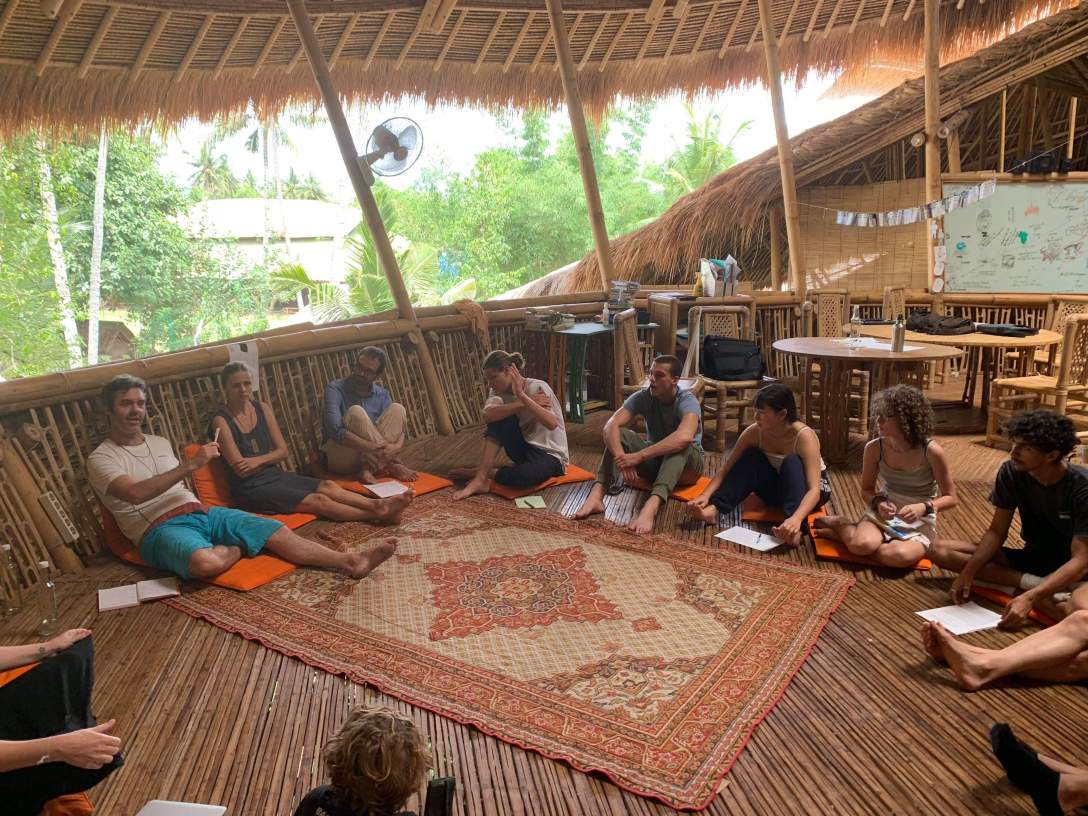
Over the years I have experienced, and also facilitated, group processes which seek to help participants in ways that offer some of the benefits of coaching without the limitations I’ve just described. Many of the people listed in the ‘deep adaptation guidance database’ have learned how to offer something more relevant for today. Yes, even the ones who came from manifestation life coaching traditions! One modality that Katie Carr and I dubbed ‘deep relating,’ helps us break out of habituated patterns of superficial communication. But what I’ve begun to wonder is whether a simpler-yet-comprehensive model for peer mentoring in small groups would be useful. And that is the origin of a new peer mentoring programme within the Metacrisis Initiative, for which this essay is background reading.
I mentioned earlier that peer mentoring is a developmental relationship in which individuals regard themselves as having similar status and role to support each other’s reflection, problem-solving and deeper learning — typically through semi-structured dialogue. Also dubbed ‘co-mentoring’, it is where each participant alternately receives perspective, feedback, accountability, and emotional support, as well as offering that to others when invited to do so. In my experience of such processes, I discovered a paradox. On the one hand, participants benefit from a basic structure for how to be in a circle together — virtual or real — and from a menu of process tools to call upon when someone in the group chooses that. Otherwise, groups can repeat the patterns of superficial conversation and biased representations as we experience in normal life. However, on the other hand, an attachment to rules and the use of process tools, can displace the intention of being together and hide, or smother, the humanness of each participant. What I loved about the men’s group I was part of, is that we came together to support ourselves and each other with open hearts. When it fell apart, for me and some others, was when people wanted to ‘do the work’ with process tools, with little interest in the other men, or in being fully seen. I realised that our ‘heartfulness’ is what made the group so valuable, and it is what has drawn me to the guidance of Reverend Wright on ways to cultivate that.
This experience also brought me to an awareness that is not just ‘critical’ of attachment to specific processes and methods, but ‘metacritical’, where all models and explanations, as well as critiques of them, can be unpacked for what they do or don’t help us to see, be, and do, rather than some being ultimate truths. This reflects a deeper understanding of the ‘criticality’ I mentioned above, which recognises that any of our concepts and models are ‘social constructions’ which can point in the direction of truth but not precisely represent such truth. As Lao Tsu wrote, millenia ago, “the truth that can be told, is not the eternal truth.” That is really important to keep in mind when considering participating in coaching or mentoring during these times, where existential questions about the nature and meaning of life are naturally arising. Unless we are metacritical in our view, we might open the door to a procession of religious leaders and alternative spiritual gurus, each asking us to uncritically accept their stories of everything seen and unseen.
In my book Breaking Together, I explained that when our assumptions about life, society, and the future are fractured, we can feel bewildered and become vulnerable to manipulation, whether from authorities or opportunists. Therefore, I argued how important it is to cultivate our ability to continually investigate the nature of truth, without craving for emotional security or escape. I termed that ‘critical wisdom’, which involves four capabilities. Logical reasoning remains incredibly important to test any ideas we are told and reduce the various biases that are mobilised in public communication today. The ability to recognise assumptions and views embedded in the terms and symbols we experience in society, and how they enact and enforce power relations, is also essential (something termed ‘critical literacy’). Mindfulness, where we can better witness our thoughts and associated emotions, rather than be defined and driven by them, remains key to avoiding delusion. Such mindfulness can also enable our ability to allow our unconscious mind to rise into our consciousness and be assessed, which is another way of thinking about our ‘intuition’. Perhaps what we call ‘intuition,’ is also our capacity to listen to what might be communicated by the aspect of our consciousness that is connected to the universal and eternal nature of reality. The loving quality of that communication is why Reverend Wright describes it as ‘heartfulness’, and his guidance on cultivating that quality in us has been influencing my development of practices for peer mentoring.
Metacritical Mentoring
The ideas I have explained thus far have led me to experiment with a different approach with the people who joined the Metacrisis Initiative. By naming this ‘Metacritical Mentoring’, I am pointing to the need for ‘critical wisdom’ in a metacrisis, including our constructive and open-ended questioning of concepts, methods and contexts, as we centre our aims of connection, curiosity and kindness. We are trialling the approach in small online groups composed of people who aim to live and act well within the metacrisis — to be ‘heartful’ in our responses to these times. We will draw practices from peer-to-peer coaching, co-mentoring, dialogue practices, and community learning, while avoiding some of the assumptions embedded in existing traditions, and to give space to the existential questions that arise from a recognition of metacrisis and collapse.
Six working principles will guide the approach of Metacritical Mentoring:
First, we do not focus merely on individual self-actualisation and success, but invite each other to experience ourselves as curious and kind participants in processes of collective liberation and reconnection.
Second, we do not assume stable and progressing contexts, but recognise that many of us think that we are living through volatile and uncertain conditions, and therefore we seek to support reflection and adaptation within that reality.
Third, we do not frame difficult emotions as obstacles to vitality. Instead, grief, fear, anger, dread, and confusion are welcomed as understandable responses to what we perceive around us, and can be sources of insight and solidarity if we help each other towards that.
Fourth, we do not restrict ourselves to specific frameworks of co-mentoring. Instead, we use them as tools which we can benefit from, while also benefitting from critiques of such tools, as part of cultivating our ‘critical wisdom’ and our foregrounding of ‘heartfulness’ in our interactions.
Fifth, we do not assume any mentor’s or facilitator’s neutrality, but recognise the assumptions, beliefs, and values, of all co-mentoring participants, are involved in the process and can be usefully explored without craving correctness or avoiding shame.
Finally, we do not treat the capacity to support others as a scarce professional skill, but share practices and facilitation approaches so that participants can support one another and seed similar activities elsewhere. Therefore, we will continue to ask ourselves how we might bring what we benefit to others with less privilege or opportunity.
These ideas are still evolving, and the groups themselves are modest experiments rather than a finished methodology. By attempting to meet the need for forms of accompaniment on how to live meaningfully in a metacrisis, we will learn something useful as we go.
For those of you involved in coaching and mentoring, this may be an interesting moment to ask: what kinds of conversations does our time now require, and how might our practices evolve to hold them? For more and more people?
You are also welcome to join the Metacrisis Initiative. If you are a young professional from the Majority World, you can apply to join for free.
❤ Jem
Reflection Exercise:
Remember a time when you received support from someone (or group) that changed your life for the better over the mid-to-long term. It might have been one conversation, or a series of conversations, or a tangible action rather than conversation. Recall the situation you were in, materially and emotionally, what the person(s) did, what was it about you and/or their input which helped it reach you, and how you changed as a result. Write down all of these aspects. Then write one sentence which summarises what it was about the person(s) and the interaction that helped you.
PS: If you would like a definition…
The practice of peer mentoring in the metacrisis might not need a new term to describe it, especially if it doesn’t grow beyond our initial pilot this year. But just in case…
Metacritical Mentoring is the name given to a peer mentoring approach, where non-experts both receive and offer support, to help them live more consciously and positively during the metacrisis of environmental, societal and personal circumstances. The approach deploys a deeper understanding of ‘critical thinking’ as involving the consideration of the benefits and limitations of any concepts, how they shape our attention, how they are produced by and re-produce power dynamics, while also reflexively considering how those insights also apply to any critiques. Six initial principles, published in March 2026, provide an initial philosophy, which attempt to differentiate the practice from popular forms of coaching and mentoring at the time.
In memory of Martin Caine: who brought into men’s groups his heart, humility, presence, warmth, and joy of being in the company of others, whom he saw as chosen brothers.
My thanks to Josie McLean for comments on an earlier version of this essay. As a member of the Metacrisis Initiative you can share thoughts on this essay and related ideas with us and others.
PREVIOUS WRITINGS ON PROFESSIONAL IMPLICATIONS OF COLLAPSE AWARENESS
Keeping your job at the end of the world (as we know it)
The Professional Implications of Collapse: Deep Adaptation in Organizations
Join the Metacrisis Initiative
If a member, then you can see the meetings and decide if you want to join either the salons, the peer mentoring, or both. As a member you can also discuss the issues in this essay in the community chat.









You must be logged in to post a comment.