Establishment lies about Covid-19 continue. In the UK, currently there is an inquiry into the pandemic. It is as much of a sham as the mainstream media’s coverage of it. Due to a bereavement, I’m briefly back in the country, and watched the 6 o’clock ITV news for the first time in a long while. Their viewers were encouraged to assume that lockdowns were a good idea. That’s ignoring evidence from comparing the policies of various countries which has shown that lockdowns didn’t help curb the disease, while also generating widespread damage to both physical and mental health. That’s before we even consider the damage to small businesses and ordinary people’s incomes. The viewer was also encouraged to think the only alternative to lockdowns would be a callousness in letting the virus kill the elderly and vulnerable. There was nothing mentioned about other interventions that could have helped, such as air filtration systems or helping symptomatic workers to stay home. Learning meaningful lessons to curb Covid-19 transmission is incredibly important, as the virus remains an ongoing threat to long-term health due to recurring and persistent reinfections. If you are unsure what I’m talking about, or want to see official evidence and scientific papers for what I’ve just stated, then please review my essays on the topic, since October 2021.
Continue reading “The Covid Sham Continues”Talking with relatives about societal collapse
I’d just spent the last few minutes demolishing the fanaticism of the belief that technology will fix all the problems in the world. As we were coming to the end of our conversation, Daniel Pinchbeck asked me what I could say that’s positive about my conclusion that we have entered an era of societal collapse. I was sitting in my father’s living room, having returned due to him passing away just a few days earlier. I suddenly realised how grateful I am for how my father and I became closer to each other in the last few years. Probably one reason is how I changed since I felt the grief of what is happening in the world, as well as the potential proximity of death for both myself and everyone I know. I hadn’t talked a lot with Dad about my findings on the environmental predicament or the implications for society. But it had come up, and he had been more attentive to the news on climate change as a result. Perhaps that helped him to be more open and appreciative himself. I didn’t ask. But something changed for us over the last few years. That feels like a very personal and unexpected benefit from anticipating societal collapse. It’s an example of what I call ‘breaking together’ not apart. We won’t all react that way, but it’s a real possibility for many of us. Talking about that seems far more true to me than the elaborate ideas some people have about the emergence of an ecological civilisation or a collective higher consciousness after a collapse. I’d happily swap such stories of brighter tomorrows for some extra kindness between more of us today. Especially as we see such appalling and unnecessary violence around the world right now.
My conversation with Daniel reminded me of what I wrote in the introduction of my book about my stumbling efforts at chatting about societal collapse risk, readiness and response with my parents. In case that is a challenge you are also grappling with, I felt like sharing some of that experience. Therefore, below is an excerpt from my book where I write about it, and then some simple advice on how to approach talking with relatives, and others, about this topic. My chat with Daniel is available here, and a slightly odd transcript (as it didn’t pick up on sarcasm) is here.
Subscribe / Support / Study / Essays
Continue reading “Talking with relatives about societal collapse”Money systems at the root of omnicide
Poly, perma, meta, multi, omni… social commentators today like to put a prefix in front of ‘crisis’. Their common idea is that something generically bad is happening in modern societies. Whatever their prefix, using the word ‘crisis’ is misleading, as it suggests those bad things can be overcome. But most of them can’t, as shown by research on the global causes of the global disruptions, chronicled in my new book. Instead, there is a general breaking of the economic, political and environmental systems that maintain modern life. To recognize that is to open a can of worms – including a judgement against the systems, hierarchies and worldviews which brought us to this point. Which is why the commentators for mainstream media, and populist alternative media, will keep saying we are in the ‘whatever-crisis’. One problem with their rhetoric is it delays the potential learning about how we got into this mess, and delays a rethinking of priorities ahead of further declines, breakdowns and collapse. In my book Breaking Together I explain how monetary systems are both the underlying reason we got into this mess and the reason we can’t get out of it. That mess is total, as we humans are manipulated, coerced and rewarded to feel, think and behave in ways that oppress and destroy all life… a kind of omnicide. One example is how an expansionist monetary system not only empowers all corporations to grow, but also necessitates them to grow, including those involved in making war. Therefore, rather than us humans becoming more violent over time, the logic of the system demands more war. These monetary systems are also the reason why elites in corporations and governments will make matters more difficult, as biophysical and economic systems further degrade.
Continue reading “Money systems at the root of omnicide”Leading with the Heart as We Hospice Modernity
Guest article from Deep Adaptation facilitator Katie Carr…
As the systems of modernity collapse around us, what kind of leadership can guide us compassionately through this transition?
Let’s be very clear – modern industrial civilization is dying. Its fundamental pillars – hyper-individualism, the myth of progress, the religion of capitalism, disconnect between head and heart, consumption as a measure of success and happiness – have engineered this disaster. Our relentless destruction of the planet has led us to the brink of extinction. Interconnected systems we rely on for survival, like food production, economics, and law and order, are unraveling.
Continue reading “Leading with the Heart as We Hospice Modernity”Accurate climate activists face prison, while their incorrect critics face… a pay rise?
What I have really valued, but also taken for granted over the years, is how my leadership courses have always been attended by a mix of people, brought together by a shared concern for being their best selves in an era of disruption and collapse. There have been climate activists, scientists, NGO officials and government officials in the room, or the zoom room, exploring sensitive issues together. It has been clear how much they are able to learn from each other. That contrasts with the way many top climatologists appear in the media, and on social media, to assume themselves to know everything that matters. That has led many over the years to casually disdain activists in various ways. The inconvenient truth they now need to face is that the activists are turning out to have been better at reading what was salient from the climate science than them, the salaried experts. Might some humility ensue? Or perhaps some curiosity about what creates such dangerous reticence amongst senior scientists and science bureaucrats? Maybe. But I’m not holding my breath.
Continue reading “Accurate climate activists face prison, while their incorrect critics face… a pay rise?”Responding to the new wave of climate scepticism
When my book Breaking Together came out in May, some of my climate activist friends were surprised that I gave significant attention to rebutting scepticism on the existence of manmade climate change. I also surprised some of my colleagues at COP27 a year ago, when I gave a short talk on the rise of a new form of scepticism. That new form is couched in the important desire to resist oppression from greedy, hypocritical and unaccountable elites. I think the surprise of some that we still need to respond to climate scepticism reflects the bubble that many people working on environmental issues exist within. That’s a bubble of Western middle classes who believe they are well-informed, ethical and have some agency, despite relying on the Guardian, BBC or CNN for much of their news. Outside that bubble, there has been a rise in the belief that authorities and media misrepresent science to protect and profit themselves, while controlling the general public. That was primarily because of the experience of the pronouncements and policies during the early years of the pandemic. When people who are understandably resistant to that Covid orthodoxy have discovered the way elites have been using concern about climate change to enrich themselves, such as through the carbon credits scam, many have become suspicious of the whole agenda on climate change. Those of us who know some of the science on climate, and pay attention to recent temperatures and impacts, can feel incredulous at such scepticism. My green colleagues ask me: “How can someone deny what’s changing right before their very eyes?”
Continue reading “Responding to the new wave of climate scepticism”The benefits of collapse acceptance, part 2: the doomster way
“Around the world, people are dramatically changing their lives to prioritise creativity and social contribution. They are worrying less about their career, financial security, or the latest trends. They are helping those in need, growing food, making music, campaigning for change and exploring self and spirituality. Why is this shift occurring? Because they have rejected the dominant view of reality and no longer expect elites or officers of the establishment to solve the worsening problems in society. After decades of greed, hypocrisy, lies, corruption and stupid policies, they are no longer waiting for any elites to rescue anyone, let alone the planet. But they are no longer upset, numb or despairing. They are living life more fully, according to what they value. It is precisely because these people regard modern societies to be breaking down, that they are living more freely. They need neither an underground bunker nor a fairytale of a better tomorrow as they are living for love, truth and beauty today. Who are they? I call them doomsters. I am one of them. Perhaps you are too?”
That’s an excerpt from Chapter 12 of Breaking Together, which is now available as a free audio. In the chapter, I offer some examples of the many forms of ‘doomster’ life, around the world, what psychology tells us about this phenomenon, and the extent to which we might become a force for positive social change in an era of societal collapse. In the subsequent chapter I go on to explain why the officers and wannabes of the establishment now fear us enough to misrepresent, censor, and even criminalise us. That is probably because we doomsters are escaping so many of the lies and preoccupations of modern societies. This kind of freedom is something I explored in a discussion with former Occupy Wall Street activist Karen Perry, in our recorded conversation on the benefits of collapse acceptance.
Continue reading “The benefits of collapse acceptance, part 2: the doomster way”The reviews of Breaking Together are in
JOIN US? We are accepting applications for our online course “leading through collapse” – deadline is in 2 weeks.
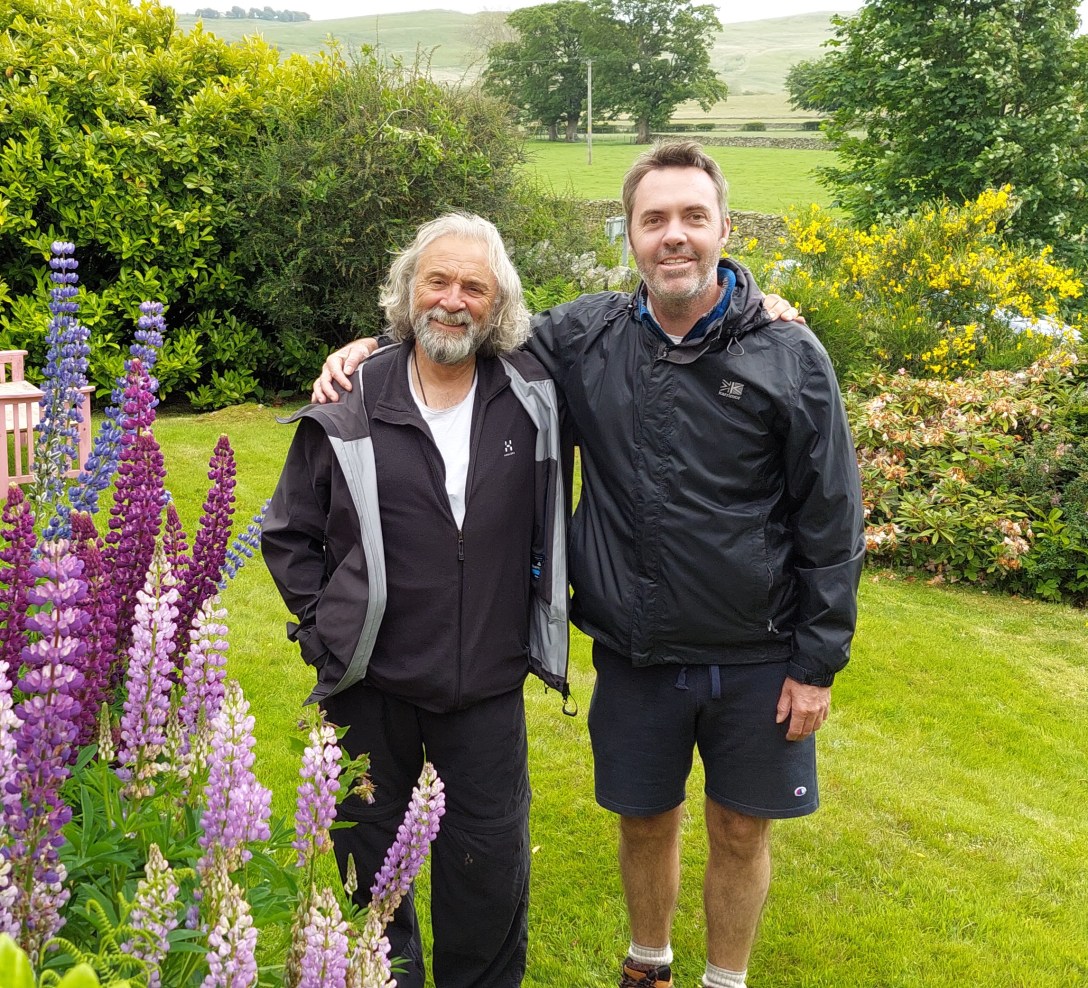
Breaking Together came out on May 9th 2023 (my Dad’s 77th birthday). When he first became bed bound, I lived with him for a couple of months at the end of 2022. After every cup of tea I delivered to his bedside, he would ask how the writing was going, and reminded me of the book deadline. That encouragement from him meant it felt very satisfying to read sections of the published paperback to him when he was at the Rowcroft Hospice in Torquay (listen here!).
I am pleased with how the book is impacting people who work on sustainability or social justice issues, either as professionals or activists, around the world. Multiple translations are underway. On the off chance you are in Bali on October 19th, please consider joining my Asia book launch at the Ubud Writers and Readers Festival. But in this post I want to share some of the book reviews, as it is fascinating to see which parts of the book resonate with whom. Below I list the reviews that I know of, before reflecting on issues arising from my writing that haven’t yet been discussed.
World Literature Today is a magazine devoted to what it says on the cover. So I was delighted to see it carry a review that focused on the main message of how to respond positively to climate-induced disruptions in our lives: “Finding Freedom amidst Climate Collapse: Jem Bendell’s Breaking Together by Simona Vaitkute.”
On the website of the community economics focused NGO Low Impact, Dr Patrick Smith focused on the challenge of marshalling evidence for an unfolding breakdown of modern societies and the plausibility of such a conclusion” “If our civilisation were collapsing, would we even know? Review of Jem Bendell’s ‘Breaking Together’. I was also happy that my first interview about the book was with the boss of Low Impact, and that my cat Buki showed up at the end. I could not have coped with the isolation involved in writing the book if it wasn’t for him. Sadly he disappeared from my life soon after, to the heartbreak of both myself and all his human and cat friends.
The organisation Shareable also focuses on relocalising economies and their review of my book honed in on the need for economic systems to enable such relocalisation: “A new compass for navigating past the collapse: A review of “Breaking Together”.
In the UK’s left wing newspaper, the Green Party Mayor of Glastonbury focused on the freedom-loving environmentalism called for in the book. She identified it as an antidote to the recent bifurcation of views into eco-authoritarian technocrats on the one hand and conspiracy theorists on the other: “It takes a village | Morning Star”. In the US, that theme of a freedom-loving environmentalism was focused on in a review by the author Aaron Vandiver, when he asked “can we reboot the environmental movement — so it protects freedom, too?”
On her Medium page, Renaae Churches focused on the part of the book where I critique some of the ideas in the ‘doomersphere’ where they consider collapse as being predetermined and therefore nothing to learn about or change on the way down: “Loving that part of nature we call human”.
The cultural commentator Daniel Pinchbeck produced a series of essays reflecting on aspects of the book. The first of these was Earth’s Breaking Point? In it he states “Jem Bendell’s new book, Breaking Together, argues that modern civilization has already started to collapse. I agree with him.” I will be participating in Daniel’s online course soon.
One review attempted to summarise the whole book, with regular cross referencing of other relevant writings. An impressive engagement and helpful summary for someone who doesn’t want to read the whole thing! “Joining Together as Imperial Modernity Breaks — Book Review and Essay with excerpts.”
As a cofounder of Extinction Rebellion, Gail Bradbrook invited fellow rebels to read the book and reassess what to do next. In “Why read Breaking Together by Jem Bendell?” she kindly wished me well in my new pursuits (more farming and music), as well as hoping that the misrepresentation of my work to attempt to cancel this topic of collapse would not repeat itself. My sense is it will! Perhaps not in the mainstream media, which still prefers to hide these issues rather than platform them. However, in recent years niche outlets like the Ecologist and Open Democracy sometimes appear to police the Western environmental movement into maintaining anti-radical attitudes. Therefore, I wouldn’t be surprised if something silly appears in publications like those. Which is not to say that there shouldn’t be critiques – there absolutely should! As I told Novara Media, I offer this book as a way to kickstart a conversation about what a postdoom politics might involve (you might call this a politics of transformative and deep adaptation). Key is that we debate and dialogue without misleading our readers with false statements about the scholarship, or the people involved, or the effects therefrom.
Looking at these reviews, I notice the following topics haven’t yet been discussed in depth in any review, so look forward to future reflections from readers:
- The limitations upon institutionalised scientists for them to coherently and saliently analyse complex systems.
- The extent to which the climate policy agenda should dramatically shift to prioritise the cloud seeding role of forests, the need for intervention in the Arctic to restore ice cover, and adaptation to severe damage to crops worldwide.
- The extent to which established green NGOs have misled the environmental movement and wider public about the nature of the predicament, because they watered down conclusions from the science to maintain a reformist outlook (and if so what to do about that).
- The nature of consciousness and why freedom of choice amongst sentient life is inherent and essential to nature (including the part we call human).
- Whether we need a fundamental reboot of socialist critique and proposals for a new era of collapse.
Perhaps these topics, and more, will come up in the online courses I co-teach on Leading Through Collapse. The book is available in all formats and as a free epub from: BREAKING TOGETHER – a freedom-loving response to collapse – Prof Jem Bendell
If you think people should know about this book, please skip sharing it on social media, and instead send a link to a few individuals by direct message or email. The reasons to avoid anti-social media algorithms are described in Chapter 13 of the book.
Next week I return to the Benefits of Collapse Acceptance. If you can’t join my online courses, then perhaps we can meet next year?
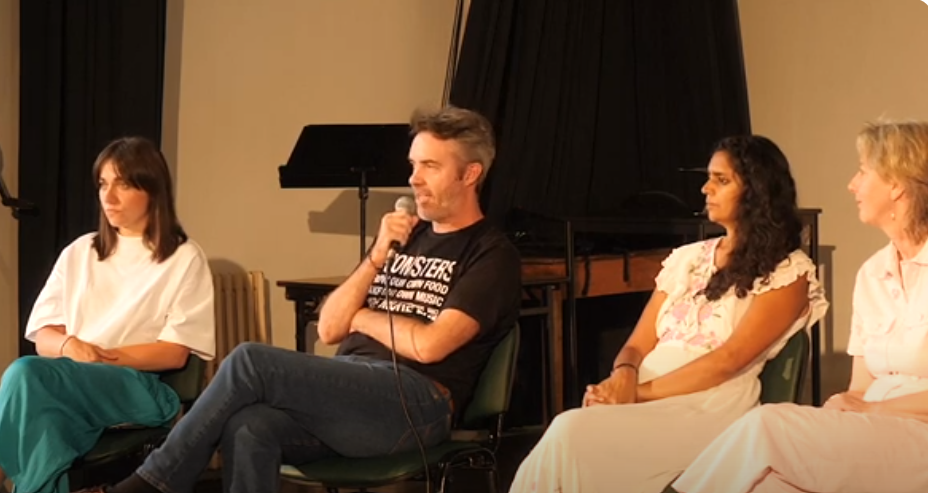
Jem in Oxford, Brussels, Geneva and Rome, April 2024
Jem in California, November 2024
Donate to keep Jem writing / Read his book Breaking Together / Read Jem’s key ideas on collapse / Subscribe to this blog / Study with Jem / Browse his latest posts / Read the Scholars’ Warning / Visit the Deep Adaptation Forum / Receive Jem’s Biannual Bulletin / Receive the Deep Adaptation Review / Watch some of Jem’s talks / Find Emotional Support / Jem’s actual views on Covid
Power and Privilege in the Face of Collapse – discussion with Silvia Di Blasio of Gaia Education
Next week I will share the second part of my essay on the benefits of collapse acceptance. One of those benefits is discovering a new impetus for acting on one’s sense of personal power and privilege. In this essay I want to delve into this topic more substantively. I want to address the rhetorical question “why bother fighting for social justice if everything is collapsing anyway?” I also want to address the very real concern that it is only people with financial means who are able to begin to prepare for the breakdown of world systems. I will do that through sharing my notes on questions put to me by Silvia di Blasio in a recent interview for Gaia Education. Born in Argentina and based in Canada, Silvia has been exploring the concepts and practices of resilience for decades. She interviewed me in her role as a course manager and facilitator for Gaia Education, which offers courses and spaces for people to explore community-based initiatives to face climate change and the combined crises. As someone who offers my own online course on similar issues, I recognise the value of such education. The question of power and privilege came up not only because Silvia is attuned to such issues but because new waves of people with relative riches are seeking to ‘live the good life’ with homesteading and ecovillages as they realise how modern societies are breaking down. It is no longer the anti-consumerists and hippies driving the ecovillage movement. What does that mean for its ability to help wider societies?
Continue reading “Power and Privilege in the Face of Collapse – discussion with Silvia Di Blasio of Gaia Education”The Benefits of Collapse Acceptance – Part 1
For years I felt quite timid about my concerns, and then my conclusions, on the dire future of modern societies under increasing environmental stress. When my Deep Adaptation paper went viral, I didn’t ride the wave onto TV screens and into bookstores. The topic was too sensitive for that, and I felt too raw. At the time, I was somewhat confused about how to integrate my own anticipation of societal collapse into my own life. Therefore, I focused on engaging people who already shared my outlook, to engage in open dialogue on the potential positive ways of responding. Five years later, I have learned much from the many people who made major life changes precisely because of their recognition that we are in an era of unfolding societal collapse. I discuss some such people, and their many positive ways of responding, in Chapter 12 of my book Breaking Together – a chapter now available as a free audio. Within it, I provide an edited list of the benefits of collapse acceptance. Because there are indeed benefits from not only being curious or aware of collapse risks, but actually accepting that such a collapse is coming or already under way. That is a key message from former Occupy Wall Street activist Karen Perry, who created the list of benefits.
Continue reading “The Benefits of Collapse Acceptance – Part 1”


You must be logged in to post a comment.