Subscribe to continue reading
Become a paid subscriber to get access to the rest of this post and other exclusive content.
living with metacrisis and collapse
Become a paid subscriber to get access to the rest of this post and other exclusive content.
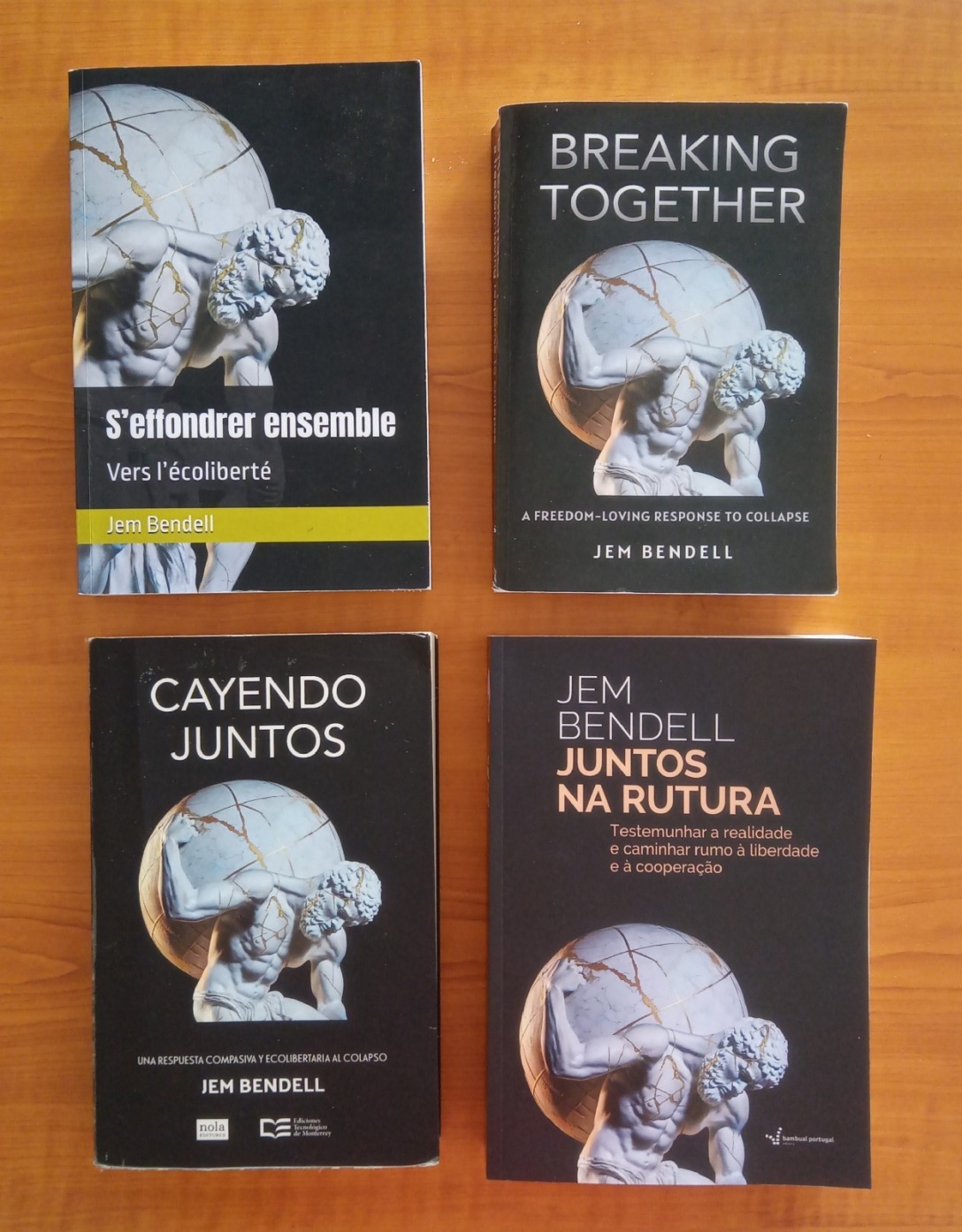
Portuguese is the fifth language that my book Breaking Together is available in. Many at the launch in Lisbon last month travelled from the countryside where they are working on community resilience. For them, the book Juntos Na Rutura provides a useful explanation to others about why they are promoting community economics. One of the interviews around the launch was with the Portuguese degrowth network, which is available on video.
After that inspirational boost, my next speech was to a more general audience in the UK, and I discovered how my analysis on the causes and implications of societal collapse can be easily misconstrued. Therefore, I wrote a summary of the foundational concepts in my work, including concepts like Deep Adaptation, the Metacrisis, the Great Reclamation and Ecolibertarianism, to appear here on my homepage. In addition, I worked with a colleague to prepare a summary of some ideas in each chapter of Breaking Together, which I publish below.
Continue reading “Summary of Breaking Together”After my essay on September 5th on the need for a pan-ecological understanding of climate change and how to respond to it, I received a range of feedback and questions. “Does it change your anticipation of collapse,” was one question. Ahead of next week’s Metacrisis Meeting on this topic, in this blog I am sharing my provisional answers. An 800-word summary of my essay on the topic can be found below the following FAQ.
The renowned Professor Bill Rees, who popularised the concept of ecological footprint, welcomed the climate dogmas essay as follows:
“Most climate science sees climate as mainly a physical system with scant attention to systems ecology… Your essay goes a step beyond, to see the climate as a biophysical phenomenon, as a product of the interactions among the physical drivers— atmospheric gases, the solar flux, etc. — and biological processes both marine and terrestrial. I.e., it forces recognition that the climate system cannot be understood in isolation from the biosphere. To acknowledge and fully understand the role of the oceans (e.g., dimethyl sulfide), forest cover, soils production, evapotranspiration, etc. and their effects on atmospheric gases (hydrological cycle), albedo, heat balance , etc. would be a massive leap forward for climate science. I suspect, as your article implies, it would go a long way toward revealing why (more or less in the words of top US climate scientist Gavin Schmidt) present climate models cannot explain what’s actually been happening for the past decade or so… I agree completely that what you are calling a ‘pan-ecological paradigm’ would “recognise that the pervasiveness and complexity of living systems” and that related bio-processes “are salient to any natural phenomena” including the climate systems.
As a sociologist and transdisciplinary research analyst, rather than a climatologist or ecologist, I am grateful for such feedback, and hope it encourages you to read the essay and look at the sources and references I link to from it.
Continue reading “Restoring Forest Cover and Ocean Health as the Frontline in the Climate Fight – an FAQ”If we are truly in a situation of ‘metacrisis’ then the foundations of our understanding of life and death are being challenged. It feels that way for many people who conclude that the upheavals of recent years are aspects of a breakdown in ‘normal’ life. Such a deep disturbance can be fertile ground for rethinking dominant ideas we received from our culture. For some, that can involve rethinking our relationship to religion, spirituality and the divine. That has brought me to a point of recognising that the cultural mis-shaping of our shared interpretations of personal experiences of non-separation and existential gratitude, are at the root of widespread destruction and exploitation. Even without the scandals and violent histories, institutionalised religion has a lot to answer for. Beyond that, exploring an enlivening and empowering spirituality can be an amazing outcome of the metacrisis. It doesn’t make the bad stuff go away, but it can change how we respond to it.
I was born into Christianity, in the Anglican tradition. It took me until my 50s to look into the content of those Gospels that were excluded from the official canon. One of those is the Gospel of Mary Magdalene. Upon studying it, I composed a mantra that draws from one of its phrases about the sacred interbeing of all that exists. I performed the mantra at a musical gathering, or Kirtan, which occurred on the day of the feast of Mary Magdalene (July 22nd, 2025). The band had not heard it or rehearsed it before, but as we had Ezca dancing with us, I wanted to record the occasion – and the video follows below. The result is a bit messy, musically, but I think it conveys some of the feeling of the moment. The chords and words of the mantra follow at the end of these reflections.
The transcript of a speech delivered in Stroud, UK on 13th Sept 2025, by Professor Jem Bendell.
“Britain’s not for sale and Palestine’s not for stealing – defending and restoring citizenship ownership in the face of collapse.”
I am pleased to be back in ‘The People’s Republic of Stroud’. I first saw that phrase in the background of a talk entitled ‘heading for extinction’ by Gail Bradbrook back in 2018. People in the town of Stroud played a key role in the formation and growth of Extinction Rebellion, which sparked a new wave of environmentalism, bringing wider attention to the climate crisis. I mention that today, as I’m interested in connections between more commonly-owned assets, on the one hand, and a political voice on the other. Only with both of those do we increase the chances of coping better with a creeping collapse of the systems and opportunities we once had.
Today is unusual for me, as I am going to talk about politics. I have never given a speech before that is explicitly about politics. In the first half of 2017, I worked in front line politics with Jeremy Corbyn and his team. I advised on strategic communication, co-wrote speeches, and some of the manifesto. I went on to train some of the current backroom staff for PM Keir Starmer, including Morgan McSweeney. But I have never given a political speech myself. I feel now is the time to do that, because of what’s happening in Britain right now.
Continue reading “Centering Citizen Ownership: Britain is not for sale and Palestine is not for stealing.”“We are already in a manmade climate emergency and it is probably not primarily due to CO2 in the atmosphere. That’s because the pace of change in our climate is what makes this an emergency, and that is largely due to a decline in the Earth’s reflectivity, primarily from a loss of cloud cover, which is due to a fall in cloud seeding, with strong evidence that is mainly from a degrading of forest cover and ocean health. Downplaying this ecological dimension to global heating due to a dogmatic allegiance to carbon-only explanations and targets, has become as bad a response as that from people who dismiss it all as a climate scam.”
How do you feel when you read these lines? Who would say such a thing? Could it be true? Please read on to explore why we can update our understanding of climate chaos and what to do about it…
Being curious despite our fear
If you have been noticing the temperatures around the world over the last 2 years, then you will have felt some degree of shock and trepidation. Both on land and in the oceans, the thermometers have been going up faster than we were told to expect – and faster than the top scientists have been able to explain. We’re talking about present day measurements – so the facts of observation – not the latest theories about what might, or might not, occur. Living in a world that’s reached 1.5C degrees above pre-industrial averages, years before past predictions of worst case scenarios, is both scary and a challenge to the claimed expertise of mainstream climatology. Or so it should be. That does not need to be something to be feared and avoided. Instead, science is, by definition and methodology, an ongoing dialogue with nature, which requires an openness to unanticipated or anomalous data, which might lead to the ditching of old ideas, the testing of new hypotheses and even the transition into new paradigms. Unfortunately, that is not how all climate science is being practiced and communicated today. Instead, it has become a field plagued by dogma and tribalism, which results from multiple commercial and institutional interests.
Continue reading “The Dangers of Climate Dogma – and what we can do about it”We had some interesting discussions in the first Metacrisis Meeting, on the politics of collapse, with 27 joining for the first session, and 35 for the second. The first session was more participative, whereas the second session had more space for a Q&A with Richard Hames from Novara Media. We were delighted to be joined by people from around the world, including academics, artists, activists, therapists, medics, consultants and local government leaders.
The Metacrisis Meetings are a salon for discussion of ideas, with no recordings or formal outputs, and under ‘Chatham House’ rules. That means that afterwards, participants can share what was discussed but not claim who said what. The next meeting is on October 6th – and you will receive the background essay for it will be out on September 6th. Read on if you want to have a glimpse of our discussions… (To keep this blog focused on substantive commentary, future summaries of the meetings will only go to members of the metacrisis meetings initiative).
Continue reading “Report on the First Metacrisis Meeting”Richard Hames of Novara Media and his colleague Beau-Caprice Vetch, recently wrote an essay on what they call ‘critical collapsology’ to help stimulate collapse-aware innovation on the left of the political spectrum. They write:
“The question is not “when is it appropriate to lose hope once and for all?” But, instead, when are we required to give up on the specific forms of animating hope that structured much of 19th and 20th century left[wing] thought?”
You can read their full essay here. I asked AI for an 800-word summary, including a final paragraph assessing any resonance with the ecolibertarian ideas in my book Breaking Together. It follows below.
Continue reading “Critical Collapsology & the Future of the Left – info ahead of the Metacrisis Meeting”Not long ago, I sat across from a UN civil servant at a quiet café in Geneva. She had worked for over two decades in the UN system, from humanitarian relief to climate diplomacy. As she stirred her coffee, she confessed: “I feel disappointed, bewildered. Sometimes I wonder if anything we do makes a difference anymore.” Her voice was tired, but not bitter—more like someone watching a dam crack and realising she only had her teaspoon to stem the flood.
She is not alone. In conversations across UN agencies, I’ve been hearing similar expressions of despair. As institutions strain under the weight of cascading crises—climate chaos, ecosystem breakdown, spiralling inequality, violent conflict, and the abandonment of international law—many international civil servants find themselves in a moral and professional no-man’s land. They are loyal to the ideals of the UN, yet unable to reconcile those ideals with what they now see daily: the world is not just “failing to meet the SDGs“—it is unraveling.
Continue reading “A new role for the UN in an age of collapse”Do you ever feel a quietly gnawing discomfort at the direction technology is taking us? Not just a concern about screen addiction or misinformation, but a deeper unease: that a world is being built in which our presence, thoughts, and behaviours are constantly detected, catalogued and analysed, often without us even knowing? Perhaps it’s the sense that the tools of surveillance, often accepted for personal convenience or public security, are being normalized in all aspects of our lives. Perhaps it feels like a tide: as if an inevitable force of nature, rather than a set of human choices.
I have known that feeling of uneasy resignation for some years. But recently I came across a new study which snapped me out of that torpor. Suddenly I wanted to be clearer on what I think is unacceptable, what should be resisted, and to identify some small steps to take. Consequently, I realise this issue of technosurveillance should be firmly on the political agendas of any serious political party or individual politician. So I want to share with you some ideas on that and why it matters within my particular niche of the environment, metacrisis, and societal collapse.
Continue reading “Let’s Turn the Tide on Surveillance – starting with radio biometrics”
You must be logged in to post a comment.