Responding to the new wave of climate scepticism

When my book Breaking Together came out in May, some of my climate activist friends were surprised that I gave significant attention to rebutting scepticism on the existence of manmade climate change. I also surprised some of my colleagues at COP27 a year ago, when I gave a short talk on the rise of a new form of scepticism. That new form is couched in the important desire to resist oppression from greedy, hypocritical and unaccountable elites. I think the surprise of some that we still need to respond to climate scepticism reflects the bubble that many people working on environmental issues exist within. That’s a bubble of Western middle classes who believe they are well-informed, ethical and have some agency, despite relying on the Guardian, BBC or CNN for much of their news. Outside that bubble, there has been a rise in the belief that authorities and media misrepresent science to protect and profit themselves, while controlling the general public. That was primarily because of the experience of the pronouncements and policies during the early years of the pandemic. When people who are understandably resistant to that Covid orthodoxy have discovered the way elites have been using concern about climate change to enrich themselves, such as through the carbon credits scam, many have become suspicious of the whole agenda on climate change. Those of us who know some of the science on climate, and pay attention to recent temperatures and impacts, can feel incredulous at such scepticism. My green colleagues ask me: “How can someone deny what’s changing right before their very eyes?”

Continue reading “Responding to the new wave of climate scepticism”

The benefits of collapse acceptance, part 2: the doomster way

“Around the world, people are dramatically changing their lives to prioritise creativity and social contribution. They are worrying less about their career, financial security, or the latest trends. They are helping those in need, growing food, making music, campaigning for change and exploring self and spirituality. Why is this shift occurring? Because they have rejected the dominant view of reality and no longer expect elites or officers of the establishment to solve the worsening problems in society. After decades of greed, hypocrisy, lies, corruption and stupid policies, they are no longer waiting for any elites to rescue anyone, let alone the planet. But they are no longer upset, numb or despairing. They are living life more fully, according to what they value. It is precisely because these people regard modern societies to be breaking down, that they are living more freely. They need neither an underground bunker nor a fairytale of a better tomorrow as they are living for love, truth and beauty today. Who are they? I call them doomsters. I am one of them. Perhaps you are too?”

That’s an excerpt from Chapter 12 of Breaking Together, which is now available as a free audio. In the chapter, I offer some examples of the many forms of ‘doomster’ life, around the world, what psychology tells us about this phenomenon, and the extent to which we might become a force for positive social change in an era of societal collapse. In the subsequent chapter I go on to explain why the officers and wannabes of the establishment now fear us enough to misrepresent, censor, and even criminalise us. That is probably because we doomsters are escaping so many of the lies and preoccupations of modern societies. This kind of freedom is something I explored in a discussion with former Occupy Wall Street activist Karen Perry, in our recorded conversation on the benefits of collapse acceptance.

Continue reading “The benefits of collapse acceptance, part 2: the doomster way”

The reviews of Breaking Together are in

JOIN US? We are accepting applications for our online course “leading through collapse” – deadline is in 2 weeks.

Breaking Together came out on May 9th 2023 (my Dad’s 77th birthday). When he first became bed bound, I lived with him for a couple of months at the end of 2022. After every cup of tea I delivered to his bedside, he would ask how the writing was going, and reminded me of the book deadline. That encouragement from him meant it felt very satisfying to read sections of the published paperback to him when he was at the Rowcroft Hospice in Torquay (listen here!). 

I am pleased with how the book is impacting people who work on sustainability or social justice issues, either as professionals or activists, around the world. Multiple translations are underway. On the off chance you are in Bali on October 19th, please consider joining my Asia book launch at the Ubud Writers and Readers Festival. But in this post I want to share some of the book reviews, as it is fascinating to see which parts of the book resonate with whom. Below I list the reviews that I know of, before reflecting on issues arising from my writing that haven’t yet been discussed.  

World Literature Today is a magazine devoted to what it says on the cover. So I was delighted to see it carry a review that focused on the main message of how to respond positively to climate-induced disruptions in our lives: “Finding Freedom amidst Climate Collapse: Jem Bendell’s Breaking Together by Simona Vaitkute.”

On the website of the community economics focused NGO Low Impact, Dr Patrick Smith focused on the challenge of marshalling evidence for an unfolding breakdown of modern societies and the plausibility of such a conclusion” “If our civilisation were collapsing, would we even know? Review of Jem Bendell’s ‘Breaking Together’. I was also happy that my first interview about the book was with the boss of Low Impact, and that my cat Buki showed up at the end. I could not have coped with the isolation involved in writing the book if it wasn’t for him. Sadly he disappeared from my life soon after, to the heartbreak of both myself and all his human and cat friends. 

The organisation Shareable also focuses on relocalising economies and their review of my book honed in on the need for economic systems to enable such relocalisation: “A new compass for navigating past the collapse: A review of “Breaking Together”.

In the UK’s left wing newspaper, the Green Party Mayor of Glastonbury focused on the freedom-loving environmentalism called for in the book. She identified it as an antidote to the recent bifurcation of views into eco-authoritarian technocrats on the one hand and conspiracy theorists on the other: “It takes a village | Morning Star”. In the US, that theme of a freedom-loving environmentalism was focused on in a review by the author Aaron Vandiver, when he asked “can we reboot the environmental movement — so it protects freedom, too?”

On her Medium page, Renaae Churches focused on the part of the book where I critique some of the ideas in the ‘doomersphere’ where they consider collapse as being predetermined and therefore nothing to learn about or change on the way down: “Loving that part of nature we call human”.

The cultural commentator Daniel Pinchbeck produced a series of essays reflecting on aspects of the book. The first of these was Earth’s Breaking Point? In it he states “Jem Bendell’s new book, Breaking Together, argues that modern civilization has already started to collapse. I agree with him.” I will be participating in Daniel’s online course soon.

One review attempted to summarise the whole book, with regular cross referencing of other relevant writings. An impressive engagement and helpful summary for someone who doesn’t want to read the whole thing! “Joining Together as Imperial Modernity Breaks — Book Review and Essay with excerpts.”

As a cofounder of Extinction Rebellion, Gail Bradbrook invited fellow rebels to read the book and reassess what to do next. In “Why read Breaking Together by Jem Bendell?” she kindly wished me well in my new pursuits (more farming and music), as well as hoping that the misrepresentation of my work to attempt to cancel this topic of collapse would not repeat itself. My sense is it will! Perhaps not in the mainstream media, which still prefers to hide these issues rather than platform them. However, in recent years niche outlets like the Ecologist and Open Democracy sometimes appear to police the Western environmental movement into maintaining anti-radical attitudes. Therefore, I wouldn’t be surprised if something silly appears in publications like those. Which is not to say that there shouldn’t be critiques – there absolutely should! As I told Novara Media, I offer this book as a way to kickstart a conversation about what a postdoom politics might involve (you might call this a politics of transformative and deep adaptation). Key is that we debate and dialogue without misleading our readers with false statements about the scholarship, or the people involved, or the effects therefrom. 

Looking at these reviews, I notice the following topics haven’t yet been discussed in depth in any review, so look forward to future reflections from readers:

  • The limitations upon institutionalised scientists for them to coherently and saliently analyse complex systems.
  • The extent to which the climate policy agenda should dramatically shift to prioritise the cloud seeding role of forests, the need for intervention in the Arctic to restore ice cover, and adaptation to severe damage to crops worldwide.
  • The extent to which established green NGOs have misled the environmental movement and wider public about the nature of the predicament, because they watered down conclusions from the science to maintain a reformist outlook (and if so what to do about that). 
  • The nature of consciousness and why freedom of choice amongst sentient life is inherent and essential to nature (including the part we call human). 
  • Whether we need a fundamental reboot of socialist critique and proposals for a new era of collapse. 

Perhaps these topics, and more, will come up in the online courses I co-teach on Leading Through Collapse. The book is available in all formats and as a free epub from: BREAKING TOGETHER – a freedom-loving response to collapse – Prof Jem Bendell 

If you think people should know about this book, please skip sharing it on social media, and instead send a link to a few individuals by direct message or email. The reasons to avoid anti-social media algorithms are described in Chapter 13 of the book.

Next week I return to the Benefits of Collapse Acceptance. If you can’t join my online courses, then perhaps we can meet next year?

Jem in Brisbane, March 2024

Jem in Oxford, Brussels, Geneva and Rome, April 2024

Jem in Mexico, October 2024

Jem in California, November 2024

Jem in Taiwan, November 2024

Donate to keep Jem writing / Read his book Breaking Together / Read Jem’s key ideas on collapse / Subscribe to this blog / Study with Jem / Browse his latest posts / Read the Scholars’ Warning / Visit the Deep Adaptation Forum / Receive Jem’s Biannual Bulletin / Receive the Deep Adaptation Review / Watch some of Jem’s talks / Find Emotional Support / Jem’s actual views on Covid

Power and Privilege in the Face of Collapse – discussion with Silvia Di Blasio of Gaia Education

Next week I will share the second part of my essay on the benefits of collapse acceptance. One of those benefits is discovering a new impetus for acting on one’s sense of personal power and privilege. In this essay I want to delve into this topic more substantively. I want to address the rhetorical question “why bother fighting for social justice if everything is collapsing anyway?” I also want to address the very real concern that it is only people with financial means who are able to begin to prepare for the breakdown of world systems. I will do that through sharing my notes on questions put to me by Silvia di Blasio in a recent interview for Gaia Education. Born in Argentina and based in Canada, Silvia has been exploring the concepts and practices of resilience for decades. She interviewed me in her role as a course manager and facilitator for Gaia Education, which offers courses and spaces for people to explore community-based initiatives to face climate change and the combined crises. As someone who offers my own online course on similar issues, I recognise the value of such education. The question of power and privilege came up not only because Silvia is attuned to such issues but because new waves of people with relative riches are seeking to ‘live the good life’ with homesteading and ecovillages as they realise how modern societies are breaking down. It is no longer the anti-consumerists and hippies driving the ecovillage movement. What does that mean for its ability to help wider societies?

Continue reading “Power and Privilege in the Face of Collapse – discussion with Silvia Di Blasio of Gaia Education”

Central Bankers v The World

“The Governor of the Bank of England has warned of “apocalyptic” global food price rises and said he is “helpless” in the face of surging inflation” reported The Daily Telegraph newspaper in the UK last year.

It feels a little odd when a central banking head uses words associated with doom-mongers like me. Governor Andrew Bailey was making headlines for describing his difficulties with managing inflation. The news coverage was a stark, if momentary, reminder that we exist in a living world, where our health and nutrition come from the soil, water, plants and animals, and not the abstract digits that pass across our screens. No, we can’t eat money, as Native Americans elders pointed out to the genocidal invaders centuries ago. Governor Bailey’s comment revealed how environmental change is impacting on modern societies in tangible ways. In my book Breaking Together, I marshal evidence that the fall in standard of living in most countries prior to the pandemic was partly the result of the fracturing biophysical foundations such societies. However, I can’t claim ‘I told you so’ as I disagree with the Governor on the key causes of inflation. Although the war in Ukraine matters greatly to grain markets, recent inflation has had little to do with our damaged global environment. Instead, as I describe in detail in Chapter 2 of my book, inflation since 2020 has been the result of the cavalier policies that central bankers, including Bailey himself, launched under the cover of the pandemic. The impacts of environmental change on prices are only now beginning to be felt. Because central bankers caused a wave of inflation prior to ecologically-driven inflation, the longer-term situation is going to be worse than the Governor claimed. So, I want to share with you what I think the implications are for those of us who care about both environmental and economic justice. But first, let’s go a little deeper into the inflation situation.

Subscribe / Support / Study / Essays / Covid

It’s true that environmental degradation, including a destabilized climate, is beginning to impact on the production and distribution of everything that we consume in a modern society. There is only one future for that trend, whatever we do with carbon emissions during this decade. By recognising this situation publicly, Bailey was aligning with alert economists like James Meadway and his colleagues at The Progressive Economy Forum. Since 2021, they have described the ways that climate change and environmental degradation are affecting the quality and availability of many products, and will do so increasingly in future. Meadway summarises this thesis in a recent episode of Planet Critical. I agree with their analysis of what is ahead, but it seems premature to blame the higher inflation of the last few years on environmental disruption. For instance, one key input is oil, which has often been identified as likely to ‘peak’ and drive inflation. In Chapter 2, I note that the price of a barrel of oil was much higher for consecutive years in the past without that impacting significantly on the price of food and other products. Instead, monetary policies launched during the pandemic caused a flood of money into economies around the world. That chapter is now available as a free audio, as well as a discussion paper. In it, I detail how the central bankers justified their novel purchasing of bonds issued by the largest companies in their countries as a sensible response to the economic impacts of lockdowns, and that story was accepted uncritically by the world’s business and financial press. However, I provide the evidence that the central bankers had the policy ready to go before the lockdowns were announced, and launched them when the lockdowns were expected to only be for a few weeks (so not presenting a significant impact economically). Moreover, anyone who knows the first thing about business could see that money given to corporations would not be used by them to keep staff employed to serve customers that didn’t exist anymore. Instead, they took the money, sacked thousands of people, and invested in foreign acquisitions. I perceived this as a neo-colonial dash for corporate territory, perhaps as a hedge by the ruling class against future currency declines or collapses.  

I know James Meadway from when we were working for the Labour Party under Jeremy Corbyn in 2017 and he was advancing bold policies for a more environmentally-smart economy. He continues to be an important voice on economic affairs through his Macrodose podcast. Although we might disagree on the extent of ecological contributions to past inflation, I think his analysis of what is ahead for societies is spot on, and he powerfully challenges the basis of economics as an anthropocentric discipline. That is how economists stupidly assume the wider world to be infinite. Unfortunately, leftist intellectuals in the West have generally been timid, or absent, in critiquing the orthodox policy agenda on the pandemic. Therefore, a ‘disaster capitalist’ form of feasting on society by Big Pharma, Big Tech, and Big Finance, went largely unchallenged by those best equipped to do so. For some, that might have been due to a fear of being labelled as disrespectful to medical staff, arrogant about science, or lacking concern for the vulnerable. Such labels of disdain for people who questioned the narrative were promoted by politicians and mass media. They were then falsely promoted to us as widely-held opinions as US Big Tech platforms choose what we all saw, and did not see, from our friends and colleagues online. One doesn’t need to endorse any conspiracy theory about the pandemic to see that the dates and impacts of monetary decisions do not fit with the official explanations (as I detail in my book), and instead the situation was used an excuse for an agenda that the ruling class already had in mind.

Unfortunately, the ecological drivers of inflation will kick in over the coming years, especially given the recent acceleration of global warming. That inflation begins from a baseline of prices forced higher by the policies of central banks. But that isn’t where the crimes of the bankers end. Astonishingly, given their claims to take climate change seriously, they dished out huge amounts of pandemic cash to corporations in the oil sector as well as those sectors that consume large amounts of oil. More deeply, they continue to oversee an expansionist monetary system. That is one where over 97% of all money in circulation in modern economies is issued by private banks in the form of interest-bearing debt. In Chapter 10 of my Breaking Together, I explain how that monetary system requires the ever-increasing consumption of natural resources to enable economic growth, rather than allowing for a steady-state economy. That pressure to grow is exactly what we don’t need in an era when we are hitting the limits of the Earth to provide our resources and process our wastes.

If you like this analysis, then send it to someone influential, and if you want more, please help fund future writing.

Speaking of the many intersecting factors driving inflation, the Governor of the Bank of England joked that he had ‘run out of horsemen’. Yet all he had to do was look in the mirror for a little longer. Central bankers have neither the skills nor the legitimacy to shape any society’s response to the global predicament. Will anything change? There is zero evidence of that, despite the valiant efforts of people engaged in The Progressive Economy Forum, and similar groups worldwide. Therefore, the most likely scenario is that the monetary system will collapse in on itself. We don’t know when. Perhaps the bankers do. Nevertheless, we won’t need to wait that long: in Chapter 1, I pull together the data that indicates the breakdown of modern societies has already begun.

So, what can we do? Some socialists are discussing whether future persistent and even runaway inflation, especially for food, that is caused by environmental pressures will radicalise populations. Disgruntlement is inevitable, but channelling that into a coherent political agenda that includes changing monetary systems is extremely unlikely (and I am not aware of it happening before). I would be ecstatic if a political party could be elected on an agenda to take over central banks and make them serve the public again. That agenda would also require recognising the era of societal disruption and decline that we now face and reshaping monetary systems accordingly. Sadly, all evidence in my lifetime, and in history, is that the ‘powers-that-be’ won’t allow such fundamental change. Perhaps our only solace is knowing that during collapse, the bankers have further to fall. I say that without wishing to accelerate a collapse… in their hubris the bankers have that well covered themselves. Instead, it is time for more of us to turn away from the suits administering destructive systems and their stenographers in media. Instead, we can turn to each other. In Chapter 12 of Breaking Together, I describe a range of community economy initiatives, seeking to re-localise production, consumption, and exchange systems. Key to their efforts is that they are developing alternative means of exchange that do not rely on the banking system. I was therefore pleased to see the book reviewed by Shareable, an organisation that is promoting such local-scale initiatives, including those that are explicitly aimed at restoring or protecting the common ownership of shared resources. This perspective is why I will be promoting local exchange systems between small regenerative businesses here in Indonesia, alongside our training centre at Bekandze Farm. If successful, we won’t need to eat the rich. Which might be another reason to channel philanthropic funds to the project?! I’ll be talking about these ideas at the Ubud Writers and Readers festival on October 19th, as well as with Gaia Education, online on September 9th.

Perhaps you want to ‘up your game’ during the unravelling of modern societies? If so, please consider studying with me.

Donate to keep Jem writing / Read his book Breaking Together / Read Jem’s key ideas on collapse / Subscribe to this blog / Study with Jem / Browse his latest posts / Read the Scholars’ Warning / Visit the Deep Adaptation Forum / Receive Jem’s Biannual Bulletin / Receive the Deep Adaptation Review / Watch some of Jem’s talks / Find Emotional Support / Jem’s actual views on Covid

What I tweeted the day I disappeared (from Twitter)

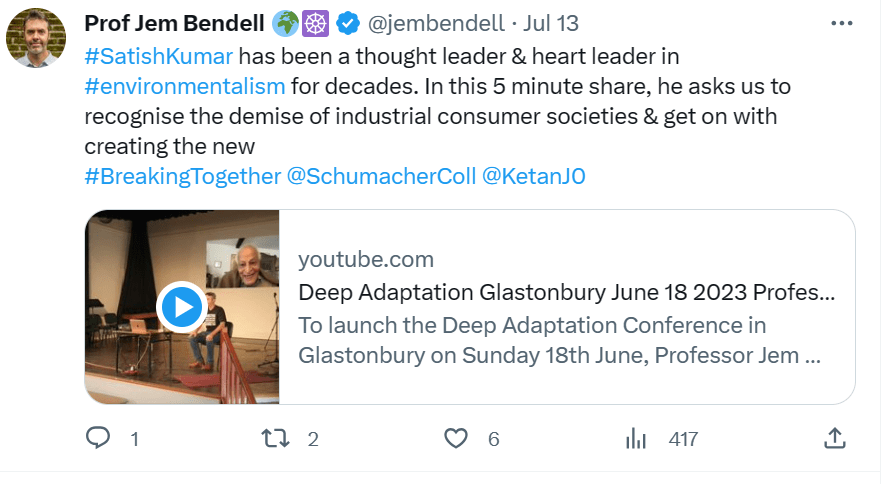
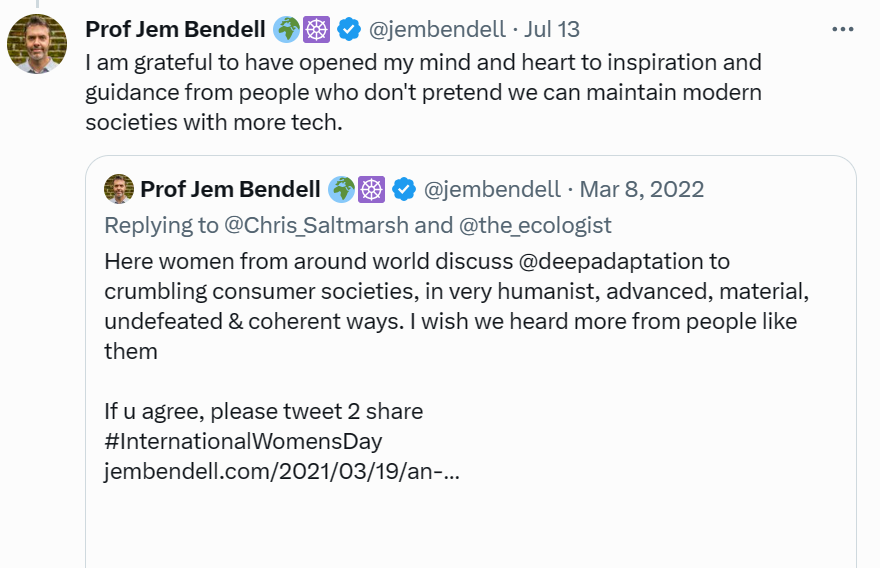
As it is coming up to a month since I was suspended from Twitter, without any explanation or any response to my immediate appeal, I went into my account and looked at what I tweeted just before I was suspended. It might have been a complaint, or a hack, or an algorithm… but someone didn’t want me tweeting. It had been an uneventful day online, with limited visibility and only a few reactions to my tweets on corporate irresponsibility, radical environmentalism, wise women, climate data, military profiteering and US government involvement in online censorship. What has surprised me since the suspension is that all my past tweets, since 2009, are no longer visible to anyone but me. All the immense wisdom and verifiable foresight, distilled into tweets like botanical gardens into essential oils.. all gone in an instantaneous digital bonfire! I jest. But some of what I shared was a bit nice. For instance, my very last tweet before suspension was on the short talk at my book launch, by the wonderful Satish Kumar. It read:

#SatishKumar has been a thought leader & heart leader in #environmentalism for decades. In this 5 minute share, he asks us to recognise the demise of industrial consumer societies & get on with creating the new. https://www.youtube.com/watch?v=LDMSFT23YLw

I recommend you see his magical 5 minute talk. I have screen shot that tweet along with the other essential oils from that fateful day. If you feel like using them as pictures in your own tweets, that would be great. And I shall pray that you don’t get banned. In the meantime, I recommend subscribing to this blog, where I intend to keep sharing ideas on collapse readiness and response. As I am now leaving my employment, I would also welcome any financial support to encourage me to keep writing essays on such topics.

Update: as there is some amusing projection happening on twitter by folks who don’t know me (unlike how they know their inner repertoire of human characters) at the end of this blog I append a screenshot of my updated appeal, where I ask for any info on why this suspension occurred.

Donate to keep Jem writing / Read Jem’s book Breaking Together / Read Jem’s key ideas on collapse readiness / Subscribe to this blog / Read the Scholars’ Warning / Visit the Deep Adaptation Forum / Receive Jem’s Biannual Bulletin / Receive the Deep Adaptation Review / Watch some of Jem’s talks / Find Emotional Support.

Screen shot of my repeat appeal after a month…

Let’s tell the moodsplainers they’re wrong and then get back to work

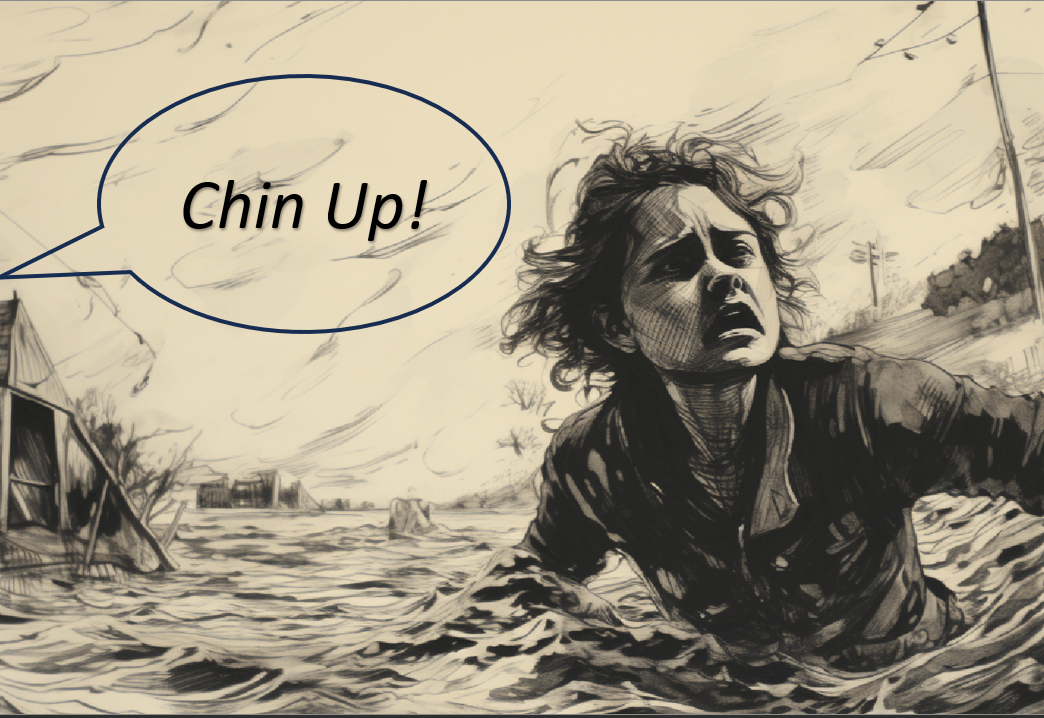
As we reel from the impacts of strange weather and the news of unprecedented ocean temperatures around the world, the moodsplainers are out in force. They tell us we are right to be anxious but wrong to not believe that our way of life can be saved. In our favourite news outlets, they tell us that it is both morally and practically important to stay positive, stem panic and bypass despair. They warn us not to abandon fairytales of change and salvation. It might be OK if they wanted to live in a self-protective bubble of delusion. But in their public advocacy, they’re dangerously suppressing necessary dialogue that might help us all to reduce harm in this era of societal disruption and collapse.

Continue reading “Let’s tell the moodsplainers they’re wrong and then get back to work”

Loving being human, despite a fracturing world

Last week in London I began my talk about Breaking Together by asking the people gathered to raise their hand if they felt proud of being human. Only a couple of people did. I then asked for a show of hands on the question on whether humans are inherently destructive to nature. A small majority supported that idea. I asked these questions to get to the heart of the issue of how environmentally-conscious people understand our situation. Because I know how sadness, anxiety and frustration pulse through us in regular waves. I wanted to explore how we can love ourselves and each other, fully, despite the destruction that has been caused by modern societies – and how that can guide our future action as situations become more difficult. 

I shared some lines from Chapter 9 of my book, where I use the latest archeology and anthropology to debunk some of the assumptions that help people to conclude that humanity is inherently bad for nature, and that ecocide was in some way a ‘choiceless’ destiny for homo sapiens. The chapter is now available as a free audio on soundcloud. In it I explain some of the following insights. 

Continue reading “Loving being human, despite a fracturing world”

Do environmentalists secretly hate people?

“When people like you fly over Africa you want to see wild animals. When I fly over Africa, I don’t want to see dead Africans.” I still remember this statement from one of my former bosses at the UN, about 20 years ago. I was shocked at his idea that caring about the environment meant caring less about people. It seemed an attitude born of an urban life, forgetting the need to sustain the environmental basis of the livelihoods of billions. It showed me how hyper-modernist some leaders from Africa could be – perhaps from too much time flying over things to talk to people who fly over things. Since then, I always thought it a baseless form of rhetoric to claim that environmentalists prefer nature to people. Even if some might be like that, their lack of power on this planet means critiquing their psyche was  a distraction from serious policy discussion.

However, there is indeed another form of misanthropy, or people-hating, which can arise in environmentalism, as people become more anxious about the state of the planet. It is more subtle, involving a general denigration of humanity or the human condition, so people conclude we need to be controlled for our own good. This sentiment is not marginal to power and is facilitating the recent growth of authoritarian views within parts of the Western environmental movement. In my book Breaking Together, I explain how it is a fear-driven and illogical response which risks making matters worse as we go deeper into an era of societal disruption and collapse. The following is an excerpt where I explore this phenomenon. In it I mention various terms and chapters – if interested, the book is now free as a pdf from my University (clearly I haven’t got the hang of that ‘doomer grift’).

Subscribe / Support / Study / Essays

Continue reading “Do environmentalists secretly hate people?”

Be my twitter?

As I have been suspended from Twitter, I’d like to ask your help so that a Q&A on my book can be heard about. I was heartened that over 80 people joined me to discuss “Breaking Together: a freedom-loving response to collapse.” The event was hosted by Katie Carr of the Deep Adaptation Forum. The video follows below.

Why have I been booted from Twitter? Short answer: dunno. I received no warnings and no explanations. The text on my account says “After careful review, we determined your account broke the Twitter Rules.” Although I can be radical and forthright, at times responding to what I consider unfair criticism, I aim to be civil. Without further information, I’m curious as to the reason. Possibilities include some censorship code from old Twitter being triggered by a recent uptick in attention to my account. Or perhaps new Twitter doesn’t like my views on the unfortunate limits of renewables and electrification to transition humanity to sustainability. Another possibility is that the account was hacked in a sophisticated way so Twitter suspended it. I have submitted an appeal.

Subscribe / Support / Study / Essays

Continue reading “Be my twitter?”