The one talk that I’m scheduled to give in the UK this year is at the Festival of Commoning in Stroud. My reason for that is my support of what Michel Bauwens describes as cosmolocalism [0] in the face of collapse, and what I term the ‘Great Reclamation’ of our power. It is best explained and illustrated by one of the organisers of the Festival, Dave Darby, in a guest article…
“All civilisations collapse in the end. The Roman Empire is long gone, along with the ancient Greeks, Egyptians and Sumerians. Will the global civilisation of corporate capitalism buck the trend? Of course not, but how long does it have left? In such a complex system, it is impossible to predict when there will be a sudden shift, but there is good evidence that the process of breakdown has already begun. Damage to soils, water tables, forests, the oceans and climate is occurring alongside economic and political upheaval. No longer is this a theoretical matter about the distant future, but something we should be preparing for today. But how?
A year ago, the co-founder of the activist group Extinction Rebellion joined me in Glastonbury Town Hall to mark the launch of Breaking Together and put it in the context of a liminal space that environmental activism had entered. A year on, an edited version of Gail Bradbrook’s talk is featured in the May/June issue of Resurgence Magazine. In that time, have been impressed by how Gail has been exploring forms of international solidarity for an era of disruption and collapse. That is because it can be easy to turn inward, either by arguing over agendas that will probably never win power in the West, or trying to prepare one’s own community for further decline and disruption. I don’t disparage such a focus, but it can lead to a lack of attention to the wider world, and how we influence it. Or might do if we tried. Therefore, I’d like to share with you a recent blog from Gail where she offers reflections on solidarity with the revived anti-imperialism movements in Africa. Comments are welcome below. Thx, Jem
As Europeans, MEPs and movement founders, we are honoured to have been invited to support a delegation study visit to the Alliance of Sahel States (Mali, Burkina Faso and Niger). We have found common cause with our family in the Sahel; here’s why we believe this matters immensely to you too.
A guest blog by Matthew Slater, Founder of Community Forge and General Assistant with the Deep Adaptation Forum.
As Professor Jem Bendell and I discussed recently on this blog, localisation is an essential element of attempts at adapting to climate change. Reasons include how working at the local level is often easier than at the national level, local initiatives are often more appropriate than initiatives determined at a higher level, and a plethora of local initiatives creates diversity, which means the larger system can become more resilient.
One of the things we don’t often hear about being localised is finance. In the context of relocalising things like food, health, education, infrastructure, governance, localising finance is an obvious complement. That can involve giving local authorities more control over taxation, monetary policy, government debt, investment in infrastructure and the risk management that goes with all that.
It is possible to do all of this with national money, such as the pound, dollar or euro, but not is not optimal because national money is created and made available with somebody else’s intentions and for their profit. Contrary to popular misunderstanding, money is not simply a neutral form of ‘value’, like a lump of metal, that we use to trade. Money is designed to serve the same powerful political and economic interests who have imposed global capitalism on us. This becomes apparent when one comes to understand that in most modern economies, 97% of money is our debt to commercial banks (mortgages, business loans and government borrowing). The quantity, the price and the availability of that money is determined by their commercial interests. This global money has built-in biases which make it very difficult to use it to finance relocalisation, because it determines, through pricing and other mechanisms that, for instance, Chinese manufacturing with all its pollution and poor labour conditions, is ‘more efficient’, while local sourcing, which might entail a more circular economy, local jobs, more responsible waste management, more resilient supply chains, less transportation costs, is ‘unaffordable’.
So in the spirit of imagining ‘deep’ change, let us envisage how an economy with more local financial sovereignty might be different.
First of all, in contrast to global money which is issued (lent) to the least risky most profitable enterprises, local money would more likely be issued to finance local businesses. The choice of which businesses to finance and whether to use equity or debt would be an important political power which, devolved to the local level would enable appropriate decisions about risk. For example if a coastal town wanted to raise its sea defenses, instead of going to the bank and borrowing at commercial rates and paying back twice the amount from taxes, they might prefer other options like spreading the cost amongst the most low lying property owners, creating a financial instrument tied to the property insurance, or factoring in the cost of rehousing those people in later decades. On the other hand a new bakery might be widely expected to succeed unless badly mismanaged, so perhaps a local share issuance would be a good way to share risks and rewards within face-to-face relationships without anonymous intermediaries.
A local currency gives citizens and businesses a way to create credit amongst themselves, i.e. credit that is only acceptable in town. This credit can be used to settle debts incurred through local trade without recourse to borrowing from banks. Flexible amounts of ‘Money’ can be created this way to facilitate trade beneficial to all, as much as creditors are prepared to bare the risk of their neighbour debtors going broke or dying. A thriving local currency which can buy lots of local goods and services, would find itself being accepted in neighbouring communities.
Turning away from the global market would change the mood, attitudes and behaviours of producers and consumers. This could be viewed both positively and negatively. If consumers have less choice and producers would have less competition, this could be seen as correcting one of the injustices of globalisation – but the differences would be more profound than that. Localisation would bind producers and consumers more closely to one another, which would hopefully translate into better relationships and better customer service.
On the macro-scale, locally issued money would create a kind of diversity we are not used to, which provides resilience to national monetary policy made by banks for banks. The next banking crash is feared by some to bring down the whole global economy – a single system which ultimately depends on the dollar, the Federal Reserve, and US domestic policy. While there is no good reason why feckless speculation by hedge funds and others should obstruct the essential and stable process of growing grain, or baking bread and consuming it, because both ‘real’ and ‘speculative’ economies occupy the same marketplace and use the same money, they interfere with each other. We have a financial system which is super-efficient at channelling profits into stagnant money lakes of the tax havens, but a single spanner thrown in the works stops production! If spanners were anticipated and if the long term was seen as important, we would choose a more diverse, less efficient money system in which policy failures were contained, affecting only those markets who voted for those policies.
What would it mean to live in an economy not optimised for efficiency? To offer a very simplistic example: what if, instead of three clicks to summon a product to your doorstep in fifteen minutes, your purchase took more time and effort? Would the extra time be wasted? You might meet the producer, give somebody a lift on the way, talk to them, get some sunlight, exercise your eyes, gain knowledge which can be shared with others, learn something about your locality etc etc. Plus the Deliveroo and Amazon warehouse worker would be freed up to do other things. The increased effort you put into the purchase is dissipated over all the economy like ‘waste’ heat, except it needn’t be seen it as waste. It is greasing relationships, building trust, spreading information, improving mood increasing social and physical health, all of which is more valuable than the difference in price, if you want to measure it that way. The ‘slack’ in the system and the slowness also means the system can better absorb shocks. These ideas are explored more by Helena Norberg Hodge in the Economics of Happiness.
In saying the above I’m not proposing that the economy should slow down so that we can all have a nicer life, indeed that might not be the case. I believe, in spite of the GDP that the real global economy has been slowing down since 2008, and will continue to do so; it would be better for us if our policies and behaviours reflected the reality that global growth is over.
Prof Bendell and I have been fascinated by money for many years, and so we are proposing two monetary innovations for adaptation-oriented policy-makers. Both ideas could help local communities develop local economic resilience in the face of initial phases of climate chaos
The first idea is for local governments, which over the last decade have borne the brunt of the austerity resulting from the 2008 financial crisis. Some local governments have fallen into debt equivalent to many years of tax receipts and are paying significant proportions of their income in interest. With falling budgets and sometimes increased responsibilities, local government has been reduced to deciding which services to cut, and how to supplement taxes through property speculation. Our proposal is that instead of borrowing from commercial lenders at commercial rates of interest, local governments should cut out the middlemen and borrow from taxpayers directly. If they could entice citizens to prepay their taxes both lenders and borrowers would have better rates of interest. The prepaid taxes would be used twice – immediately spent by the local government, while at the same time, taxpayers could pay or receive payments with other taxpayers using taxes paid, but not yet due. In addition to financing local government this would create a government owned payment system and source of liquidity which would survive a catastrophic bank failure. Such an initiative could help develop resilience in the face of increased risks from climate disruption. Read more about Local Future Tax Credits here.
The second idea is a blueprint for an informal ‘solidarity’ money system. One of the problems with mainstream money is that it functions as a medium of exchange and a store of value at the same time. When there is a shortage of money, because people are saving it all, that slows down business, even though businesses only need it for a short time between buying and selling. The practice of reciprocal trade, or business barter, allows businesses to work in groups to buy and sell from each other without money. Commercial systems are widespread in USA and elsewhere, but punitive taxation and competitive dynamics prevent the networks from becoming economically significant, but the mechanism is slowly being recognised as potentially transformative. Portugal has just made allowance for them in law, and in UK there are new socially progressive systems in Birmingham and another supported by the Welsh parliament. Each these clubs struggles to make swapping commercially viable, which is really hard until or unless they become large. Why my protocol, these groups would be able to federate to increase their effectiveness and to try to align their incentives towards cooperation. I published a white paper on this called the Credit Commons and a London-based group called Open Credit Network is working to create and connect these groups to create a moneyless economy at scale.
I know that these innovations are just shallow techo-fixes without deeper changes in the sociopolitical fabric. Their value at the moment is to show that another economy is possible, and bold policy-makers and citizen advocacy is very much required to manifest such ideas in the face of globalised neoliberal economics.
In this this Q&A with Matthew Slater covers some of the background to these ideas.
Deep Adaptation is firstly and mainly about coming to terms with the end of our way of life, and finding in ourselves and each other loving responses in place of fear and blame. Many people, having dwelled in that space for a while, then seek various forms of meaningful action, usually around living more fully and trying to reduce future harm. Increasingly, people are putting energy into re-localising their societies and economies. The rationale for such action is often quite personal. In our experience of engaging with people who are seeking to localise their lives as part of their deep adaptation, the following ideas often come up:
there are many links between globalised neoliberal economics and the drivers of the climate crisis
there is a long tradition of alternative economics promoting localisation for environmental benefit that goes back to EF Schumacher
most people express little to no political agency at the national level, whereas local politics appears much more accessible
many people find working face-to-face with neighbours easier and more enjoyable than sporadic collaborations at national levels
they consider they are more likely to benefit from results of their own local improvements.
It is not that all globalisation is all bad, but that there has been a huge imbalance in power at the global level, with the interests of corporations and banks shaping the agendas. Progressive internationalists can point to many benefits. For instance, global technical standards make the internet available to everyone, our electronic devices (somewhat) compatible, and other infrastructure like GPS means no-one (carrying a phone) gets lost any more. Global law like the human rights charter is a fantastic political achievement despite many countries’ neglect of it. Intergovernmental cooperation is also essential for both cutting and drawing down carbon emissions, as well as adapting to the effects of extreme weather on our societies. So it is important to clarify which aspects of life most need to be local, and indeed, regional and national.
There is one really important reason why we need to rebuild local life, which has been hollowed out by the needs of the economic machine in recent decades, and indeed centuries: that reason is resilience.
There are growing debates about how society will respond, breakdown or collapse through the impact of global heating. Probably the most referenced theory of previous societal collapses is Joseph Tainter’s theory of complex societies. He alleges that when the base conditions change, the layer and layers of governance, bureaucracy built up during long periods of stability come crashing down. That means that our means of global governance, global infrastructure, and global trade, are at the greatest risk – ironically the very things our prevailing ideologies have been driving us towards, in the name of efficiency.
Of course Tainter’s collapse is an interpretation of history, not necessarily a prediction of the future, but it gives grounds for thought. It suggests that if say food, or fuel were to become generally scarce, flows of resources towards the most abstract, and complex organs of society would wither. From that theory, perhaps the Bretton Woods institutions, complex trade agreements, international law, the most complex financial instruments, airlines, computer hardware and social networks, could be amongst the first things to fail?
This could be a matter of ‘falling back’, but it could be worse if we have come to depend on those things. For example much food is imported by air, interest rates in all mortgages are globally linked to high risk finance, and we may struggle to imagine life without mobile phones and social networks. If national infrastructure should start to crumble, life could become very difficult.
A great explanation for all this vulnerability can be found in a biology / economics study which shows that efficiency and resilience lie at opposite ends of a spectrum. Generally, more diverse systems encourage more redundancy and more linkages between components, and more uses for each component. Imagine running across a tightrope – you can go pretty fast unless you fall off! Running across the safety net is less efficient but you are less likely to die. The authors stressed that this principle applied in economics as in other fields. “Economics seems in pursuit of monistic goals and all too willing to sacrifice everything for the betterment of market efficiency… Preoccupation with efficiency could propel into disaster.” Capitalism has always been about building greater efficiency (maximising GDP for a given population), and within that the regular financial mishaps have been regarded as mere abberations. The theoretical cost of super-efficiency is the risk of super-accidents, which implies that economic globalisation is setting us up for the mother of all collapses.
There are several formulations of resilience in general terms. Key amongst them is the need avoid single points of failure, by distributing the work and the processing throughout the system. A related goal for resilience is that the same functions should be fulfilled by different mechanisms so that when conditions change in unforseeable ways, some mechanisms are likely still to work. Localisation is desirable for many reasons, but it is systemically important for these reasons, so after that somewhat long introduction to the topic of localisation for deep adaptation, in the remainder of this blog we will look closer at what it could involve. If you would like to engage on this topic, we recommend joining the Community Action discussion group of the Deep Adaptation Forum.
The most prominent localisation movement in UK at the moment is the Transition Town network, which grew out of the systemic thinking of permaculture. That movement has thoroughly explored what localisation entails in the modern context, and piloted many projects. Ecovillages also play an important role in pioneering deeply different ways of life, which many of them can do, as intentional communities.
So let’s take a closer look. The Transition movement emphasises several areas of life in need of localisation, which we will now expound upon, sometimes using examples from other movements:
Food
Food is usually the highest priority because humans require lots of it, every day, and it requires months of preparation and often lots of organisation to produce and prepare it. The industrialised food system depends on massive inputs of fossil fuels, both to power machinery and for fertiliser, and results in high waste, pollution and often poor nutrition. And yet by growing food in gardens, allotments or on public land, families and communities can dramatically reduce dependence on imports and industry. In most countries there is a large informal food scene, consisting of farmers’ markets and part-time, self-sufficient growers alongside people drying, preserving, baking and occasionally serving labour intensive foods – and those who wish to pay the price. Those who want to support local growers and eat organic food with the seasons can find more and more veggie box schemes, formally known as Community Supported Agriculture.
Energy
Energy prices are increasing over the long term, and our supplies in the West have depended on militarised subjugation of people in other countries. Much energy generated in power stations is lost in transit. The imperative to reduce or stop fossil fuel consumption can involve four approaches: reducing energy consumption and changing usage patterns, nuclear power to which many object forcefully, massive solar and wind farms, and small scale renewable energy, owned by individuals or local communities.
Government
In these kinds of matters, the hand of government is everywhere from creating minimum standards, to reporting requirements, and market influence through taxes, grants, and subsidies. Governments, especially local governments are under enormous pressure to cut costs and sell assets, and this creates an environment, not accidentally, favourable to enterprises led by large corporations with better access to credit, lobbying power, cheap labour etc. Many elected representatives and civil servants don’t really understand the full extent of this process, or if they do, they don’t or can’t organise, stick their necks out, and change it. A recent phenomenon in UK, dubbed flatpack democracy has seen citizens organise, get themselves elected, and accomplish useful things at the local level.
Finance
Modern capitalism favours large institutions which can spread risk and maximise profit for shareholders, which means that small and local businesses find it very hard to get loans. Other non-commercial community institutions, including government struggle for viability, especially after a decade of austerity. Philanthropic funding increasing comes with demands that revenue streams be developed. UK has a law called ‘community right to bid’ which allows local groups to purchase local assets and amenities like post offices, village shops or community pubs. The Plukett foundation helps communities to organise themselves, and the UK government helps them to issue shares for such purposes. We are watching another initiative which aims to create local care cooperatives as an alternative to crumbling state care system. All of this is a far cry from reversing the centralising effect of the last forty years of capitalism.
Currency
The difficulty of all of these things points towards deeper drivers. A number of local money projects in UK were spawned from Transition Towns initiatives, which helped to show the public that money is not the simple/neutral tool it may appear to be to the casual user, but could be designed differently. But the low traction of these projects also showed just how intractable money and assumptions about it are. We critiqued these projects elsewhere. Other initiatives like LETS and timebanking reimagine non-monetary currencies, supporting value-flows and exchange within communities, without banks, debt or government behind the accounting unit. In a forthcoming blog, we will offer two new ideas for local monetary innovation which build on these efforts, while focusing particularly on currency and payment systems that would survive an economic (and banking) collapse.
Leisure
In an era of fuel scarcity we shall have to re-learn how to holiday and play closer to home. In the UK, hardworking people often escape to the sunshine, but a more resilient attitude might be to focus on building quality relationships and having fun with other people, sometimes called ‘staycationing’. Cultivating musical talent, group activities and festivals, form another thread in the transition culture.
Our minds
For the Transition movement, “inner transition” is the mental, psychological and spiritual processes that accompany the social, economic and political transition to a post-peak oil world. It can be a personal or collective process and bears a lot in common with Deep Adaptation. These practices and ideas can be more intense in intentional communities, where living more closely together requires a higher degree of knowledge of self and trust of others.
Learning from the Limits of Localisation Past
There’s one more reason the localisation agenda chimes with Deep Adaptation. We don’t know how meaningful any of our efforts will be on trajectory of climate or the global response of humanity. Perhaps the future will disagree with Tainter and our society will collapse from the bottom up! So what is important to us about the localisation agenda and the practical things people are doing in relation to it, is that it is about a more vibrant way of living right now. Localisation points towards a more grounded, more connected, more human way of life in contrast with the ‘alienation’ many people feel from their work, families and neighbours. Helena Norberg Hodge promotes it for this reason, calling it “The Economics of Happiness”.
In Western countries, these efforts at environmentally-friendly localisation have been around for decades. So as we reflect on the implications for Deep Adaptation, it is useful to consider the limitations of current and past initiatives. Many of them have failed to spread to economically disadvantaged communities. The accusation then heard from some critics is that movements like Transition are elitist and excluding. While the limited extent or diversity of any movement can seem like an unfair criticism of hard-working, well-meaning volunteers, it is nevertheless a central issue for an agenda as all-encompassing as Deep Adaptation. Therefore, a key question for people interested in localisation to promote resilience for unfolding societal breakdowns and likely collapse is to learn from those limitations.
We can learn from situations in other countries where resilience has been improved in the past. In Cuba, for instance, where the past trade embargo led to self-reliant organic agriculture across the whole country. Or in Kenya, where people living on only a few dollars (equivalent) a day in informal settlements have reduced poverty without foreign aid money by issuing their own currencies. We do not know for certain the reasons for these successes, but the answers might be found in:
a) Community leaders convening those local people with the capacity to explore issues, prioritise actions and implement them in ways that reduce dependence on support from outside.
b) Focusing those initial actions on acknowledging and mobilising existing community assets, in order to collaboratively meet immediate needs.
Unfortunately, when funders get involved, they often start by bringing a deficit mindset, characterising communities by what is lacking. External funders’ agendas and mechanisms then privilege a few people in a community who are best able to look outside the community for answers and, once funded, begin to think on behalf of the funder as much as the community. It is why one of us has argued previously for a more solidarity-based approach from grant makers in the face of climate-induced collapse.
For more on this subject, see this Poetry of Predicament podcast.
The Deep Adaptation Forum would welcome any financial support you can offer via patreon.com.
People working on the environment, human rights, and social progress have not always had an easy relationship. The idea of “sustainable development” that first became popular 20 years ago was meant to bring them together. Instead, it has enabled an obsession with profit making to creep into thinking and practice in most areas of environment, rights and social progress. On the positive side, that has led to business and banks engaging with these issues more than they might otherwise – something Ive been involved in for the last decades. But what might have been lost in that process?
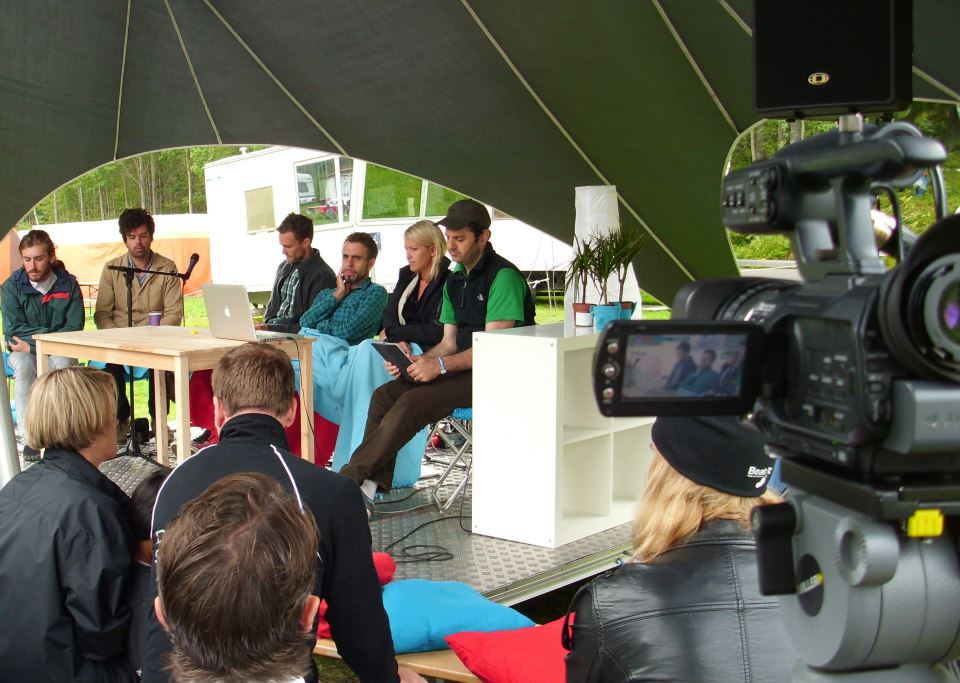
A speech on rights and media freedoms was the keynote at a festival to celebrate what an amazing future we have ahead of us if we embrace the transition to sustainability. In Sweden, at FuturePerfect, Wikileak’s editor in chief, Julian Assange, delivered a recorded speech from the Embassy where he has been given asylum by Ecuador.
SBS TV focuses in on laptop as Assange audio address played at FuturePerfect Festival
What has Wikileaks got to do with sustainability? Here are some highlights from the talk, and some reflections on what they mean for the “sustainability profession”, by which I mean those of us who have day jobs working on the social and environmental aspects of business, finance and economy.
Assange believes free media is critical to us understanding our society and what challenges we face. Thats key to enough people organising to promote sustainability:
“there is no civilisation, there is no society without media. That is: let’s take away all media, let’s take away all mediums, let’s take away all ability for humans beings to communicate with each other in the present and also it will learn from past experiences to teach the future. If there is no communication between people, if every person is entirely isolated like a tree in a forest, then clearly there is no civilisation and there is no society.”
“With the best possible communication, with the best possible ability to learn from our experiences, we have a chance of not simply doing the dumb thing. We have a chance of being more civilised to each other, we have a chance of avoiding pitfalls that have been discovered in the past.”
He also explains that our media is now so controlled by incumbent interests, that it marginalises critique, or those who want to see a transformation in society, such as towards a more sustainable one:
“Now the [corporate] media insofar as it is successful and is profitable and widely distributed, as an industrial body is inherently corrupt. And to understand where the corruption comes from, first of all see that an industrial body, an organisation that becomes powerful in influencing others, is able to manufacture consent and suppress dissent. As a result, the people who work within it, and those proprietors who own it, are invited to sit down at the table of power and are given certain concessions in their life and their business practices. They thereby become part of the very establishment that they are meant to be policing.”
The internet provides us with an opportunity to communicate and better understand our common predicaments, but not one that isnt being counter-acted by the amount of content produced by mainstream media:
“it is clear that most of the mainstream media outlets in Sweden are able to publish a truthful article on even perhaps the most controversial issues. But what they cannot do is show any sign of an institutional agenda to do so. They cannot publish in volume on those issues. Of course, when we are dealing with politics, we are dealing with perceptions en masse. And perceptions en masse are affected by communications en masse. It is not enough to simply reveal the truth in one isolated article or one isolated tweet; what is important is to have the truth revealed en masse, where people can see it en masse and where opinions can be affected en masse.”
The answer, Assange says, is therefore for all of us, in our personal and professional lives, to become engaged in developing and scaling up alternative media. Many people working on sustainability are working towards a better future, and can sometimes forget that may be taking for granted existing hard one freedoms and situations. Assange reminded participants at the conference of the situation facing many people today:
“We face a choice of whether we can have something not just for our grandchildren but even something for ourselves,” he noted. “We are rapidly approaching continuous war, in fact most of the Western countries have now been involved in war over 10 years and are being
increasingly involved. We see a tremendous increase in the size of intelligence agencies; the border between police and military is starting to collapse, with the weaponisation of police; increasing amount of body armour that police have. Across the world we see a collapse in the rule of law, politicised and arbitrary justice, with U.S. assassination lists approved by the President in secret with no due process; the continued detention without charge of children in Guantanamo Bay for over 10 years with no prospect of release.Mass surveillance being introduced into every country with no effective oversight by the population. The linking up of international companies and networks of influential people of the banking people, all these people lifting up the democratic and electoral control of their respective population bases.”
In the past decades “sustainability” has become a profession, with people working in business, government and civil society on various aspects of the agenda. It is useful therefore, to be reminded of the insights of those who are activists, people who take personal risks and do not have to worry about their employer or client.
“We face a serious global crisis, so we must understand that this is not a choice about doing the right thing, this is not a choice about whether we
appear to be moral, this is not a choice about whether we make friends, or are approved as an effective member of society. We face a choice of whether we will have a civilisation that is civil or not.”
So what should sustainability folk do?
“first of all we must understand the problem, we must understand the severity of the problem, we must tell the others the severity of the problem, we must explain that it is not a choice, that is not something we could get out of, that there is a very real chance of a global technological and political dystopia appearing…”
Thats an useful reminder of speaking it as you see it, rather than worrying about how to frame your message in a positive tone that will help sell some products or votes.
“Then we must link together with people with a similar understanding, we must invent new technological means to fight fire with our own form of fire, we must have absolute unity and determination in the response. If we look back at the previous resistance struggles, similar phenomenon that occurred in the past, that is what has held the day in the end. Unity, determination, understanding and creativity, looking for every possible venue where the forces of darkness can be held back, that is the only way that we are all going to survive that ongoing threat that is against everyone.”
So what has Wikileaks got to do with sustainability?
In a field in Sweden, I learned that we should, sometimes, ditch our silos, labels, and professional affiliations in order to get a better sense of the interconnected causes of the various problems we face. If sustainable development is to be a true integration of social, enviornmental and economic priorities, then we need to lose the blinkers that our desire for an easy life have given us.
You can hear the speech or visit the organisers of FuturePerfect to see more about this great festival project. Im proud to have been associated with the organising of it, and look forward to more conversations and celebrations of how to be fully awake, connected and hopeful in our work at these critical times.
The financial crisis is actually a monetary crisis, and you can do something about it now.
On an island next to Stockholm, leaders in systemic solutions to financial chaos are gathering at a sustainability festival. Join them at the Future Perfect festival in Stockholm on 23-26 August, and hear a panel on monetary reforms and innovations for sustainability, and a workshop for executives who want to start, scale or participate in alternative means of exchange.
Panel: “Currencies of Transition: monetary reforms and innovations for sustainability.”
Chair: Professor Jem Bendell (Lifeworth Consulting, Community Forge and Griffith Business School)
Ben Dyson, director of Positive Money, which campaigns for a systemic solution to monetary crises, by full reserve banking.
Josh Ryan Collins, New Economics Foundation, the Brixton Pound and co-author of “Where does money come from?”
Lynnea Bylund, Board Member, Ormita, the international business barter network.
The panel will address the questions: Is a fair and sustainable economy possible with our debt-driven money system? If not, what needs to change? What is being done already? What can we do to get involved, personally and professionally? How can we make this a movement? What mistakes can we avoid?
Workshop: “How alternative exchange systems work and how to get started”
Trainers: Professor Jem Bendell and Matthew Slater
You will be able to interact with these experts and others attracted to the topic, at a world class music festival! To book your tickets to the festival, visit http://www.futureperfect.se
The workshop will also be offered in Greece in the second week of October. Contact the European Sustainability Academy for more information.
In the face of financial crisis and mass unemployment, do you believe we have to choose between either austerity or debt-funded economic growth? Its a false choice, based on false assumptions. My video-keynote at a forthcoming conference in Denmark, explains how we can achieve job creation without austerity or more debt, by redesigning our monetary systems.
If you are near Denmark, go join the conversation at Rebuild21.
Everywhere we turn, we hear people asking “how long can it go on?” Whether it is financial crisis in the West, environmental pollution in the East, or increasing prices and natural disasters everywhere, there’s a growing sense of dystopia, and of the need for more fundamental reform of our economic and political systems. Mass protests can remove leaders, but what creates a lasting positive shift in society? And what are YOU doing about it? Rather than ask “how long can it go on”, it’s time to ask “how can we move on with essential changes?”
As I read leading commentators on business responsibility and sustainability sharing their insights on trends for 2012, I saw a new boldness. People are recognising the need for ambitious goals that address root causes, including economic governance failures. At Lifeworth we have been seeking to contribute to a sustainable economic transformation and published a variety of works on that theme over the past ten years. In that time I’ve seen the more critical analyses initially ignored by leaders in favour of less challenging narratives. Yet this year I think we will see more opportunity for ‘radical’ suggestions for change to be discussed and trialled. In that sense, despite the fears, it’s the year we have been waiting for. But rather than adding to the many predictions, I’ll summarise Lifeworth’s efforts that could be of relevance if you seek to team up to strive for far greater positive change than you might have before.
The first area for transformative action in which we are engaged is policy innovations for scaling responsible enterprise and finance. Rightly or wrongly, government budgets cuts are happening in many countries. The implications for them to regulate businesses for social and environmental objectives are beginning to be felt. How then can we promote and reward better business practice, without increasing the costs to government? Leveraging private standards of social or environmental performance is one option. In work for the UN Conference on Trade and Development (UNCTAD), we looked at public policy innovations to scale the number of firms adhering to voluntary standards like the Forest Stewardship Council. This appeared in the World Investment Report, with the full academic study published elsewhere. The idea that these forms of ‘collaborative economic governance’ are a pragmatic response to the twin challenges of sustainable development and government efficiencies, was fed into the policy discussions leading to Rio+20, happening this June. The need now is to create systems for collecting innovative public policies for scaling responsible business, analysing which work well in what contents, and disseminating this to government officials worldwide. If you can help on this project, do get in touch.
Yet we must go further than coping mechanisms in a world of irresponsible enterprise and governance failures. The second area for transformative action, therefore, is redesigning financial systems for more fair and sustainable outcomes. Although commitments to responsible investment have existed for some years, the translation into investment practice and the realities of corporate leaders has far to go. The limitations of current environmental, social and governance (ESG) practice in empowering investors to act is one of the stumbling blocks which we analysed in 2011, sparking lively debate. Our interest in ESG is because of the potential for progressive investor influence, which is a historically novel situation. In 2012 I hope we see the emergence of a progressive voice from investors on matters of public concern. Aside from investor-business relations, the public voice of the progressive investor has been slow to emerge. The Carbon Disclosure Project has shown that on climate change investors can sound a new tune on public policy. In 2012 and beyond, we could see other forums, particularly the UN-backed Principles for Responsible Investment (UNPRI), providing opportunities for progressive investors to promote policy debates that better include social and environmental priorities. Whether they will be able to counter-balance the more regressive investor resistance to financial re-regulation will be interesting to watch.
In 2012 we will continue to participate in fora that discuss the need for transformation of economic systems for sustainable development, including the World Economic Forum in Davos, Switzerland, The Finance Innovation Lab in the UK, and the Griffith University conference on transition, in Australia. As I explained in an interview for Griffith, the key stumbling block to progress on tough issues is our limiting assumptions and oversights about the real causes of our crises. During the next months I’ll be asking world leaders what they think are the key activities to drive massive positive change that weren’t possible before now, and who they need to work with to make that happen. Identifying such pressure points for massive positive change will inform our philanthropy advisory during 2012, and beyond.
One area where I think there is currently a woefully lack of attention, funding and action is in “sustainable currencies”. Current monetary systems are incompatible with the goal of a fair and sustainable economy, and thus we need greater efforts at reform, as well as at developing secure, scalable and community-owned alternative currencies and barter systems. It is, no doubt, a difficult area for many to grasp; as I experienced myself. Yet in 2011 there were strides towards greater understanding by sustainable development professionals, through the work of New Economics foundation (nef), among others. My TEDx talk on the topic reached over 12,000 views in a couple of months. As austerity bites and unemployment persists, new ways of getting people working for each other without putting governments further into debt will inevitably rise up political agendas. In 2012 we will help through collaboration with Community Forge and The Finance Innovation Lab, amongst others, and promote the uptake of ‘sustainable currencies’ as an innovative social development mechanism, through fora such as the Geneva Forum on Social Change.
What does this renewed emphasis on systemic change mean for specific industry sectors? I think the main implication is to be more ambitious in attempting to mainstream change for sustainable development. That is a third area for seeking transformative action. That has been our approach in the work we do in the luxury and mining sectors. With the organisation Fair Jewelry Action we researched and published “Uplifting the Earth: the ethical performance of high jewellery brands.” In this report we mapped out a transformative agenda for responsible jewellery, where the industry can contribute to sustainable development. From this basis, we aided De Beers’ stakeholder consultations, and worked with the UN Institute for Training and Research (UNITAR) on their training for the jewellery industry, which will be rolled out from Antwerp this year. The Spanish version of the report was launched at the world’s first Sustainable Luxury Awards, in Buenos Aires, co-organised with CSSL and the Authentic Luxury Network. The aim of these awards is to encourage sustainable innovation in the luxury sector; this year’s awards are scheduled for November. The insights from our work on transformative corporate responsibility in the luxury sector were refined for the launch of the world’s first MBA module on ‘Sustainable Luxury and Design’, which I teach at IE Business School, in Madrid. Students learn how sustainability is the smartest and most elegant paradigm within which to design anything. At the other end of the value chain, in 2012 we are working with Channel Research and the German development agency Gesellschaft für Internationale Zusammenarbeit (GIZ) to encourage disclosure on the social, environmental and economic impacts and contributions of mining companies in the Congo. There are few more challenging locations for mining to align better with the goals of peace, human rights and development.
A fourth area for transformative action in 2012 is enhancing the way UN agencies and civil society organisations engage companies. There are now many cross-sectoral partnerships, and the relationships they established hold the potential for greater changes. Largescale change goals need to be connected back to practical steps that can deliver benefits in the near term for various partner organisations. That’s the thinking behind a spate of new resources on more transformative partnering that were released in 2011, including reports from the UN Global Compact, and my own book, “Evolving Partnerships: engaging business for greater social change.” During 2011 we applied our approach to developing transformative alliances in our support for the International Labour Organisation’s fight against forced labour. In 2012 we aim to help the development of their Global Business Alliance against Forced Labour.
Despite the shocking persistence of slavery today, and the general dystopian tone we hear from thoughtful people in international fora, or indeed, because of such darkness, we need a bright vision for life on Earth. That is why we are helping the Future Perfect Festival in Sweden in August. It will celebrate the brilliance and fun of sustainable lifestyles, sustainable businesses and sustainable communities. It will shine rays of light on a better way of life, beyond the dark mountains of outmoded and destructive ways of thinking, working and living. Our ability to understand values, and articulate them in professional contexts, is important when working towards a positive vision. My colleague Ian Doyle has therefore been teaching ‘voicing your values’ class at Grenoble Graduate School of Business, and we will be integrating this into various lines of work in 2012. In our forthcoming book, Healing Capitalism, Ian and I will seek to integrate both the personal and systemic levels of analysis, to aid transformative action.
In summary, we hope our 2012 will involve the following arenas of transformative action:
1) Policy innovations for scaling responsible enterprise and finance;
2) Redesigning financial and monetary systems for more fair and sustainable outcomes;
3) Mainstreaming contributions to sustainable development within specific industry sectors (including luxury, mining etc);
4) More ambitious collaborations between UN agencies, civil society organisations and companies;
5) Visions of sustainable ways of living, pathways to achieve them, and values competence to walk that path.
To better develop our work, this year we become a Swiss non-profit association. We will remain a network of independent associates, and will continue to deliver in partnership with other service providers, for a limited number of clients who seek to create meaningful change. If you can help us have an impact in these areas, I’d love to hear from you.
Ive been delighted in the interest generated by my TEDx talk on money in September. In addition to general enthusiasm, some friends and others have asked me about monetary systems, or challenged me on my depiction of them. These conversations have not got onto what to do about flawed monetary systems, as they are stuck in simple misunderstandings about the history of money, the current nature of money, and its implications for our economy, society and environment. As I mentioned in my talk, we have so many unfounded assumptions about money. Im amazed at how many high flyers in various walks of life confidently make outlandish statements about the history, nature or effect of monetary systems. We need a better understanding of these issues to then have an informed debate about solutions, and to know where to put our efforts. Ill write more about those solutions and how to get involved in a future post, but for now, here are some resources to wise up on money.
Books on the problem of debt-money:
The End of Money and the Future of Civilisation, by Thomas Greco Jr
The Future of Money, by Bernard Lietaer
The Ecology of Money, by Richard Douthwaite
The Lost Science of Money, by Stephen Zarlenga
For proposals, training, action and analysis of action, focused on complementary currencies (rather than other solutions to the debt-money problem) see:
(For transparency: I co-developed the concept for The Finance Lab when at WWF-UK in 06/07 and am an advisor to Community Forge since 2010).
Once you read into some of this you might start wondering if its all to big to tackle… but it isnt, there are many things we, and importantly, our organisations, our employers, our local governments, can do right now. More on that in future blogs.
Why is the whole world in debt? How can we end these crises? Here is a TEDx talk on the hidden cause of the financial crisis. The real crisis is in our monetary system – the way our money is created. The solution is to redesign the way money is created. This is the underlying reform required to end the financial, environmental and social crises afflicting our societies. In this TEDx talk, Professor Jem Bendell calls on assembled broadcasters from across Europe, to expose the true nature of our current crises, and how to solve them.


 As Professor Jem Bendell and I discussed



You must be logged in to post a comment.